
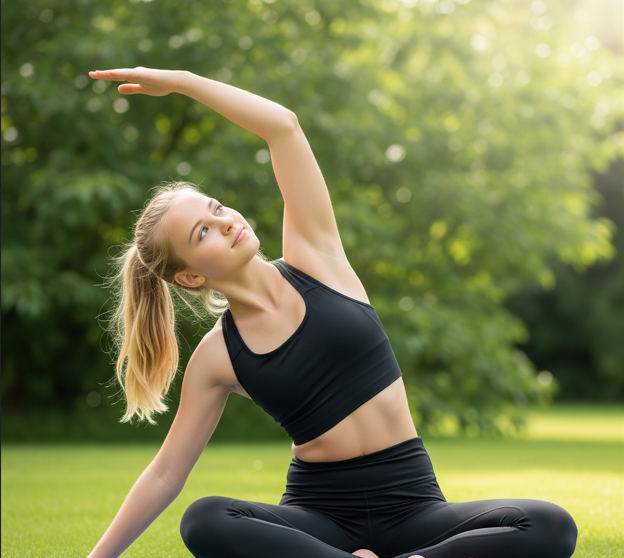
Meet your external obliques, the powerhouse muscles wrapping around your waist like nature’s corset! This targeted stretch relieves tension in those often-neglected side muscles that work overtime when you twist, bend, or even just breathe deeply. Perfect for athletes, desk warriors, and anyone who’s ever felt that “side stitch” during exercise, this stretch improves rotational flexibility while giving your core some much-needed love. Think of it like wringing out a sponge you’re releasing all the tightness that builds up from daily movements and poor posture.
✅ Enhances Rotational Flexibility – Say goodbye to that stiff “tin man” feeling when you twist.
✅ Relieves Side Stitches – The perfect prep before runs or workouts.
✅ Improves Posture – Counters the hunch from sitting all day.
✅ Boosts Core Mobility – Helps your abs move more freely.
✅ Reduces Back Tension – Your obliques connect to your spine happy sides = happy back!
Muscles Worked | Difficulty Level |
External Obliques, Intercostals, Latissimus Dorsi | Beginner-Friendly |
🔹 Warm Up First – Do some gentle torso twists before deep stretching.
🔹 Move Like Molasses – Slow, controlled leans prevent strain.
🔹 Engage Your Core – Gentle abdominal activation protects your spine.
❌ Common Mistakes:
🔸 Overarching Your Back – Keep ribs “zipped” to avoid crunching your spine.
🔸 Dropping Forward – Imagine sliding between two panes of glass.
🔸 Bouncing – Hold steady – this isn’t the time for rhythmic movements.
If you want to target the obliques and core from different angles, try these:
The Setup: Sit comfortably on the floor in a cross-legged position (Sukhasana) or on your heels (Vajrasana). Place your left palm on the floor about a foot away from your left hip, fingers pointing outward or slightly away from you.
The Movement: Inhale and sweep your right arm straight up overhead. On an exhale, begin to lean your torso to the left, pressing firmly into your left hand for support. Let your right arm follow the movement, reaching over your head toward the left wall. Keep both sitting bones rooted to the floor, don’t let your left hip lift up.
Why do it: This version adds an element of stability. Because you are sitting, your hips cannot shift sideways easily, forcing the bend to come purely from the waist. The supporting hand allows you to control the depth of the stretch safely.
The Setup: Find an open doorway or a sturdy corner. Stand beside it, about a foot away. Reach your inside arm (the arm closest to the wall) across your body and place your palm flat against the door frame at shoulder height.
The Movement: Keep your palm pressed firmly against the frame. Begin to gently push your hips away from the doorway, allowing your torso to turn slightly and your side body to open. You should feel a distinct pull from your armpit down along your ribs to your waist.
Why do it? This doorway stretch is a fantastic “desk detox” because it requires no mat and no getting on the floor. It specifically targets the latissimus dorsi (the “lats”) along with the obliques, which is great for swimmers, climbers, or anyone with a tight upper backs
The Setup: Come onto your hands and knees in a tabletop position. Your wrists should be directly under your shoulders and your knees directly under your hips. Keep your spine neutral to start.
The Movement:
Cow Pose (Inhale): Drop your belly toward the mat. Lift your chin and chest, and gaze gently upward. Let your sitting bones point toward the ceiling. This creates a gentle arch in the spine.
Cat Pose (Exhale): Round your spine toward the ceiling like a Halloween cat. Tuck your chin into your chest and tuck your tailbone under. You should feel a stretch across your upper back and the sides of your torso.
Why do it: While it seems simple, the Cat Cow stretch mobilizes the entire spinal column. The rounding phase (Cat) actively compresses and stretches the oblique muscles on the sides, while the arching phase (Cow) stretches the abdominal wall. It’s the perfect warm-up before any deeper side stretch.
The Setup: Start in a high plank position (or on your forearm). Shift your weight onto your right hand (or forearm) and stack your left foot on top of your right foot. If this is too intense, you can stagger your feet or drop your bottom knee for support.
The Movement: Press firmly into your right hand and engage your entire core. Lift your hips toward the ceiling until your body forms a straight line from your head to your heels. You can either stack your left foot or place it in front for stability. For an added stretch, you can reach your left arm straight up toward the ceiling.
Why do it: Unlike the other stretches, this is a strengthening move. While the standing side bend lengthens the obliques, the side plank contracts them to hold you up. Building strength here prevents injuries and creates the definition of the waistline. It is the perfect “active” counterpoint to the “passive” stretches listed above.
Morning: When you sleep, you often curl into a fetal position, which shortens the obliques on one side of your body. A morning side stretch helps balance the spine length immediately, setting you up for better posture all day.
Post-Workout: After any cardio (running) or core work (like crunches or planks for abs), the obliques can feel tight or “pumped.” Stretching them here helps reduce soreness and maintains flexibility.
Midday (Desk Break): Sitting causes the rib cage to settle down toward the hips. A standing side stretch lifts the rib cage and creates space, improving breathing and focus.
1. Standing Side Stretch (1 Minute Total)
Stand with feet hip-width apart.
Inhale both arms overhead and clasp the right wrist with the left hand.
Exhale and gently pull on the right wrist, leaning the torso to the left.
Keep hips pointing forward (imagine you’re sandwiched between two glass panels).
Hold for 30 seconds, breathing into the right side.
Inhale to center, switch wrist grip, and hold left side for 30 seconds.
2. Cat Cow Stretch (1 Minute Total)
Transition to hands and knees.
Inhale for Cow Pose: Drop belly, lift chest and tailbone.
Exhale for Cat Pose: Round spine, tuck chin and tailbone.
Move slowly with your breath. Aim for 5-6 slow rounds (about 10 seconds per round).
Focus on the side body stretch during the Cat (rounding) phase.
3. Seated Figure-Four Oblique Twist (1 Minute Total)
Sit on the floor with legs extended. Bend your right knee and cross your right foot over your left thigh, placing it flat on the floor (a Figure-Four shape).
If this is hard on the knee, simply sit cross-legged.
Place your right fingertips on the floor behind your right hip for support.
Inhale and lengthen your spine. Exhale and twist your torso to the right, hooking your left elbow outside your right knee (or thigh).
Use the leverage of the elbow against the knee to deepen the twist, feeling the stretch along the left side waist/obliques.
Hold for 30 seconds, breathing deeply. Slowly release and switch sides.
4. Seated Lateral Flexion (1 Minute Total) – NEW ADDITION
“The perfect finisher to target those often-missed intercostal muscles between your ribs.”
A: This stretch primarily targets the external obliques (side waist), but also lengthens the latissimus dorsi (back wings) and intercostal muscles (between the ribs).
A: The obliques are a key part of your abs & core. Stretching them keeps them flexible, while strengthening them with exercises like planks for abs creates a balanced, strong midsection.
A: After stretching your sides, lying on your stomach and doing cobra for abs is a great follow-up. This pose stretches the front of the core (rectus abdominis) for a complete front-to-side release.
A: You might be moving too fast or have tight intercostal muscles. Breathe deeply into the stretch and move slowly to allow the muscles to release.
A: Yes. It is a gentle mobility stretch and is safe for daily practice, especially if you sit at a desk for long hours.
Pair this with cat-cow stretches afterward to balance your core flexibility, your obliques will feel like they got a mini-vacation! 🌴