
Your quads work harder than almost any muscle in your body yet they’re often the most neglected when it comes to recovery. Foam rolling your quadriceps isn’t just a luxury; it’s a necessity for anyone who walks, runs, or stands.
Foam rolling, also known as self-myofascial release, involves using a dense foam cylinder to apply pressure to tight spots in your muscles. When applied to your quadriceps the powerful muscles at the front of your thighs this technique:
✅ Breaks up adhesions (knots) in the muscle tissue
✅ Increases blood flow to accelerate recovery
✅ Restores normal muscle length and function
✅ Prepares your legs for movement or helps them recover afterward
Think of it as giving your quads a deep tissue massage on your own terms, whenever you need it.
Your quadriceps endure constant stress every step, squat, and climb tightens these fibers. Foam rolling applies direct pressure to:
Break up adhesions and trigger points
Separate sticky muscle fibers that have “knotted” together
Reach layers of muscle that stretching alone can’t access
Provide relief that feels like a professional massage
Result: Quads that feel softer, more pliable, and less “angry” after activity.
The pressure and release of foam rolling creates a powerful pumping action in your tissues:
Fresh oxygenated blood rushes in as you roll
Metabolic waste (like lactic acid) gets flushed out
Capillaries dilate, improving overall circulation
Healing nutrients reach damaged tissues faster
Result: Faster recovery, less next-day soreness, better overall leg health.
Tight quads limit your range of motion in everything from walking to squatting:
Regular foam rolling lengthens shortened muscle fibers
Restores elasticity to the fascia surrounding your quads
Complements static stretching like the lying quadriceps stretch
Creates lasting flexibility gains when combined with stretching
Result: Deeper squats, longer strides, and legs that move through full range.
This might surprise you but tight quads are a common cause of lower back pain:
When quads shorten, they pull your pelvis forward (anterior tilt)
Forward pelvic tilt increases arch in your lower back
Increased arch compresses lumbar vertebrae and discs
Foam rolling quads releases this pull, allowing pelvis to neutralize
Result: Less lower back strain, better posture, happier spine.
Every athlete needs mobile, responsive quads:
Runners: Longer strides, less hamstring compensation
Cyclists: More powerful pedal strokes, reduced knee strain
Weightlifters: Deeper squats, better form on what is a lunge exercise variations
CrossFitters: Improved performance on how to do reverse lunges with proper depth
Yogis: Deeper backbends, easier transitions
Result: Better performance across every sport and activity.
Your quadriceps attach directly to your kneecap (patella). When they’re tight:
They pull the kneecap unevenly during movement
This creates abnormal wear on the back of the kneecap
Leads to patellofemoral pain syndrome (runner’s knee)
Foam rolling restores normal length and pull
Result: Knees that track properly, less pain during activities.
Foam rolling before stretching creates a powerful one-two punch:
Rolling “wakes up” the tissue and increases blood flow
Relaxes the nervous system’s protective tension
Allows subsequent stretches like the quadriceps stretch to reach deeper
Makes the kneeling quad stretch more effective and comfortable
Result: More progress from your stretching routine in less time.
The sustained pressure of foam rolling has surprising mental benefits:
Activates parasympathetic (rest and digest) nervous system
Reduces cortisol (stress hormone) levels
Provides a moment of mindfulness in your day
Releases tension stored in the body from stress
Result: You feel not just physically looser, but mentally calmer.
Most people overdevelop certain muscles while neglecting others:
Foam rolling helps identify tight spots you didn’t know existed
Creates awareness of imbalances between right and left legs
Prepares muscles for activation work (like glute bridges)
Complements hip openers like the thread the needle stretch for complete mobility
Result: More balanced, symmetrical leg development.
For those rehabbing from injuries:
Gentle foam rolling maintains tissue quality during downtime
Increases blood flow to healing tissues
Prevents scar tissue from forming chaotically
Can be modified for sensitivity (softer pressure, avoiding acute injuries)
Works alongside specific rehab exercises like the hip flexor lunge stretch
Result: Faster return to activity with better tissue quality.
Why it’s essential:
Your quads absorb 3-4x your body weight with every stride
Repetitive impact creates micro-trauma and tightness
Tight quads alter your gait, leading to compensation injuries
How to incorporate:
Post-run: Focus on slower rolling to aid recovery
Pre-run: Light, fast rolling to warm up tissues
Target: Entire front thigh, with extra attention to outer quad
Expected results:
Less IT band tightness
Improved stride length
Fewer knee issues
Why it’s essential:
Cycling keeps quads in a shortened, contracted position for hours
The repetitive motion creates specific tightness patterns
Hip flexors (including rectus femoris) become particularly shortened
How to incorporate:
Post-ride: Deep, sustained rolling on quads and hip flexors
Recovery days: Gentle maintenance rolling
Target: Focus on rectus femoris (center of thigh) where hip flexor lunge stretch targets similar areas
Expected results:
More comfortable riding position
Reduced lower back strain
Better power transfer
Why it’s essential:
Heavy squats and lunges create significant muscle tension
Without release, quads become chronically tight
Tight quads limit depth on subsequent lifts
How to incorporate:
Post-workout: Primary recovery tool
Pre-workout: Light rolling as part of warm-up
Target: Full quadriceps, especially after leg day
Expected results:
Better squat depth
Improved form on what is a lunge exercise variations
Faster recovery between sessions
Why it’s essential:
Sitting for 8+ hours keeps your quads in a shortened position
This creates adaptive shortening over time
When you finally stand, your quads are “stuck” in sitting mode
How to incorporate:
Evening: Release the day’s accumulated tension
Work-from-home breaks: Quick sessions between meetings
Target: Full quadriceps, with extra attention to where quads meet hips
Expected results:
Less morning stiffness
Improved standing posture
Reduced lower back pain from pelvic tilt
Why it’s essential:
Flexibility naturally decreases with age
Tight quads increase fall risk by limiting mobility
Independent living requires mobile, responsive legs
How to incorporate:
Gentle pressure only no need for intensity
Shorter sessions (2-3 minutes per leg)
Use softer foam rollers designed for sensitivity
Combine with lying quadriceps stretch for comprehensive care
Expected results:
Maintained mobility for daily activities
Reduced fall risk
Easier transitions (sitting to standing, stairs)
Why it’s essential:
Backbends require mobile quads and hip flexors
Tight quads limit progress in poses like Camel and Hero
Foam rolling prepares tissues for deeper expression
How to incorporate:
Pre-practice: Light rolling to warm up
Post-practice: Deeper rolling to release worked muscles
Target: Whole quadriceps, especially rectus femoris
Complements poses like thread the needle stretch for upper body release
Expected results:
Deeper backbends
More comfortable Hero pose
Better overall practice
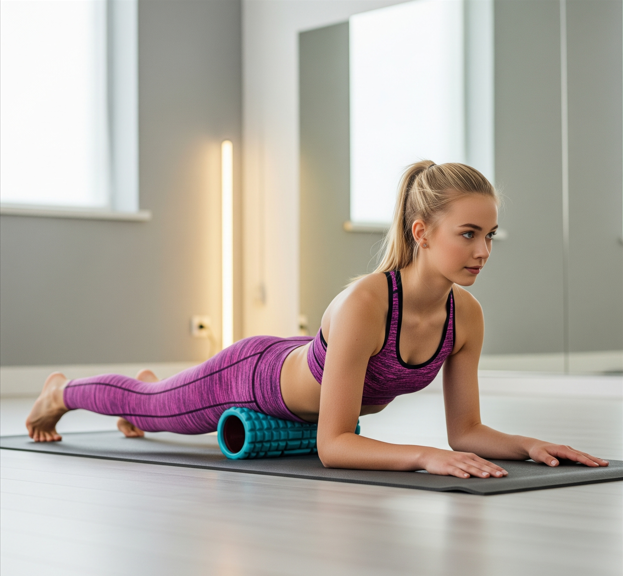
Place the foam roller on the floor and lie face down, supporting your weight on your forearms.
Position your thighs over the roller, just above the knees.
Use your arms to push your body forward, rolling up to your hip crease.
When you hit a tender area, hold for 20-30 seconds until tension eases.
Repeat on the other leg for balanced relief.
Target Area | Difficulty |
Quadriceps | Beginner to Advanced |
🔹 Avoid Rolling Over Knees – Keep the roller on muscle, not joints.
🔹 Control Your Speed – Slow rolls are more effective than fast, jerky motions.
🔹 Stay Hydrated – Helps flush out toxins released during rolling.
🚫 Common Mistakes
🚫 Rolling Too Fast – Slow and steady wins the flexibility race!
🚫 Skipping Tight Spots – Those “ouch” areas need the most attention.
🚫 Holding Your Breath – Breathe deeply to help muscles relax.
A: They serve different purposes! Foam rolling releases fascia and breaks up adhesions, while stretching lengthens muscle fibers. For best results, foam roll FIRST (30-60 seconds), then follow with static stretches like the lying quadriceps stretch. This combination delivers deeper, longer-lasting flexibility gains than either method alone.
A: For most people, 3-5 times weekly is ideal. Athletes training heavily may benefit from daily rolling, especially post-workout. Listen to your body if you’re extremely sore, gentle rolling helps; if you have acute pain, give it a rest.
A: If it’s painful, you’re likely hitting trigger points (knots) where fascia has become sticky and tight. The “good pain” of foam rolling should feel like a deep, tolerable pressure not sharp or unbearable. Ease off pressure and breathe through tender spots. Over time, the discomfort decreases as tissues release.
A: Absolutely! Tight quads pull your pelvis forward, creating anterior tilt that strains the lower back. By releasing your quads through foam rolling, you allow the pelvis to return to neutral position, often providing significant lower back relief. It’s one of the most effective indirect treatments for lumbar discomfort.
A: Great question! The kneeling quad stretch actively lengthens the muscle through positioning, while foam rolling passively releases fascia and breaks up adhesions. They’re complementary rolling prepares the tissue, then stretching capitalizes on that release. Think of rolling as “prehab” and stretching as the main event.
Incorporate foam rolling into your routine to unlock flexibility, reduce soreness, and keep your quads feeling fresh. Your legs will thank you, promise! 🙌