

The Forward Leg Swings exercise is a dynamic stretch that targets your hip flexors, hamstrings, and glutes, boosting flexibility, increasing mobility, enhancing athletic performance, and reducing stiffness perfect for runners, dancers, or desk workers!
🔥 Boosts Hip Flexibility & Mobility: Loosens tight hips for smoother, pain-free movement.
🏃♂️ Enhances Athletic Performance: Improves flexibility for runners, cyclists, and martial artists.
🔄 Improves Balance & Coordination: Trains dynamic flexibility while stabilizing.
💪 Activates Glutes/Hamstrings: Wakes up muscles for better posture and flexibility.
🧠 Mental Wake-Up: Increases blood flow to improve flexibility and alertness.
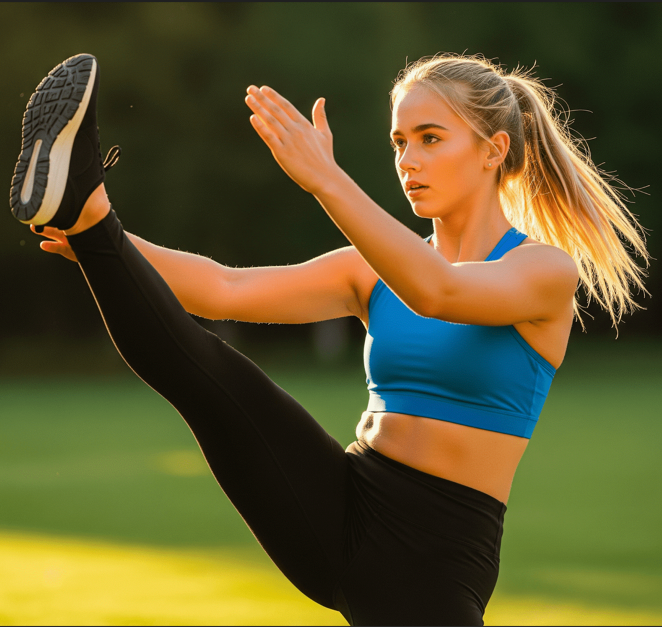
Stand beside a wall/chair, lightly holding for balance
Keep torso upright to protect spine while improving flexibility.
Move leg forward like a pendulum 🕰️ (straight but not locked) to stretch hip flexibility.
Swing back naturally; do 10-15 reps/leg for optimal flexibility gains.
Repeat evenly to balance flexibility development.
Muscles Worked | Difficulty Level |
Hip Flexors, Hamstrings, Glutes | Beginner to Intermediate |
✔ Have unstable hip joints or hip impingement
✔ Experience sharp pain during movement (especially in the SI joint)
✔ Are in late-stage pregnancy (due to balance and ligament concerns)
✔ Have severe osteoporosis (risk of over-rotation)
🚫 Common Mistakes
🔄 Over-rotating the hips – Keep hips square to avoid straining ligaments
📉 Looking down – Maintain neutral neck/spine alignment (gaze forward)
⏱️ Holding breath – Breathe rhythmically to oxygenate muscles
🦶 Pointing toes aggressively – Keep foot relaxed (like a flipper, not a ballet shoe)
🧍♂️Standing on soft surfaces – Use firm ground for proper balance
Adding leg swings to your day is easy and takes less than 3 minutes. Here is how to schedule them for maximum benefit:
Option A: The Morning Wake-Up (After getting out of bed)
Why: Your spine discs hydrate overnight, and your joints are stiff. Swings lubricate the hips.
The Routine:
10 Slow Front Swings (Right Leg)
10 Slow Front Swings (Left Leg)
10 Side-to-Side Leg Swings (to open the inner thighs)
Benefit: Reduces morning stiffness in the lower back before you start walking.
Option B: The Pre-Workout Primer (At the Gym/Field)
Why: Activates the central nervous system (CNS) and wakes up dormant glutes.
The Routine:
15 Controlled Front Swings (Leg 1)
15 Controlled Front Swings (Leg 2)
Follow immediately with light cardio or your first lifting set.
Benefit: Ensures your hips aren’t “lazy” during your main workout, preventing knee and back compensation.
Option C: The Movement Snack (During Work Hours)
Why: Prolonged sitting puts the hip flexors in a constant state of contraction.
The Routine:
Stand up from your desk.
Hold your desk for balance.
Perform 10 gentle swings per leg.
Benefit: Relieves pressure on the lumbar spine and resets your posture.
Front Leg Swings are one of the most universally accessible movements, but they are particularly beneficial for:
Runners & Sprinters: They mimic the running gait and prepare the hip flexors for high-impact repetition.
Office Workers: Sitting all day shortens the hip flexors. Swings help reverse that damage and release tension in the lower back.
Weightlifters: Necessary for warming up before squats and deadlifts to ensure deep, safe range of motion.
Seniors: When done holding onto a chair, they help maintain hip mobility and balance, which are crucial for preventing falls.
Yoga Practitioners: Essential prep work for poses like Warrior III or standing balances.
Contraindications: Those with acute hip injuries, recent pelvic fractures, or specific impingement syndromes should consult a physical therapist first.
While the movement feels simple, Front Leg Swings coordinate a chain of muscles throughout your legs workout and core.
Primary Movers (The Swingers):
Hip Flexors (Iliopsoas): Located at the front of the hip, these are the main drivers of the forward swing.
Hamstrings: These control the descent of the leg, creating a gentle hamstring stretch, and prepare for the backswing.
Glutes: Activate at the peak of the backswing to reverse the motion, which also provides a deep Glutes stretch for the stabilizing leg..
Stabilizers (The Support System):
Quadriceps: Keep the standing leg strong and straight (but not locked), which also provides a light Quadriceps stretch for the supporting leg.
Core Muscles: Engaged to keep the torso upright and protect the lower back from twisting.
Hip Abductors/Adductors: Small muscles, specifically the Hip Abductors and Adductors, located in the hips that keep the swinging leg tracking straight, rather than veering out to the side.
1. For warming up, yes. Leg swings are dynamic, which means they activate the nervous system and increase blood flow to the legs without desensitizing the muscles. Static stretching is better saved for after a workout to cool down.
2. A painless click or pop is usually just gas releasing from the joint (crepitus) or a tendon snapping over bone. If there is NO pain, it is generally safe to continue. If you feel a sharp pinch, stop immediately.
3. Absolutely. Because they are a low-impact mobility drill, Front Leg Swings are safe for daily use. Incorporating them into your morning routine can help alleviate stiffness in the lower back and hips from sleeping.
4. Yes. The standing leg is doing the hard work of stabilizing your entire body. This exercise strengthens the stabilizers in the standing ankle, knee, and hip while the swinging leg works on flexibility.
5. Only as high as you can while maintaining perfect posture. If your torso leans back to lift the leg higher, you are cheating and compromising your lower back. Control is the goal, not height.
Don’t let gravity do all the work. As your leg swings forward, focus on squeezing your core to control the movement on the way down. This eccentric contraction protects the lower back and forces the Hip Flexors to work harder. Think of it like a leg swings session for strength, not just flexibility. Your legs will feel more engaged and ready for your actual workout.