
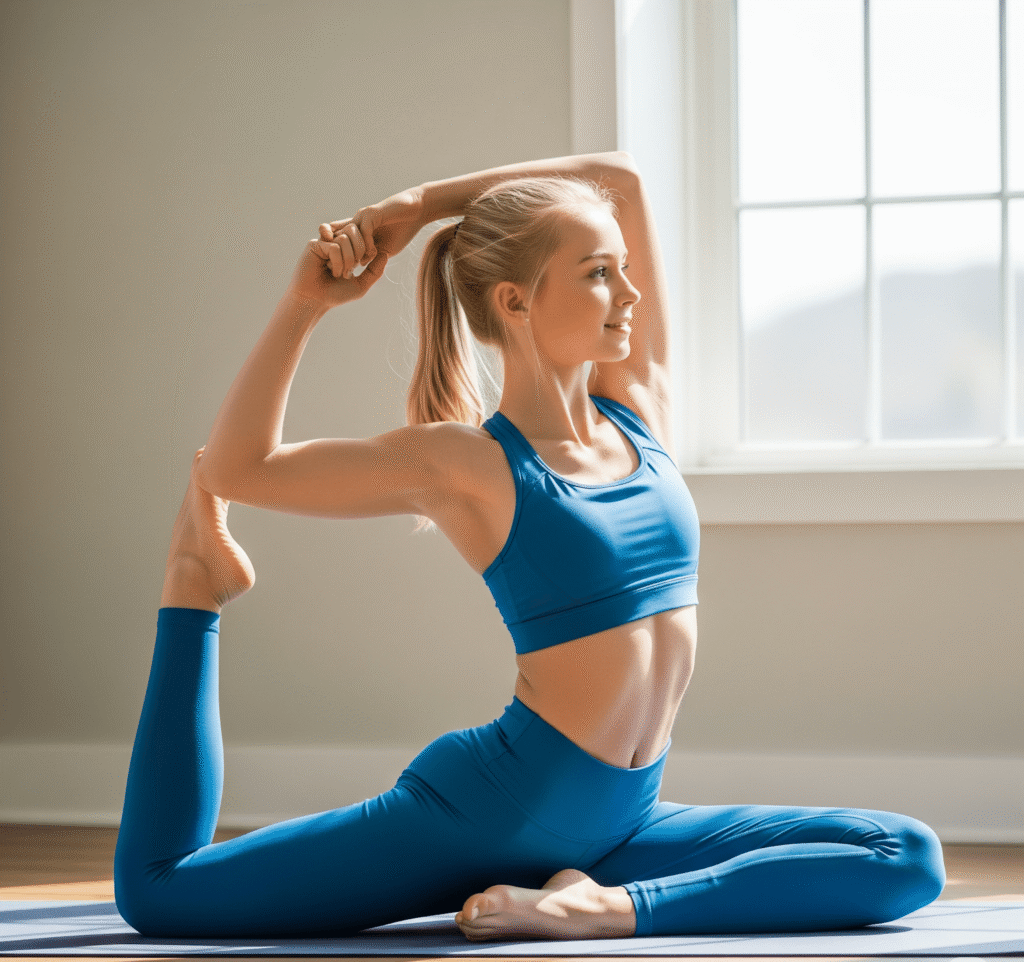
If your hips feel as tight as a jar lid that won’t budge, this modified Pigeon Pose is your go-to fix! Designed to gently release tension in the hip flexors those hardworking muscles that get stiff from sitting all day this stretch is like a “reset button” for your lower body. Whether you’re a runner, desk worker, or yoga newbie, this pose helps improve mobility while calming the mind. Think of it as giving your hips a much-needed deep breath.
The Pigeon Pose is more than just a stretch – it’s a comprehensive hip opener that targets multiple layers of muscle tension. In our modern world of prolonged sitting, the hips become chronically shortened and tight. This pose directly counteracts that by taking the hip joint through external rotation and extension, addressing both the deep rotators (like the piriformis) and the larger hip flexor complex. When performed regularly, it can dramatically improve your ability to perform everyday movements and athletic endeavors with greater ease and less discomfort. It’s a foundational element of any serious hips exercises routine.
➔ Relieves Hip Tightness: Perfect for counteracting the “office chair slump” or post-workout stiffness.
➔ Boosts Flexibility: Gradually opens the hips and improves range of motion for squats, lunges, and more.
➔ Eases Lower Back Tension: By loosening the hip flexors, it takes pressure off the spine.
➔ Mind-Body Connection: Encourages mindful breathing and relaxation (great for stress relief!).
➔ Improves Pelvic Alignment: By releasing asymmetric tension in the hips, Pigeon Pose can help correct pelvic imbalances that contribute to issues like a Trendelenburg gait.
➔ Prepares the Body for Deeper Stretches: It serves as an ideal preparatory pose for more advanced hip openers and even for movements requiring significant external rotation, like the cossack squat stretch.
➔ Supports Healthy Knee Function: By releasing tightness in the hips and quads, it can reduce stress on the knee joints during activities like leg extensions and walking.
➔ Enhances Athletic Performance: Runners, cyclists, and weightlifters all benefit from the increased hip mobility this pose provides, leading to more powerful and efficient movement.
✔ Kneel on all fours (hands under shoulders, knees under hips).
✔ Gently bring your right knee toward your right wrist, placing your shin diagonally (it doesn’t need to be perfectly parallel comfort first!).
✔ Slide your left leg straight back, keeping the hips squared (imagine balancing a tray on your pelvis).
✔ Walk your hands forward and lower your torso over your front leg. Rest on your forearms or forehead for a deeper stretch.
✔ Stay for 5 – 10 breaths, then switch sides.
This versatile pose can be used in several ways to enhance your overall wellness:
As Part of a Cool-Down: After a lower body workout, use Pigeon Pose to lengthen the hips and glutes, aiding recovery. It pairs beautifully with glute stretches and the lying hip flexor stretch.
During a Mobility Session: Include it in a dedicated mobility practice alongside other hip openers like the butterfly stretch and knees-to-chest stretch.
For Stress Relief: The combination of deep hip opening and forward folding is inherently calming. Hold the pose for longer (2-3 minutes per side) with a focus on slow, deep breathing. This can be a wonderful addition to any 5-minute daily stretching routine or evening wind-down.
As a Warm-Up for Specific Activities: Before activities that demand hip mobility, like a lunges workout or dance, a few rounds of Pigeon Pose can prepare the joints for a fuller range of motion.
Muscles Worked | Difficulty Level |
Hip flexors, glutes, lower back | Beginner to Intermediate |
✔ Skip if: You have knee or hip injuries (check with a physio first!).
✔ Avoid: Letting your hips collapse to one side – keep them level.
✔ Listen to your body: Discomfort is normal; sharp pain means ease off.
🚫 Common Mistakes (and How to Fix Them!)
🗼 Collapsing hips? Square ‘em like a picture frame!
🦵 Front knee screaming? Ease off – it’s a stretch, not a wrestling match!
🌬️ Forgetting to breathe? You’re not a deep-sea diver – inhale!
🦐 Hunching like a shrimp? Lengthen that spine, superstar!
For a general stretch, aim to hold for 5-10 deep breaths (about 30-60 seconds) per side. For a more therapeutic, relaxing effect, you can hold for 2-3 minutes, allowing the muscles to gradually release.
Sharp knee pain is a signal to stop and adjust. Immediately ease out of the pose. Try bringing your front heel closer to your opposite hip. If the pain persists, place substantial support (like a thickly folded blanket) under the hip of the front leg. If it still hurts, switch to the reclined figure-four stretch instead. Knee safety is paramount, especially if you also perform exercises like reverse lunges that stress the joint.
Yes, it can be very beneficial for sciatica caused by piriformis tightness. However, it must be approached with caution. If you feel a sharp, shooting pain down your leg (a sign of nerve irritation), ease off immediately. The stretch should be felt in the muscle, not the nerve. For a comprehensive approach, explore our sciatic nerve stretches guide.
Asymmetry is completely normal and often results from daily habits (like which leg you lead with) or past injuries. This information is valuable! Spend a little more time breathing into the tighter side to help restore balance, which can also improve your performance in bilateral movements like squats and good mornings exercise.
A gentle, diffuse sensation in the lower back can be normal, especially as the hips release. However, if you feel a sharp, pinching sensation in the lower back, you may be collapsing into the pose or have underlying issues. Focus on keeping your spine long and your hips square. Pairing this with pelvic tilts can help you find a neutral spine position.
Pair this stretch with deep belly breaths like you’re blowing up a balloon to melt tension even faster. Your hips will thank you later! 🎈