

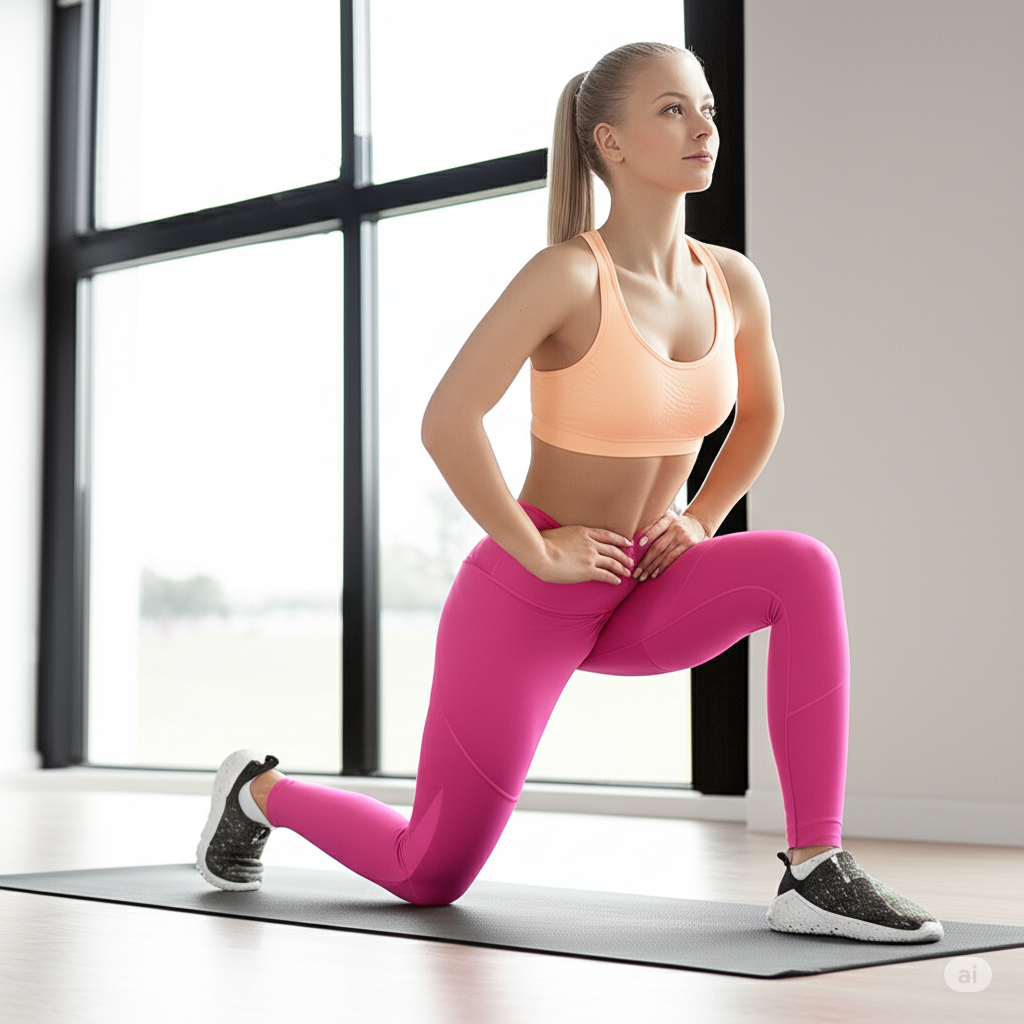
 The Complete Daily Routine: At a Glance
| Time of Day | Sets | Duration Per Side | Primary Benefit |
|---|---|---|---|
| Morning | 2 sets | 30 seconds | Wake up hips, reverse overnight stiffness |
| Every 2-3 Hours (Workday) | 1 set | 30 seconds | Combat sitting damage, prevent tightening |
| Post-Workout | 2 sets | 45-60 seconds | Aid recovery, build lasting flexibility |
 Why This Schedule Works: The Science of Habit Stacking
The genius of this routine is that it attaches the hip flexor lunge stretch to existing daily events:
| Habit | Stretch Attachment |
|---|---|
| Waking up | Morning stretch |
| Work break reminders | Midday stretch |
| Finishing a workout | Post-exercise stretch |
This is called habit stacking and attaching a new habit to an existing one. It’s the most effective way to build lasting consistency.
 Sample Full Day of Hip Flexor Care
| Time | Activity | Hip Flexor Work |
|---|---|---|
| 7:00 AM | Wake up, bathroom | 2×30 sec morning stretch |
| 9:00 AM | Start work | – |
| 11:00 AM | Coffee break | 1×30 sec midday stretch |
| 1:00 PM | Lunch | Walk (passive hip benefit) |
| 3:00 PM | Afternoon break | 1×30 sec midday stretch |
| 5:00 PM | Finish work | – |
| 6:30 PM | Evening workout | 2×60 sec post-workout stretch |
| 10:00 PM | Bedtime | Gentle movement if stiff |
 The 30-Day Challenge: Build the Habit
| Week | Focus | Goal |
|---|---|---|
| Week 1 | Morning only | Build foundation habit |
| Week 2 | Add midday | Interrupt sitting damage |
| Week 3 | Add post-workout | Complete the trifecta |
| Week 4 | Maintain all three | Automatic habit formed |
By Day 30: You won’t have to think about it. Your body will actually crave the stretch at certain times of day.
The kneeling hip flexor stretch is unique because it:
✅ Targets the deep psoas muscle that other stretches miss
✅ Mimics functional movements like lunging and running
✅ Can be modified for any fitness level
✅ Provides immediate feedback on hip tightness
✅ Requires no equipment just your body and floor
The Long-Term Benefits: A Detailed Breakdown
 Sustained Postural Improvement
| Time Frame | What Happens Without Stretching | What Happens With Consistent Practice |
|---|---|---|
| After 1 year | Pelvis gradually tilts forward, belly protrudes slightly | Pelvis maintains neutral position, standing tall feels natural |
| After 5 years | “Swayback” posture develops, shoulders round forward | Posture remains upright without conscious effort |
| After 10+ years | Chronic postural changes feel “normal” and permanent | Good posture is ingrained as your body’s default state |
When you sit for decades without stretching, your hip flexors adapt to the shortened position. They literally remodel themselves to be shorter. This pulls your pelvis forward like a tug-of-war rope that’s too short.
Regular practice of the lunge hip flexor stretch sends a different signal to your body: “We need length here.” Over time, your muscles adapt by:
 Increasing sarcomeres (muscle fiber units) in series
Reducing resting tension in the psoas and iliacus
Retraining your nervous system to allow pelvic neutrality
By age 50 or 60, this means:
You stand taller than your peers
Your clothes fit better (no protruding belly from tilted pelvis)
People comment on your “good posture” without realizing it’s hard-earned

 Chronic Back Pain Prevention
| Age Range | Without Hip Flexor Care | With Consistent Stretching |
|---|---|---|
| 30s-40s | Occasional lower back tightness after long days | Minimal to no back discomfort |
| 50s-60s | Recurring back pain, “sciatica” complaints | Occasional stiffness, quickly relieved |
| 70s+ | Chronic back pain limits activities | Back remains functional and pain-free |
Your lumbar spine and hip flexors are locked in an intimate relationship. Here’s what happens over decades of tight hips:
| Year | The Cascade of Damage |
|---|---|
| 1-5 | Tight psoas pulls lumbar vertebrae forward |
| 5-10 | Lower back muscles overwork to compensate |
| 10-20 | Discs in lumbar spine experience uneven wear |
| 20+ | Degenerative changes accelerate; chronic pain develops |
By regularly performing the hip flexor lunge stretch, you:
Reduce tension on the lumbar spine
Allow back muscles to relax instead of constantly fighting the pull
Maintain disc height through proper spinal alignment
Preserve nerve function by preventing spinal compression
Real-World Impact:
You can garden, travel, and play with grandchildren without “throwing out your back”
You avoid the cycle of pain-medication-inactivity that traps so many older adults
You maintain independence longer

 Greater Mobility & Independence
| Life Activity | Without Hip Flexibility | With Long-Term Hip Health |
|---|---|---|
| Getting in/out of cars | Awkward, painful, uses arms for leverage | Smooth, effortless, no thought required |
| Tying shoes | Must sit, bend awkwardly | Can easily reach feet standing or sitting |
| Gardening | Limited to raised beds only | Can kneel, bend, and rise freely |
| Playing with kids/grandkids | Watches from bench | Actively participates |
| Hiking | Avoids uneven terrain | Enjoys trails confidently |
The Science of Aging and Mobility:
As we age, we lose flexibility at a rate of approximately 1-2% per year after age 30 if we don’t actively maintain it. This gradual loss is so subtle that we don’t notice until suddenly we CAN’T do things we used to.
| Age | Without Maintenance | With Consistent Stretching |
|---|---|---|
| 40 | Can’t touch toes | Can touch toes easily |
| 50 | Hesitates to sit on floor | Sits cross-legged comfortably |
| 60 | Uses handrails for stairs | Navigates stairs normally |
| 70 | Needs assistance with bathing | Bathes and dresses independently |
| 80 | May require mobility aids | Maintains independent movement |
The kneeling quad stretch and its variations preserve the specific ranges of motion needed for:
Getting up from the floor (fall recovery critical for older adults)
Climbing stairs without pain
Maintaining balance (hip mobility is essential for stability)

 Enhanced Athletic Longevity
| Athlete Type | Without Hip Care | With Consistent Practice |
|---|---|---|
| Runner | Hamstring strains, IT band syndrome, knee pain by 40s | Runs strong into 50s and beyond |
| Cyclist | Chronic hip tightness, lower back pain | Maintains power and comfort |
| Weightlifter | Limited squat depth, compensates with back | Perfect form, heavier lifts safely |
| Weekend Warrior | Frequent injuries, long recoveries | Stays active, quick recovery |
| Yoga Practitioner | Hits mobility plateau | Continues progressing into advanced poses |
The Athletic Aging Curve:
Athletes face a choice as they age: adapt or decline. The hip flexor lunge stretch is a key adaptation tool.
| Decade | Without Flexibility Work | With Consistent Hip Stretching |
|---|---|---|
| 30s | Peak performance, minor tightness | Peak performance, full mobility |
| 40s | First “mystery” injuries appear | Maintains performance, fewer injuries |
| 50s | Gives up certain activities | Adapts activities, continues participating |
| 60s | “Used to be athletic” mindset | “Still athletic” identity |
How Mobile Hips Protect Athletes:
Proper Biomechanics: Tight hips force compensation patterns (knees turning in, back arching) that wear out joints. Mobile hips allow natural movement.
Force Absorption: Flexible hip flexors absorb shock during running and jumping rather than transferring it to the spine.
Power Transfer: In explosive movements, mobile hips allow force to flow smoothly from lower to upper body.
Injury Resilience: Muscles that can lengthen under load are less likely to tear.
For the Lifelong Athlete:
Practicing the lunge hip flexor stretch means:
You’re still running 5Ks at 60
You’re still squatting at 70
You’re still playing with grandkids at 80
You never have to say “I used to…”
 The Cumulative Effect: A 40-Year Projection
| Age | Without Hip Flexor Care | With Daily Kneeling Hip Flexor Stretch |
|---|---|---|
| 30 | Feel fine, sit all day | Feel fine, stretch occasionally |
| 40 | Occasional back tightness | Rare discomfort, quick recovery |
| 50 | Noticeable stiffness, avoids floor | Comfortable on floor, active lifestyle |
| 60 | Chronic back issues, limited activities | Still hiking, gardening, playing |
| 70 | Mobility aids likely | Independent movement, minimal pain |
| 80+ | Quality of life significantly reduced | Maintained independence, active to end |
The kneeling hip flexor stretch works best when included in a short daily mobility routine. It can be performed after long periods of sitting, before lower-body workouts, or at the end of a stretching session. Regular practice helps release tension built up in the hip flexors from desk work, driving, or intense training. Aim to perform the stretch on both sides with controlled breathing, focusing on gentle hip extension rather than forcing a deep stretch.
Consistency is more important than intensity when working on hip flexibility. The kneeling hip flexor stretch can be performed several times a week to gradually reduce tightness caused by sitting or repetitive movements.
Beginners: Start with 2–3 sessions per week to allow your hips to adapt.
Regular mobility work: Perform the stretch 4–5 times per week for steady improvement.
Active individuals: Add it after workouts or long sitting periods to maintain hip mobility.
Hold each side for 20–30 seconds and repeat 2–3 rounds for balanced flexibility.
This section works well because it answers a common user question and adds useful, scannable information for readers.