
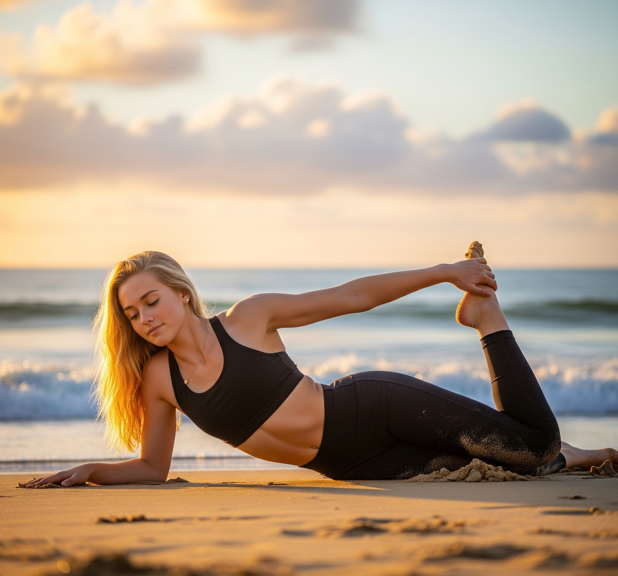
The Lying Quadriceps Stretch is a gentle yet powerful stretch performed while lying on your side. Unlike standing versions that challenge your balance, this position allows you to completely relax while targeting the front of your thigh.
Rectus Femoris – The quad muscle that crosses both hip and knee joints
Vastus Muscles – The three vasti that make up the bulk of your thighs
Hip Flexors – Particularly the rectus femoris, which acts as both a quad and hip flexor
Knee Joint – Improves range of motion and reduces stiffness
| Standing Quad Stretch | Lying Quadriceps Stretch |
|---|---|
| Requires balance | ✅ Complete stability |
| Can strain lower back | ✅ Spine fully supported |
| Limited by standing leg fatigue | ✅ Hold longer, stretch deeper |
| Harder to relax | ✅ Easier to release tension |
✅ Morning routines when balance isn’t optimal
✅ Post-workout when muscles are fatigued
✅ Anyone with balance concerns
✅ Deep, sustained stretching sessions
✅ Rehabilitation phases
Think of this stretch as giving your quads a vacation. While you lie comfortably supported, your thigh muscles finally get the release they’ve been begging for.
Your quadriceps are among the most powerful muscles in your body, but that power comes with a tendency to get tight.
Daily accumulation: Every step, squat, and climb tightens these fibers
The lying position allows complete muscle relaxation
No compensatory muscles can take over, ensuring the quads truly release
Result: Soft, supple thighs that move freely
The rectus femoris (one of your four quad muscles) also functions as a hip flexor.
Dual-action muscle: When it’s tight, it limits both knee bending AND hip extension
Lying quadriceps stretch addresses both functions simultaneously
Benefit: Better walking stride, easier running, improved squat depth
Pelvic release: Takes pressure off your lower back
Every athlete needs mobile quad. That’s why:
| Athlete Type | How Mobile Quads Help |
|---|---|
| Runners | Longer stride, less hamstring compensation |
| Cyclists | More powerful pedal stroke, reduced knee pain |
| Weightlifters | Deeper squats, better form, heavier lifts |
| Yogis | Deeper backbends, easier hero pose |
| Dancers | Higher kicks, more controlled landings |
Your quadriceps attach directly to your kneecap (patella). When they’re tight:
✅ They pull the kneecap unevenly
✅ Increase pressure behind the kneecap
✅ Contribute to patellofemoral pain syndrome
✅ Limit full knee extension
The lying quadriceps stretch restores normal length to these muscles, taking pressure off your knee joint and allowing proper tracking of your kneecap.
Gravity assists blood flow back toward your heart
Sustained hold flushes metabolic waste from worked muscles
Fresh oxygenated blood delivers nutrients for repair
Result: Faster recovery, less next-day soreness
Lying position signals safety to your brain
Deep breathing during holds activates the parasympathetic response
Stress stored in the hips begins to release
Result: You emerge feeling stretched AND centered
The lying quadriceps stretch is often a gateway to:
✅ Hero pose (Virasana) in yoga
✅ Deeper backbends
✅ Improved squat mechanics
✅ Greater overall lower body flexibility
Tight quads don’t just affect your legs they pull your entire pelvis out of alignment.
Anterior pelvic tilt correction: When quads shorten, they tilt the pelvis forward, creating a lower back arch
Spinal decompression: A neutral pelvis means less compression on the lumbar vertebrae
Posture transformation: Stand taller with less effort
Chain reaction: Proper pelvic position improves everything above AND below
Most people overdevelop their quads while neglecting hamstrings and glutes.
Restores equilibrium: Lengthening quads allows opposing muscles to engage properly
Injury prevention: Balanced muscles = stable joints
Aesthetic benefits: Creates a more proportionate leg appearance
Functional improvement: Better coordination between front and back leg muscles
Tight quads contribute to a cascade of tension that can irritate the sciatic nerve.
Pelvic connection: When quads pull the pelvis forward, the sciatic nerve pathway can become compressed
Indirect relief: Releasing quads often eases referred pain patterns
Complementary benefit: Works alongside specific nerve glides for comprehensive relief
Whole-body approach: Addresses one link in the kinetic chain affecting nerve health
Counteracts repetitive quad contraction from miles of pounding pavement
Prevents the “tight quad” syndrome that leads to knee pain
Maintains stride length and running economy
Complements other hip openers like Pigeon Pose for complete lower body release
Releases hips from the hunched, flexed cycling position
Prevents the anterior pelvic tilt that causes lower back pain
Improves pedal stroke efficiency through better hip extension
Essential for achieving proper squat depth
Speeds recovery after heavy leg days
Prevents muscle imbalances that lead to injury
Pairs well with Reverse Nordic Curl for balanced quad development
Improves form on deadlifts and Olympic lifts
Reverses the damage from 8+ hours of sitting
Counteracts shortened hip flexors and quads
Prevents the postural collapse that leads to chronic pain
Can be done during quick work breaks
Maintains mobility for independent living
Prevents falls by keeping legs flexible and responsive
Makes daily activities (getting up from chairs, climbing stairs) easier
Gentle enough for aging joints
Aids recovery by flushing metabolic waste
Reduces next-day muscle soreness (DOMS)
Returns worked muscles to healthy resting length
Signals body to adapt with improved flexibility
Especially effective when combined with Foam Rolling Quadriceps Stretch techniques
Wakes up stiff legs that shortened overnight
Sets the tone for mobile movement all day
Gentle enough for just-woken muscles
Can be done before even getting out of bed
Prepares the body for backbends like Ustrasana (Camel Pose)
Essential for Hero Pose (Virasana) preparation
Deepens understanding of hip extension
Balances forward-folding practice
Reduces tension on the patellar tendon
Improves kneecap tracking during movement
Addresses quad tightness a common cause of patellofemoral pain
Non-weight-bearing = safe for sensitive knees
Corrects anterior pelvic tilt caused by tight quads
Takes pressure off lumbar spine
Addresses the “tight quads = angry back” connection
Can be part of a comprehensive back care routine that includes this Lying Quadriceps Stretch
Avoid overstretching the opposite muscle group
Quad and hamstring balance is delicate during recovery
Gentle only, never force
Consult your physical therapist first
Avoid if the stretch causes knee pain
MCL, LCL, or cruciate ligament injuries require caution
The pulling motion may stress healing ligaments
Work within pain-free range only
Keep the stretch gentle never force
Stop immediately if pain increases
The pelvic position may aggravate certain conditions
Better to skip during acute flare-ups
Consult your surgeon or physical therapist first
Range of motion may be limited by design
Certain approaches (posterior vs. anterior) have different restrictions
Never exceed recommended range
Lying on side is actually recommended in late pregnancy
The position may be uncomfortable due to the size of the belly
Keep range, gentle hormones increase natural laxity
Modify by reducing how far you pull the foot
Start on your left side, legs stacked, head resting on your arm or a pillow.
Reach back with your right hand and grab your right ankle (or use a strap if needed).
Keep your hips stacked don’t let them roll backward.
Maintain for 20-30 seconds, then switch sides.
Muscle Worked | Difficulty Level |
Quadriceps | Beginner-Friendly |
🔹 Avoid yanking your foot – Gentle pressure prevents knee strain.
🔹 Keep hips aligned – Don’t let them roll back; stay stacked.
🔹 Listen to your body – Discomfort is okay, sharp pain means stop!
🚫 Twisting your spine – Keep your torso stable to avoid back strain.
🚫 Holding your breath – Deep breathing helps deepen the stretch.
🚫 Overarching your lower back – Engage your core to protect your spine.
A: Yes! The hip flexors include the rectus femoris (one of your quads), which is why this stretch targets both areas. Feeling the stretch in both the front thigh AND the front of the hip flexors is completely normal and actually ideal it means you’re addressing the entire muscle unit where your hip flexors and quads meet.
A: Hold 20-30 seconds for general flexibility, 30-45 seconds for deeper release. Never bounce—keep it smooth.
A: Yes! Daily stretching is safe and recommended. Consistency beats intensity for long-term flexibility gains.
A: Generally yes, but proceed gently. The lying position is non-weight-bearing, making it safer than standing versions. Stop if you feel sharp pain.
A: Lying version offers better stability, spine support, and deeper relaxation. The standing quadriceps stretch version is better for dynamic warm-ups.
Add this stretch to your routine to unlock flexibility, relieve tightness, and keep your quads moving freely. Sweet dreams for your muscles! 😴💪