
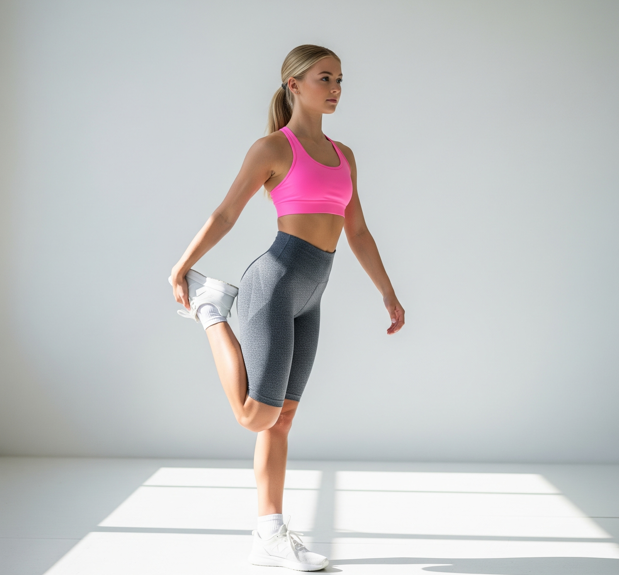
The Standing Quadriceps Stretch is a go-to move for anyone dealing with tight quads whether you’re a runner, cyclist, or just sitting too long at a desk. This stretch targets the quadriceps, the large muscle group at the front of your thighs, helping improve flexibility, reduce stiffness, and enhance mobility. Think of it like “giving your legs a mini reset” after a tough workout or a long day. Plus, it’s super convenient no equipment needed, just a little balance!
However, the importance of this stretch goes beyond just relieving a stiff thigh. The quadriceps are often referred to as the “workhorse” muscles of the lower body, responsible for extending the knee and helping to flex the hip. In our modern world, these muscles are subjected to a conflicting duality: they are incredibly strong from climbing stairs and walking, yet they are also constantly shortened due to hours spent sitting in chairs and cars. This constant state of contraction can lead to a host of issues, including anterior pelvic tilt, which is a common contributor to lower back pain.
Increases Flexibility 🧘: Regularly performing this stretch elongates the quadriceps muscles, leading to improved range of motion in the hip and knee joints. Specifically, it targets the Rectus Femoris the only quad muscle that crosses both the hip and the knee. By lengthening this bi-articular muscle, you improve the ability to extend the hip while simultaneously flexing the knee, which is essential for an efficient gait cycle.
Reduces Risk of Injury🛡️: Flexible quads are less prone to strains and tears, particularly during explosive movements like sprinting or jumping. Muscle strains often occur when a muscle is forced to eccentrically contract (lengthen under tension) beyond its current capacity. By maintaining optimal length in the quads, you increase the “margin of error” before tissue damage occurs, specifically protecting the muscle bellies from avulsion injuries during sudden deceleration.
Alleviates Lower Back Pain🔙❤️: Tight quadriceps can tilt the pelvis forward (anterior pelvic tilt), straining the lower back. Stretching them helps restore proper pelvic alignment. When the quads are chronically tight, they pull down on the anterior superior iliac spine (ASIS) of the pelvis. This forward rotation increases the lumbar lordosis (swayback), compressing the facet joints in the spine. Releasing the quads allows the pelvis to return to a neutral position, reducing mechanical stress on the lumbar vertebrae.
Improves Posture📏🧍: By releasing the front of the hips (hip flexors, which assist the quads), this stretch helps counteract the “sitting posture” of hunched shoulders and a tucked pelvis. Modern sedentary lifestyles create a “lower cross syndrome,” where the hip flexors and quads become tight and overactive while the glutes and abdominals weaken. This stretch directly inhibits the overactive anterior chain, making it easier to engage the posterior chain and stand upright with proper spinal alignment.
Enhances Athletic Performance🚀: Increased flexibility in the quads allows for a longer stride and more efficient lower-body mechanics in sports like running and cycling. A restricted Quadriceps limits knee flexion during the recovery phase of running, forcing the athlete to “shuffle” rather than stride. Furthermore, in cycling, tight quads can prevent the knee from bending fully, reducing the power transfer through the pedal stroke and leading to premature fatigue of the Vastus Medialis.
Reduces Muscle Soreness💆♀️: Gentle stretching after a workout can aid in recovery by increasing blood flow to the muscle tissue and flushing out metabolic waste. Intense exercise creates microtrauma and a buildup of metabolites like hydrogen ions and lactate. The dynamic elongation of the muscle fibers during this stretch acts as a mechanical pump, improving venous return and delivering oxygen-rich blood to aid in the repair of the muscle sarcomeres.
Prepares for Squats and Lunges🏋️: It dynamically prepares the prime movers for exercises that require significant knee and hip flexion, leading to safer and deeper movement patterns. By pre-loading the muscle spindles and elongating the fascia surrounding the thigh, this stretch improves kinesthetic awareness. It ensures that when you descend into a squat, the quadriceps can lengthen adequately, preventing the “butt wink” (posterior pelvic tucking) that often occurs when tight quads limit depth.
🏃♂️🚴♀️ Runners & Cyclists : To counterbalance the constant concentric contraction of the quads during their sport. In running, the quadriceps act as the primary decelerator every time the foot strikes the ground (eccentric load). For this reason, many coaches recommend strengthening the posterior chain with exercises like Nordic curls to balance out the quads. In cycling, the quads are under near-constant tension during the downstroke. Without stretching, these athletes risk developing patellofemoral pain syndrome (runner’s knee) because tight quads pull the kneecap against the femur with excessive force.
💼 Office Workers 🖥️: To reverse the shortening of the hip flexors and quads caused by prolonged sitting. When you sit for 8+ hours a day, your hips are fixed at a 90-degree angle. This causes the Rectus Femoris to adaptively shorten. While the standing version is great for a quick fix, you might find even deeper relief by incorporating the kneeling hip flexor stretch into your evening routine, as it allows for a greater range of motion in the hips. This stretch is essential for “reminding” the muscles of their full length, preventing the development of a sedentary gait pattern where you walk with a stiff, shortened stride.
🏋️♂️ Weightlifters: To maintain mobility for deep squats and lunges. If a lifter has tight quads, they will hit a “squat ceiling” where they cannot descend further without the lower back rounding (butt wink). This stretch helps maintain the necessary dorsiflexion and knee travel required for deep, safe squats. For those looking to build raw strength in this lengthened position, the reverse Nordic curl is an excellent complementary exercise to pair with this stretch, as it strengthens the quads at their end range of motion.
👵 Elderly Individuals : To maintain leg flexibility, which is crucial for balance and preventing falls. As we age, muscle elasticity decreases due to an increase in intramuscular fibrous tissue (fibrosis). For seniors who find standing on one foot too challenging, the lying quad stretch benefits include the ability to release the thigh while remaining fully supported on the ground. Flexible quads ensure that an elderly person can successfully navigate obstacles (like stepping over a curb) without catching their toe.
💺💢Anyone with General Leg Stiffness: If you feel tightness in your thighs after a long day, this is an excellent maintenance stretch. General stiffness is often a sign of muscle guarding or low-grade inflammation from daily wear and tear. Performing this stretch regularly can lower the resting tone of the muscle. If you want to add variety, the kneeling quad stretch is a fantastic alternative that targets the same muscles from a different angle, often providing relief to those who spend a lot of time on their feet.
🖥️💼 Desk Workers with Lower Back Ache : Specifically for those who notice their back hurts more at the end of the day than the beginning. Since the quads attach to the pelvis, tightness here is often the hidden culprit behind what feels like “back pain.” Stretching the quads can often provide relief where back stretches alone have failed. For a deeper release of the lower back, consider pairing this with gentle glute stretches like the pigeon pose to address both the front and back of the hip capsule.
🤰Pregnant Individuals : To help manage the shift in center of gravity. As the belly grows, posture changes, often increasing the curve of the lower back. This stretch can help manage the strain on the front of the hips and thighs caused by the added weight and postural shift (with modifications for balance as needed).
When to do it: Ideal for post-workout cool-downs. It can also be done as a morning mobility drill or a midday break from sitting.
Duration: Hold the stretch for 20-30 seconds per leg.
Repetitions: Repeat 2-3 times on each leg.
Plant your feet hip-width apart near a wall or chair for support if needed.
Lift your right foot toward your glutes, grabbing your ankle with your right hand.
Engage your core, stand straight (no leaning!), and gently pull your heel closer.
Maintain for 20-30 seconds, then switch sides.
Muscle Worked | Difficulty Level |
Quadriceps (front thighs) | Beginner to Intermediate |
🔹 Avoid arching your back – Keep your core engaged to protect your spine.
🔹 Don’t yank your foot – Gentle pressure is key to avoiding strain.
🔹 Use support if wobbly – Balance issues? Hold onto a wall or chair.
❌ Common Mistakes:
🚫 Knees flaring out – Keep knees close together to target quads properly.
🚫 Holding your breath – Steady breathing helps deepen the stretch.
🚫 Overstretching – Ease into it; flexibility improves over time!
A: This is usually due to how you are gripping your foot. Make sure you are holding your foot/ankle, not pulling on your toes or the front of your shin. Also, ensure your knee is pointing straight down at the ground, not flaring out to the side.
A: Use a strap, a belt, or a towel looped around your ankle to bridge the gap. Hold both ends of the strap with your hand to pull your foot toward you. You can also perform the Lying Quadriceps Stretch on your side as a more accessible alternative.
A: Some wobbling is common when you start. Focus on a fixed point in front of you (a “drishti”) and keep your core engaged. If balance is a major issue, keep your hand firmly on the wall.
A: Yes, for healthy knees. However, if you have a history of knee injuries or meniscus issues, avoid pulling your heel too forcefully into your glute. Only go to a point of mild tension, not compression. If you feel pinching in the knee joint itself, stop and consult a professional.
A: This can happen if you are bouncing or forcing the stretch aggressively. This triggers the stretch reflex (myotatic reflex), where the muscle tenses up to protect itself from overstretching. Always use slow, controlled movements and steady breathing to avoid this.
Incorporate this stretch daily to unlock flexibility and keep your quads happy. Your legs will thank you later! 🎉