
The Standing Toe-Touch with Rotation is a dynamic stretch that targets your hamstrings, lower back, and obliques while improving mobility and balance perfect for warming up or cooling down!
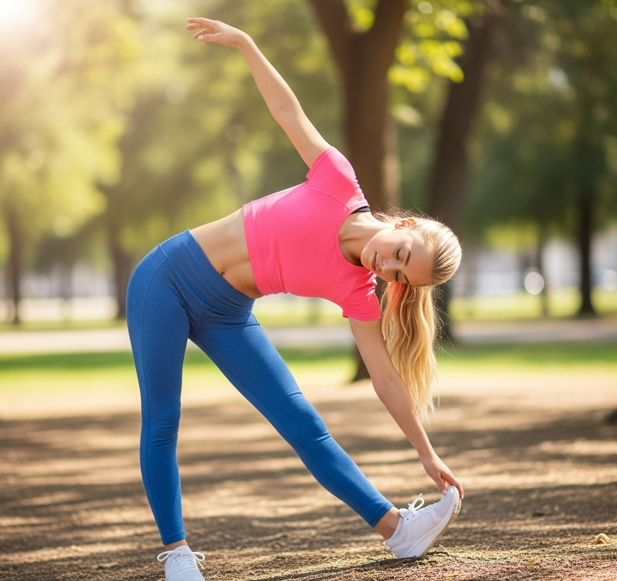
Stand with feet hip-width apart, arms relaxed.
Bend at the hips (not waist!) and lower your torso toward toes keep knees slightly bent if needed.
Place one hand on the opposite foot (e.g., right hand to left toe), extending the other arm upward..
Keep the stretch for 10-15 seconds, then switch sides
Roll back up to standing, one vertebra at a time.
Muscles Worked | Difficulty Level |
Hamstrings, Lower Back, Obliques | Beginner to Intermediate |
Avoid this stretch if you have:
✅ Recent spinal injuries or herniated discs
✅ Sciatica or severe nerve pain
✅ Hyperextended knees (genu recurvatum)
✅ Acute hamstring or lower back strains
⚠️Common mistakes:
📉 Overarching the Neck – Keep your neck neutral (don’t crane it up or drop it too low).
🔄 Twisting Too Fast – Rotate slowly to avoid straining your spine.
🦵 Completely Locking Knees – Slight microbend prevents joint stress.
🤸♂️ Bouncing in the Stretch – No “pulsing”; hold steadily to avoid muscle strain.
🙅♂️ Ignoring Pain – Discomfort is normal, sharp pain means STOP.
In every movement tradition, forward folding is considered sacred. It’s where you meet your edge literally. But the standing toe touch stretch isn’t just another hamstring stretch; it’s a daily conversation with your body about:
🦵 Where you hold tension (hello, tight hamstrings!)
🧠 How you handle discomfort (breathe through it)
⚡ What’s possible today (progress, not perfection)
When you perform a standing toe touch stretch, you’re not just “stretching” you’re triggering complex physiological responses:
| System | Response | Benefit |
|---|---|---|
| 🧠 Nervous System | Parasympathetic activation | Calms “fight or flight” response |
| 💪 Muscles | Golgi tendon organ reflex | Allows muscle lengthening |
| 🩸 Circulatory | Venous return increases | Fresh blood to heart and brain |
| 🦴 Fascia | Hydration and sliding | Improved tissue quality |
| Week | Focus | Daily Practice | Expected Result |
|---|---|---|---|
| 1 | Form mastery | 60 seconds, bent knees | Awareness of hip hinge |
| 2 | Consistency | 90 seconds, mixed levels | 1-2″ closer to floor |
| 3 | Breath integration | 2 minutes, rhythmic breathing | Deeper relaxation |
| 4 | Edge exploration | 2-3 minutes, varied positions | 3-5″ closer; mind-body connection |
| Fingertip Reach | What It Might Mean | Recommended Focus |
|---|---|---|
| Above knees | Sedentary lifestyle, acute tightness | Daily gentle stretching, walk more |
| Mid-shin | Moderate tightness, desk job common | Hip hinge practice, glute activation |
| Ankles | Good flexibility | Maintain with 3x weekly practice |
| Palms flat | Excellent flexibility | Explore advanced variation |
A: Tight hamstrings, limited hip mobility, or improper form. Start with bent knees and focus on hinging at your hips depth will come with consistency.
A: Yes. Rounded spine transfers stress to spinal discs instead of hamstrings. Always prioritize a flat back over reaching deeper.
A: Daily is ideal, especially after workouts or during work breaks. Even 60 seconds daily creates noticeable flexibility gains.
A: Yes, when done correctly. Gentle hamstring stretching reduces tension on the pelvis, which can ease sciatic nerves irritation. Avoid if you feel shooting pain.
A: Some calf engagement is normal, especially if you point your toes. The primary sensation should be along your hamstrings.
Think of this stretch like wringing out a towel gentle twists help release tension while keeping control. Add it to your routine for a happier, more flexible body! 💃🕺