Unleash Your Posterior Chain with This Powerful Exercise
Let’s talk about one of the most potent, yet challenging, exercises for your hamstrings: the Nordic Hamstring Curl. Often dubbed the “king of hamstring exercises,” this move is a true test of strength and control. At its core, it’s an eccentric-focused exercise, meaning it emphasizes the lengthening phase of the muscle under tension. Think of it like lowering yourself down with immense control. This is where the magic (and the muscle building) happens!
What Does the Nordic Curl Target? 🎯
The Nordic Ham Curl primarily blasts your hamstrings (those muscles running down the back of your thighs), with significant engagement of your glutes and lower back. It’s a fantastic way to build flexibility, raw strength, and resilience in the posterior chain, the powerhouse system critical for running, jumping, and preventing injuries.
Key Benefits of Nordic Curls ✨
Why should you incorporate this beast of an exercise into your routine? Here are the undeniable benefits:
- Unmatched Eccentric Strength: Builds incredible strength during the lowering phase, which is crucial for injury prevention, especially for athletes.
- Enhanced Muscle Flexibility and Resilience: Regularly performing Nordic Hamstring Curls improves both the strength and the flexibility of your hamstrings, making them more robust and less prone to strains.
- Superior Knee Stability & Injury Prevention: Strong hamstrings are your knees’ best friends. They provide vital stability and serve as a frontline defense against common sports injuries, such as ACL strains.
- No Fancy Gear Required: While you can use a Nordic curl bench or Nordic curl machine at the gym, you can master Nordic curls at home with just a partner or something to anchor your feet under.
Step-by-Step Guide: Mastering the Nordic Curl
Follow these steps to perform the exercise with perfect form. Remember, control is everything!
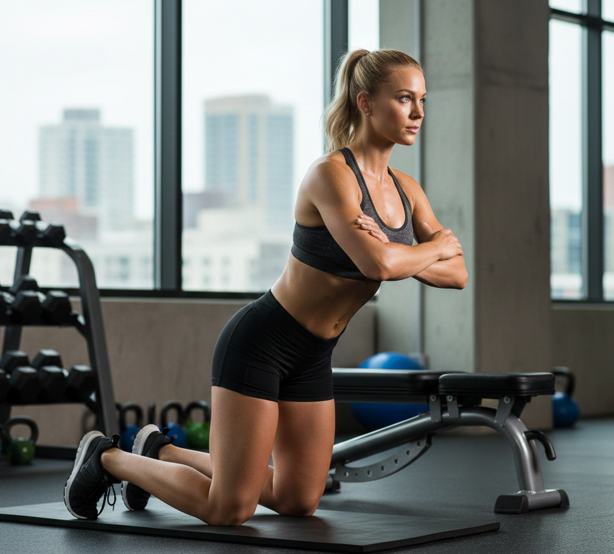
- Get Anchored: Kneel on a padded surface. Have a partner hold your ankles firmly in place, or wedge your feet under a heavy, immovable object (such as a loaded barbell in a rack or a sturdy couch for Nordic curls at home). Your body should form a straight line from your knees to your head.
- Engage Your Core: Brace your abs and squeeze your glutes. This keeps your body rigid and prevents your hips from sagging.
- The Controlled Descent: This is the main event! Keeping your body straight as a plank, slowly lean forward. Resist the fall with all your hamstring strength for as long as possible. Pro Tip: The goal isn’t to reach the floor on your first try. The goal is to fight gravity with maximum control.
- The Push-Back (or Catch): Once you can no longer resist gravity, swiftly catch yourself with your hands. Push yourself back explosively to the starting kneeling position. Beginner Modification: Use a resistance band anchored in front of you to assist with the descent and return. Advanced Move: Try to use pure hamstring and glute power to pull yourself back up from a deeper position.
Safety Tricks & Common Mistakes to Avoid 🛡️
Safety First!
- Padded Knees Always: Use a thick mat or cushion under your knees. Discomfort here can break your focus and form.
- Start with Assistance: Don’t ego-lift. Begin with a band-assisted Nordic curl or a partial range of motion. Building up flexibility and strength here is a marathon, not a sprint.
- Warm-Up Thoroughly: Never do this cold. Perform dynamic stretches and light glute and hamstring activation exercises first.
Dodge These Common Errors:
- The Hip Hinge: Your body should move as one unit. Don’t bend at the hips first; it turns the exercise into an easier movement and takes the load off the hamstrings.
- Looking Down: Keep your gaze forward and neck neutral. Looking at the floor encourages rounding your entire spine.
- Free-Falling: Dropping quickly defeats the purpose. The eccentric (lowering) phase should last 3-5 seconds. If you’re falling instantly, you need to regress the exercise.
- Anchoring Fail: Ensure your feet are securely anchored. A slip can lead to a faceplant and injury.
FAQs❓
Q: I can’t do a single rep! Is that normal?
A: Absolutely! The Nordic Hamstring Curl is brutally hard. Almost everyone starts with band assistance or partial reps. Consistency is key.
Q: Can I really do Nordic curls without a machine?
A: 100% Yes! Nordic curls at home are very achievable. A sturdy sofa, a heavy dumbbell, or a dedicated anchor strap under a door can work perfectly. You don’t necessarily need a Nordic curl machine.
Q: How often should I do them?
A: Due to the high intensity, 1-2 times per week is sufficient for most people. Allow at least 48 hours of recovery for your hamstrings.
Q: What’s the difference between a Nordic Curl and a Reverse Nordic Curl?
A: Great question! They are opposite movements targeting opposing muscle groups. The standard Nordic hamstring curl involves leaning forward to work the back of your thighs (hamstrings). The Reverse Nordic Curl involves kneeling and leaning backward to stretch and strengthen the front of your thighs (quadriceps). It’s essentially a dynamic nordic quad stretch under load, building strength at the end of your range of motion.
🏆 The Ultimate Pro Tip
Think of your descent like pressing the slow-motion button. Your primary goal isn’t to reach the floor—it’s to fight gravity for as long as humanly possible on every single rep. Imagine lowering yourself over a count of 5 full seconds. The moment you feel you’re starting to “drop,” that’s your signal to push back up. This extreme focus on the negative phase is what builds legendary eccentric strength and tendon resilience faster than anything else. While building this hamstring power, don’t forget to balance your routine. Pairing this with a Nordic quad stretch (or a simple kneeling quad stretch) can help maintain joint health and overall leg flexibility. Record yourself; if your lowering phase is less than 3 seconds, you need to use a band for assistance or reduce your range of motion. Master the slow fall first, and the full Nordic curl will follow.