
Quadriceps
Reverse Nordic Curl
Master the Reverse Nordic Curl
The Reverse Nordic Curl is a game changing exercise that targets your quadriceps, hip flexors, and core while dramatically improving lower body flexibility. Unlike traditional stretches, this movement combines strength and mobility think of it as “yoga meets strength training” for your thighs. Perfect for athletes, fitness enthusiasts, or anyone battling tight quads from sitting all day. This challenging but rewarding exercise helps correct muscle imbalances while building functional flexibility that translates to better performance in sports and daily life.
🔹 Why Your Routine Needs It:
✅ Builds quad strength at LONG lengths (where most people are weak)
✅ Trains eccentric control essential for knee health
✅ Improves squat depth by teaching your quads to work through full range
✅ Prepares your body for deeper stretches like the standing quadriceps stretch
✅ Creates the kind of resilient legs that don’t get injured
Think of it as the missing link between strength training and flexibility work a bridge between your squat rack and your yoga mat.
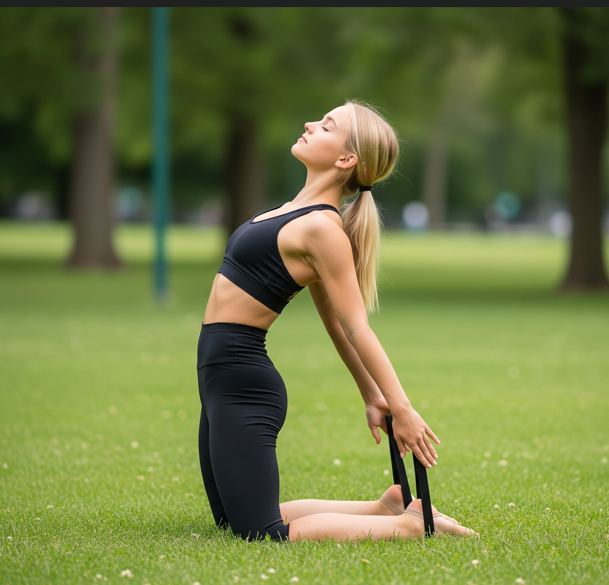
Reverse Nordic Curl Stretch
✨ 10 KEY BENEFITS OF REVERSE NORDIC CURL
🔥 1. Builds Bulletproof Quads Through Full Range
Most quad exercises (squats, lunges) only train your quads in their shortened position. The Reverse Nordic Curl challenges them at their longest, most vulnerable length where they’re most prone to injury. By strengthening here, you:
✅ Build resilience against strains and pulls
✅ Develop the kind of functional strength that transfers to real movement
✅ Create muscle fibers that are strong AND flexible
Result: Quads that can handle whatever you throw at them.
🦵 2. Improves Knee Health & Patellar Tracking
Your kneecap (patella) rides in a groove at the end of your femur. When your quads are imbalanced, the patella can track improperly, causing pain and degeneration. The Reverse Nordic Curl:
✅ Emphasizes the Vastus Medialis (the teardrop muscle that stabilizes the patella)
✅ Trains the knee through deep flexion without compression
✅ Builds strength in the exact range where most knee pain occurs
Result: Knees that track properly and stay pain-free.
🧘 3. Enhances Quadriceps Flexibility
This is the rare exercise that builds strength AND flexibility simultaneously. As you lower into the Reverse Nordic Curl, your quads are both contracting AND lengthening a state called eccentric loading. Over time, this:
✅ Increases your quad’s resting length
✅ Prepares you for deeper quadriceps stretch positions
✅ Prevents the adaptive shortening that leads to pelvic tilt
Result: Quads that are both strong AND long the perfect combination.
🏋️ 4. Deepens Squat Mechanics
Tight quads limit squat depth by pulling on your pelvis and restricting knee flexion. The Reverse Nordic Curl:
✅ Trains your quads to work comfortably in deep flexion
✅ Improves the mind-muscle connection for proper squat form
✅ Builds strength at the bottom of the squat where most people are weak
Result: Deeper, more comfortable squats with better form.
🩺 5. Reduces Lower Back Pain
This is a game-changer for back pain sufferers. Tight quads pull your pelvis into anterior tilt, which compresses your lumbar spine. The Reverse Nordic Curl:
✅ Lengthens the rectus femoris (which attaches to your pelvis)
✅ Allows your pelvis to return to neutral position
✅ Takes direct pressure off your lower back
Result: Less lower back pain, better posture, happier spine.
🏃 6. Enhances Athletic Performance
Every athlete needs quads that can absorb force AND produce it. The Reverse Nordic Curl:
✅ Improves deceleration control (essential for cutting, landing)
✅ Builds eccentric strength that protects against injury
✅ Transfers directly to sport-specific movements
✅ Prepares your body for explosive moves like lunges and jumps
Result: Better performance, lower injury risk.
🔄 7. Complements Other Leg Exercises
The Reverse Nordic Curl fills gaps that other exercises miss:
Traditional lunges build concentric strength
Squats build overall leg power
Standing quadriceps stretch builds passive flexibility
Reverse Nordic Curl builds ACTIVE flexibility AND strength
Together, they create complete leg development.
Result: Balanced, resilient legs from every angle.
🧠 8. Improves Body Awareness
The controlled descent of the Reverse Nordic Curl requires intense focus:
You must feel where your quads are in space
You learn to distinguish between muscle burn and joint strain
You develop the mind-muscle connection essential for advanced training
Result: Deeper understanding of your own body mechanics.
🦴 9. Prepares for Advanced Movements
Master the Reverse Nordic Curl, and you unlock access to:
Deeper pistol squat progressions
More controlled dragon flags
Advanced gymnastic movements
Pain-free performance in deep glute stretch positions
Result: Your strength ceiling rises across multiple movements.
🌟 10. Accelerates Recovery When Combined with Foam Rolling
The Reverse Nordic Curl and foam rolling quadriceps stretch are perfect partners:
Foam rolling before releases fascial restrictions
The exercise then trains the newly freed tissue through full range
This combination creates lasting, structural change
Recovery between sessions improves dramatically
Result: Faster progress, less soreness, better long-term outcomes.
👥 WHO SHOULD DO REVERSE NORDIC CURL?
🏋️ Weightlifters & Gym-Goers
Why it’s essential:
Squats alone don’t train quads in deep flexion
Eccentric strength is often neglected
Patellar tendon health requires specific loading
How to incorporate:
Post-squat day: 2-3 sets of 8-10 reps
As a finisher: Light, controlled reps to fatigue
Frequency: 2-3x weekly
Expected results:
Deeper squats with better control
Reduced knee pain during leg training
More balanced quad development
🏃 Runners
Why it’s essential:
Running is concentric-dominant (pushing off)
Quads shorten over miles of repetitive motion
Eccentric control prevents downhill damage
How to incorporate:
Post-run: 2-3 sets of 6-8 reps on recovery days
Strength days: Heavier, more controlled sets
Expected results:
Less quad tightness during long runs
Improved downhill control
Reduced patellar tendon stress
🧘 Yoga Practitioners
Why it’s essential:
Many poses require deep knee flexion (Hero, Camel)
Active flexibility differs from passive stretching
Strength in deep ranges prevents compensation
How to incorporate:
Pre-practice: Light activation
Post-practice: Deeper, controlled reps
Complement with standing quadriceps stretch
Expected results:
Deeper expression of kneeling poses
More comfortable backbends
Better overall lower body mobility
🩺 Knee Rehab Patients
Why it’s essential:
Patellar tendinopathy responds well to eccentric loading
Controlled range allows pain-free strengthening
Builds resilience in the exact tissues that need it
How to incorporate:
ONLY as directed by physical therapist
Start with partial range, progress slowly
Focus on control, not depth
Expected results:
Reduced patellar tendon pain
Improved knee function
Faster return to activity
👴 Older Adults
Why it’s essential:
Quad strength is critical for fall prevention
Eccentric control helps with stair descent
Maintaining knee health preserves independence
How to incorporate:
Gentle range only
Use support if needed (wall, chair)
1-2 sets of 5-8 reps, 2-3x weekly
Expected results:
Better balance on uneven surfaces
Easier stair negotiation
Reduced age-related quad decline
🏆 CrossFit & HIIT Athletes
Why it’s essential:
High-intensity training creates quad tightness
Eccentric strength protects during explosive moves
Full-range control improves complex lifts
How to incorporate:
Post-WOD: Recovery-focused sets
Skill work: Light reps before heavy squatting
Expected results:
Better overhead squat positioning
Reduced quad strains during high-volume work
Improved reception in Olympic lifts
🧑💻 Desk Workers
Why it’s essential:
Sitting shortens quads over years
Lower back pain often originates from tight quads
Active lengthening counteracts sitting damage
How to incorporate:
Evening routine: 2-3 gentle sets
Weekend: Deeper work when time permits
Complement with foam rolling quadriceps stretch
Expected results:
Reduced lower back tension
Better standing posture
Less morning quad stiffness
Improved leg aesthetics
How To Perform and Progress Reverse Nordic Curl🎯
1️⃣Start Kneeling
Begin on padded surface with knees hip-width apart, torso upright
2️⃣Engage Core
Brace your abs to protect your lower back
3️⃣Slowly Lean Back
Lower torso backward while keeping thighs vertical
4️⃣Control the Descent
Go only as far as you can maintain good form
5️⃣Return to Start
Use quad strength to pull yourself back up
🔥 Modifications:
- Beginner: Use hands on thighs for support or reduce range
- Advanced: Add weight plate on chest or try pausing at bottom
📊 Quick Reference Table
Muscles Worked | Difficulty Level |
Quadriceps | Advanced |
Hip Flexors | Advanced |
Core | Beginner |
⚠️Safety Check:
🔹 Use Knee Padding – Protect your knees with a yoga mat or cushion
🔹 Start Shallow – Only go as deep as you can control
🔹 Warm Up First – Do light cardio and dynamic stretches beforehand
🔹 Listen to Your Body – Discomfort is normal, sharp pain means stop!
❌ Common Mistakes
🚫 Arching Lower Back – Keep core engaged throughout
🚫 Dropping Too Fast – Control is key to prevent injury
🚫 Flaring Knees Out – Maintain proper knee alignment
🚫 Holding Breath – Breathe steadily throughout movement
FAQ's
Q1: Is the Reverse Nordic Curl safe for bad knees?
A: When done correctly, YES it’s actually THERAPEUTIC for many knee issues. The controlled, eccentric loading strengthens the patellar tendon and improves quad control, which can reduce knee pain. However:
Q2: How is this different from a standing quadriceps stretch?
A: Great question! The standing quadriceps stretch is a PASSIVE stretch where you simply hold the position. The Reverse Nordic Curl is an ACTIVE movement where your quads are contracting to control the descent and return.
Q3: Why do my hip flexors feel this so much?
A: Because the Rectus Femoris (one of your quads) IS also a hip flexor! Feeling it in the front of your hip is completely normal and actually desirable it means you’re reaching the part of the quad that crosses the hip joint. This is the same area targeted by dedicated glute stretch work, just from the opposite angle.
Q4: How often should I do Reverse Nordic Curls?
A: Beginners should start with 2x weekly, allowing 48 hours between sessions. Intermediates can do 2-3x weekly as part of leg day. Always follow up with foam rolling quadriceps stretch for optimal recovery.
Q5: What's the difference between Reverse Nordic Curl and lunges?
A: Lunges are concentric-dominant and build functional strength, while Reverse Nordic Curls are eccentric-dominant and build deep flexibility + knee control. Use lunges for general leg development and Reverse Nordic Curls for targeted quad lengthening.
Quick Tip:
Mastering the Reverse Nordic Curl will transform your flexibility, build resilient quads, and take your lower body mobility to new heights. It’s challenging at first, but stick with it your future self will thank you! 💥