
Hamstring Stretch
Lying Hamstring Stretch with Strap
Strap Hamstring Stretch
Tight hamstrings cramping your style? This lying hamstring stretch with strap lets you improve flexibility while comfortably flat on your back perfect for post-workout recovery, injury prevention, or just melting away stiffness.
💪 Key Benefits
✅ Deep, controlled stretch – The strap helps you safely increase range of motion
✅ Perfect for all levels – Easily adjustable for beginners to advanced flex-seekers
✅ Zero balance required – Great if standing stretches make you wobble
✅ Rehab-friendly – Gentle option for recovering from injuries
✅ Mind-body bonus – Combine with deep breathing for stress relief
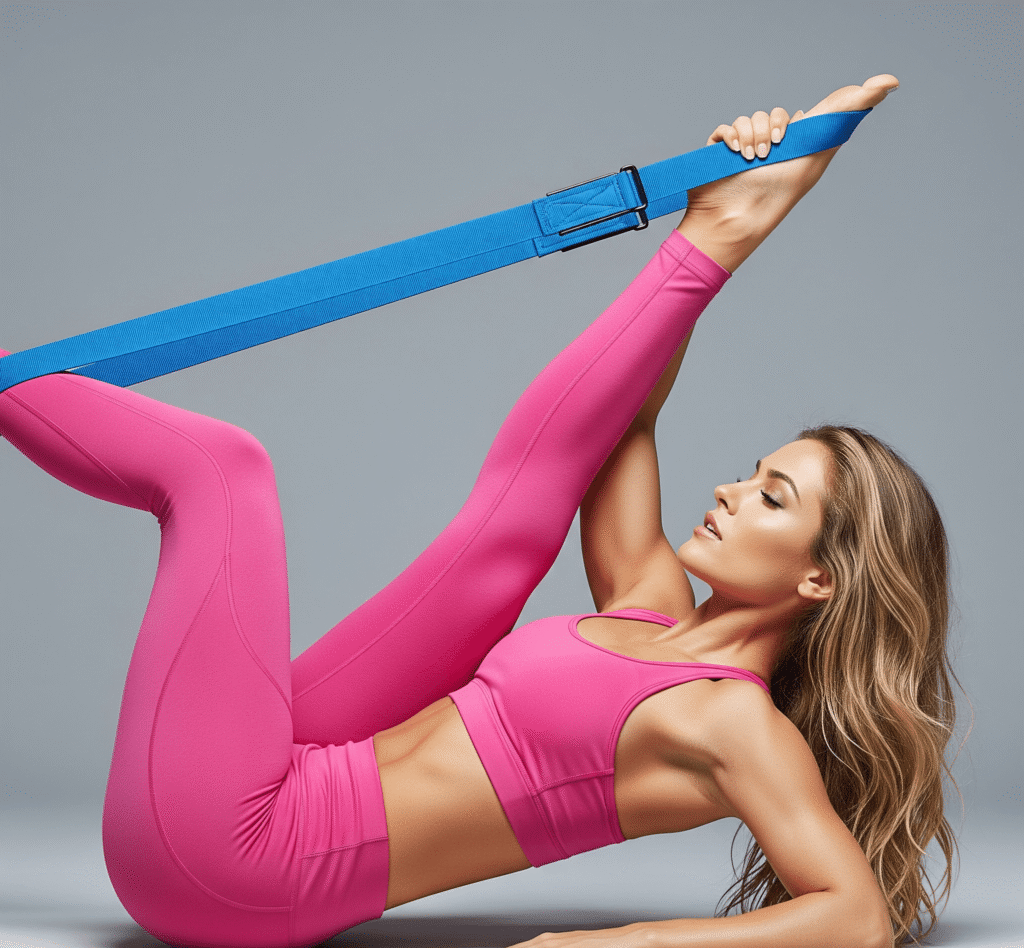
Lying Strap Stretch
🛠️How To Do Lying Hamstring Stretch?
1️⃣Get Grounded
Lie flat on your back like a starfish 🌟, legs extended.
2️⃣Loop & Lift
Place a strap/towel around one foot (mid-arch) and slowly raise that leg toward the ceiling 🎈.
3️⃣ Find Your Edge
Straighten the raised knee until you feel a gentle pull not pain! (Think “comfortable challenge” 😌) 🍬.
4️⃣ Hold & Breathe
Maintain for 30 seconds while inhaling through your nose 👃, exhaling through pursed lips 👄.
5️⃣ Switch Sides
Repeat on the other leg no favoritism! ⚖️
🔥 Modifications:
- Tight? Keep a slight bend in the raised knee.
- Advanced? Point toes toward your face for a calf-hamstring combo stretch.
📊 Quick Reference Table
Target Area | Details |
Primary Muscles | Hamstrings |
Secondary Muscles | Calves, Glutes |
Difficulty Level | Beginner-friendly |
Equipment Needed | Yoga Strap/Towel/Belt |
⚠️ Safety Check: Who Should Proceed with Caution?
🚑 Recent hamstring/hip surgery patients – Get doctor approval first
🤰 Pregnant folks – Use extra cushioning under your lower back
🤦 Common mistakes:
✅ Yanking the strap → Smooth movements only (no jerking! 🏹)
✅ Locking the knee → Keep a microbend to protect joints 🦵
✅ Holding breath → Breathe like you’re blowing bubbles 🫧
When to Choose the Lying Hamstring Stretch with a Strap
The Lying Hamstring Stretch with a Strap (also known as the Supine Hamstring Stretch) is a versatile and accessible variation of hamstring stretching. While there are many ways to stretch the back of the leg, this specific method is the best choice in the following situations:
You Have Poor Balance or Mobility
- Why: The standing hamstring stretch requires you to balance on one leg while placing the other foot on an elevated surface. For older adults, beginners, or anyone with balance issues, this can be unstable and risky. The lying version keeps your back and hips firmly supported on the ground, allowing you to focus entirely on the stretch without worrying about falling.
- When to use it: Ideal for seniors, post-rehabilitation patients, or anyone recovering from a lower body injury.
You Want to Isolate the Hamstring Without Back Strain
- Why: In a seated hamstring stretch (where you sit on the floor and reach for your toes), it is very easy to round the lower back. This transfers the stretch away from the hamstring stretch and onto the spinal discs, which can aggravate back pain. By lying on your back, your spine remains neutral and protected. The strap ensures you are pulling the leg, not rounding the back to reach further.
- When to use it: Perfect for individuals with chronic lower back pain, herniated discs, or sciatica.
You Need a Deeper, More Controlled Stretch
- Why: Gravity is working with you in this position. When you lie down, the hip joint is stabilized. Using a strap (or towel) gives you mechanical leverage to pull the leg closer to your torso without using momentum. This allows for a passive stretch, where you can relax the muscle and let the strap do the work, often leading to a greater release of tension than active stretching alone.
- When to use it: Excellent for post-workout cool-downs when the goal is relaxation and lengthening, not activation.
You Are Recovering from a Hamstring Strain
- Why: After a muscle tear, aggressive stretching can do more harm than good. The lying strap stretch is considered a low-intensity, non-weight-bearing stretch. It allows you to control the exact angle and intensity of the stretch. You can keep the knee slightly bent to protect the healing tissue, which is harder to do in a standing position. For long-term recovery and strengthening, pairing this stretch with eccentrics like the Nordic hamstring curl is crucial to prevent re-injury.
- When to use it: During the sub-acute phase of injury recovery (once the initial pain has subsided).
You Want to Improve Leg Raises and Kicking Mobility
- Why: This stretch directly improves active range of motion the ability to lift your leg high while keeping it straight. This is essential for dancers, martial artists, and swimmers. The strap helps you gently push past your usual limits, preparing the body for dynamic movements.
- When to use it: Before activities that require high kicks or straight-leg lifts.
You Want to Modify the Stretch for Different Angles
- Why: The hamstrings are actually three different muscles (semitendinosus, semimembranosus, biceps femoris). By changing the position of your foot, you can target different parts of the muscle group:
- Foot flexed (toes toward you): Targets the outer hamstring and calves.
- Foot pointed (toes away): Targets the inner hamstring.
- Leg across the midline: Targets the IT band and outer hip.
- This level of customization is difficult to achieve in a standing hamstring stretch.
- When to use it: When you feel a “knot” or tight spot that general stretching isn’t hitting.
- You Are a Beginner Building a Routine
- Why: It is simple to learn and requires minimal equipment (a yoga strap, belt, or dog leash). It teaches proper hip mechanics keeping the hips square and stable which translates to better form in other stretches and exercises.
- When to use it: As a foundation stretch before progressing to more advanced poses.
Lying Hamstring Stretch with Strap: Prop Guide
- The Yoga Strap (Webbed or Cotton)
This is the best choice for regular practitioners and yogis. It is designed specifically for stretching, usually measuring 6 to 10 feet long. Most yoga straps include a metal or plastic D-ring buckle that allows you to create a secure loop around the foot, freeing up your hands from having to grip tightly throughout the stretch. Webbed straps are durable and do not stretch, providing consistent resistance that helps you maintain a steady pull. To use it, simply loop the strap around the ball of your foot, hold one end in each hand, and as you pull the leg closer, walk your hands up the strap to deepen the stretch gradually. - The Resistance Band (Latex or Fabric)
This option is ideal for athletes looking to combine stretching with light muscular activation. Resistance bands are often longer than yoga straps, reaching up to 8 feet, and they provide a slight “give” due to the elastic material, which can feel gentler on the joints. If you choose a band with varying resistance levels, such as light, medium, or heavy, you can add a subtle strengthening component by gently pushing your leg against the band’s resistance while stretching. Fabric bands are particularly user-friendly as they stay open like a tube, making it easy to slip the foot in without needing to adjust buckles. - The Household Towel or Belt
This is the perfect solution for beginners, travelers, or anyone stretching at home without specialized equipment. A bath towel is the widest option available and distributes pressure across a larger surface area of the foot, which is especially beneficial for people with sensitive feet or neuropathy. A dress belt made of leather or vinyl is stiffer and shorter than a towel, but it remains effective if you loop it around the foot and hold the buckle end. Even a drawstring pulled from sweatpants or a hoodie can serve as a true “no-gear” option, though it may be less comfortable on the hands. To use a towel, simply drape it over the ball of your foot, hold both ends, and gently pull toward you. - The Dog Leash (Serendipity Prop)
This unconventional option is perfect for pet owners caught mid-walk who want to sneak in a quick stretch. A nylon dog leash is essentially a very durable, pre-looped strap that often comes with a padded handle, making it surprisingly comfortable to grip. Just ensure it is clean before using it as a stretching aid. - The “No-Prop” Alternative (Using a Wall)
When you genuinely have nothing to use, a wall can serve as an effective prop. Lie on your back with your hips positioned close to a wall, then swing both legs up the wall to form an L-shape with your body. Allow the leg you want to stretch to hang heavy, or gently press it into the wall. In this position, gravity acts as your strap, providing a gentle, passive stretch without any equipment.
How to Choose the Right Strap Length
Under 6 feet (1.8 meters):
Suitable for children or very petite adults.
May be too short for people with long legs or those who need to wrap the strap around the foot multiple times.
6 feet (1.8 meters) – The Standard:
Works well for basic hamstring and quad stretches for most average-sized adults.
Provides enough length to hold comfortably without excess strap getting in the way.
Ideal for beginners and general home use.
8 feet (2.4 meters) or Longer:
Best for people with long legs who need extra length to reach their foot comfortably.
Essential for more complex poses like binding in shoulder stretches or wrapping the strap around the back for deeper upper body work.
Allows for more versatility if you plan to use the strap for multiple types of stretches (legs, arms, and back).
General Rule of Thumb:
If you are unsure, size up. An 8-foot strap can always be shortened by wrapping it around your hand, but a 6-foot strap cannot be lengthened when you need more reach.
FAQ's
Q1: What is the best hamstring stretch for beginners?
A: Lying hamstring stretch with a strap. Zero back strain, full control, and easy intensity adjustment. Safest entry point for tight legs.
Q2: Why are my hamstrings always tight?
A: Usually weak glutes, tight hip flexors, or sciatic nerve tension, not short muscles. Stretch alone won’t fix it. Add a good morning exercise and glute work.
Q3: Can I do hamstring stretches every day?
A: Light maintenance stretching (20-30 sec) is fine daily. Deep, intense stretching requires 48hr recovery. Listen to your body.
Q4: Do I need a strap for lying hamstring stretch?
A: Not mandatory but recommended. Strap maintains spine length, prevents rounding, and extends reach. A towel, a belt, or a resistance band works too.
Q5: Why do I feel lying hamstring stretch in my lower back?
Yes, it’s especially helpful for people who sit for long hours, as tight hamstrings can contribute to stiffness and lower back pain. Regularly practicing this stretch helps release tension, improve flexibility, and support better posture, reducing discomfort in both the legs and lower back.
Quick Tip:
For a lying hamstring stretch, lie on your back and lift one leg toward the ceiling while keeping the other leg flat on the floor. Hold behind your thigh or calf, making sure your lower back stays pressed into the ground and your hips don’t lift. Keep a slight bend in your raised knee if you feel tightness to avoid strain. Gently flex your foot to deepen the stretch, breathe slowly, and hold for 20–30 seconds without forcing the movement.