
Quadriceps
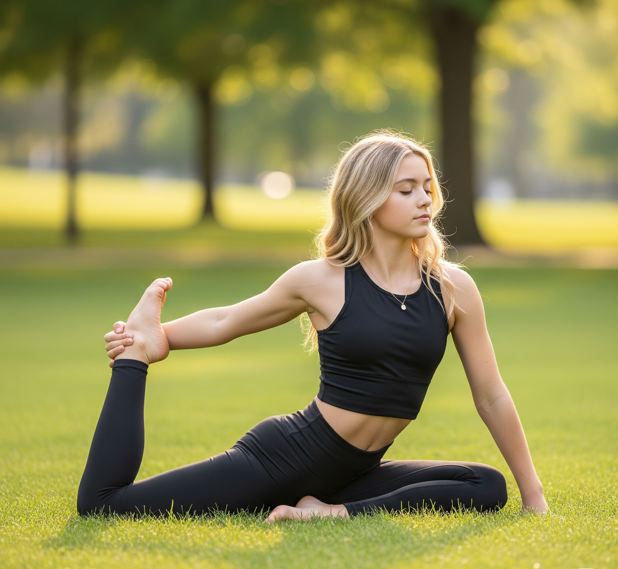
Pigeon Pose
Pigeon Pose for Total Hip Release
The Pigeon Pose is yoga’s secret weapon for melting away hip tension and boosting flexibility. This powerful stretch primarily targets your hip rotators, glutes, and lower back the areas that get cranky from sitting all day or intense workouts. Imagine it as a “reset button” for your lower body, releasing stored tension while improving your range of motion. Whether you’re a runner, desk worker, or just seeking deeper relaxation, mastering this pose will transform how your body feels and moves.
🔹 Why Your Body Needs It:
✅ Counteracts sitting damage – Hours at a desk shorten your hip flexors and tighten your glutes
✅ Releases emotional tension – Hips are known to store stress; opening them can trigger profound release
✅ Prepares for meditation – Creates comfort in seated positions
✅ Prevents lower back pain – Tight hips pull on your pelvis, straining your lumbar spine
Think of Pigeon Pose as a conversation with your hips a chance to listen to what they’re holding and give them the space to let go.
Pigeon Stretch
✨ 10 KEY BENEFITS OF PIGEON POSE
🔥 1. Deep Hip Opening & Flexibility
The primary benefit of Pigeon Pose is its unparalleled ability to open tight hips :
✅ Targets the piriformis a deep rotator that often becomes chronically tight
✅ Stretches the gluteal muscles through their full range
✅ Lengthens the hip flexors of the back leg
✅ Increases external rotation of the femur in the hip socket
Result: Hips that move freely, deeper squat potential, and relief from that constant “tight hip” feeling.
🩺 2. Alleviates Lower Back Pain
Tight hips are a hidden cause of lower back pain . When your hip flexors and glutes are tight, they pull your pelvis into anterior tilt, compressing your lumbar spine :
✅ Releases tension that pulls on the pelvis
✅ Allows the lower back to return to neutral position
✅ Reduces pressure on lumbar discs
✅ Complements other back-care practices
Result: A happier spine and fewer “my back just went out” moments.
🧘 3. Relieves Sciatica Symptoms
Pigeon Pose is widely recommended for sciatica pain because it stretches the piriformis a muscle that can compress the sciatic nerve when tight
✅ Eases muscle tension around the sciatic nerve pathway
✅ Creates more space for the nerve to move freely
✅ Reduces radiating pain down the leg
✅ Can be modified for different levels of sensitivity
Important: If you have true sciatica, consult a healthcare professional and use gentle, pain-free variations .
🧠 4. Releases Emotional Tension
Many yoga traditions recognize the hips as a storage site for emotional stress and trauma :
✅ Deep hip openers can trigger emotional release
✅ The combination of physical stretch and mindful breathing unlocks stored tension
✅ Some practitioners experience spontaneous tears or profound relaxation
✅ Creates a mind-body connection that extends beyond the mat
Result: You emerge feeling not just physically looser, but emotionally lighter.
🏃 5. Enhances Athletic Performance
For athletes, mobile hips are non-negotiable :
✅ Runners: Longer stride, reduced IT band tightness
✅ Cyclists: More comfortable position, better power transfer
✅ Weightlifters: Deeper squat, improved deadlift form
✅ Soccer/Tennis players: Greater range for pivoting and kicking
✅ Dancers: Higher extensions, more controlled movements
Result: Better performance, lower injury risk, faster recovery.
🦵 6. Prepares for Advanced Yoga Poses
Pigeon Pose is a gateway to deeper expressions :
✅ Builds foundation for One-Legged King Pigeon (Eka Pada Rajakapotasana)
✅ Prepares hips for Lotus Pose (Padmasana)
✅ Opens chest and shoulders for deeper backbends
✅ Creates the hip mobility needed for advanced arm balances
Result: A yoga practice that continues to evolve and deepen.
🪑 7. Counteracts Sitting Damage
Modern life means hours of sitting at desks, in cars, on couches. Pigeon Pose is the antidote :
✅ Reverses the adaptive shortening of hip flexors
✅ Stretches glutes that become compressed in seated positions
✅ Restores natural pelvic alignment
✅ Prevents the postural collapse that leads to chronic pain
Result: A body that feels as good at 50 as it did at 25.
🌬️ 8. Promotes Deep Relaxation & Stress Relief
The forward-fold variation of Pigeon Pose is inherently calming :
✅ Supported position activates parasympathetic nervous system
✅ Deep breathing during holds reduces cortisol
✅ Creates a moment of stillness in a busy day
✅ Can be held for several minutes for profound relaxation
Result: You finish your practice feeling stretched AND centered.
🦴 9. Improves Posture & Body Awareness
Open hips contribute to better overall alignment :
✅ Allows pelvis to return to neutral position
✅ Reduces compensatory patterns in lower back and knees
✅ Increases proprioception (awareness of body position)
✅ Translates to better posture off the mat
Result: Standing taller, moving more gracefully, feeling more “in your body.”
🌟 10. Accessible to All Levels
With modifications, Pigeon Pose is available to almost everyone :
✅ Reclined Pigeon (on back) for sensitive knees or beginners
✅ Seated Figure-4 on a chair for office workers
✅ Supported Pigeon with props for deep relaxation
✅ Wall-supported variations for added comfort
Result: A pose that grows with you, from your first day on the mat to your thousandth.
👥 WHO SHOULD DO PIGEON POSE?
🏃 Runners
Why it’s essential:
Running tightens hips and glutes with every stride
IT band tightness often originates in hip rotators
Pigeon Pose is a runner’s best friend for post-run recovery
How to incorporate:
Post-run: 60-90 seconds per side
Active recovery days: Longer holds with deep breathing
Use the seated figure-4 stretch for a quick office version
Expected results:
Reduced IT band issues
Longer, more comfortable stride
Fewer hip complaints
🪑 Desk Workers
Why it’s essential:
8+ hours of sitting = shortened hip flexors and tight glutes
Lower back pain often stems from tight hips
Can be done in office with chair modifications
How to incorporate:
Post-work: Release accumulated tension
Chair version: Seated figure-4 at your desk
2-3 minute holds for deep release
Expected results:
Reduced end-of-day back pain
Better standing posture
Less morning stiffness
🧘 Yoga Practitioners
Why it’s essential:
Foundational hip opener for advancing practice
Prepares body for Lotus, backbends, and arm balances
Develops the hip mobility essential for seated meditation
How to incorporate:
Early in practice when body is warm
Hold 1-3 minutes per side for deep release
Progress to advanced variations like One-Legged King Pigeon
Expected results:
Deeper expression of hip-opening poses
More comfortable meditation
Advanced practice unlocked
👴 Older Adults
Why it’s essential:
Hip mobility is critical for fall prevention
Maintains ability to get up from floor independently
Gentle versions protect aging joints
How to incorporate:
Reclined Pigeon (lying on back) for safety
Chair versions for stability
Gentle holds with plenty of support
Expected results:
Maintained mobility for daily activities
Reduced fall risk
Better quality of life
🏋️ Weightlifters & Gym-Goers
Why it’s essential:
Heavy squats and deadlifts create quad dominance
Tight hips limit squat depth and proper form
Recovery between sessions improves with hip opening
How to incorporate:
Post-leg day: Deep, sustained holds
Rest days: Gentle, longer-duration stretching
Expected results:
Better squat mechanics
Reduced lower back strain during lifts
Faster recovery
🧑💻 Anyone with Lower Back Pain
Why it’s essential:
Tight hips are a primary driver of lumbar discomfort
Releasing hip rotators often relieves referred back pain
Can be done gently and modified as needed
How to incorporate:
Start with reclined pigeon to protect back
Progress slowly as symptoms improve
Combine with core strengthening
Expected results:
Reduced back pain over time
Better understanding of pain triggers
Improved pelvic alignment
🤰 Pregnant Women
Why it’s essential:
Pregnancy hormones increase joint laxity stretch gently!
Hip opening prepares body for labor
Relieves lower back strain from growing belly
How to incorporate:
Reclined pigeon or seated figure-4 preferred
Avoid deep forward folds that compress belly
Use plenty of props for support
Expected results:
More comfortable pregnancy
Better-prepared body for birth
Safer stretching during this special time
How To Do Pigeon Yoga Pose 🧘♂️
1️⃣Start in Tabletop
Begin on hands and knees
2️⃣Slide Right Knee Forward
Place it behind your right wrist, foot angled left
3️⃣ Extend Left Leg Back
Keep your hips square to the front
4️⃣ Lower Toward Forearms
Walk hands forward as you exhale
5️⃣ Hold for 5-10 Breaths
Relax into the stretch, then switch sides
🔥 Modifications:
- Beginner: Use yoga blocks under the hips or stay upright
- Advanced: Fold forward over extended leg for a deeper stretch
📊 Quick Reference Table
Target Areas | Difficulty Level |
Hip Rotators | Intermediate |
Glutes | Intermediate to advanced |
Lower Back | Advanced |
⚠️Safety Check
🔹 Use Padding – Place a blanket under the knee if uncomfortable
🔹 Go Slow – Ease into the pose gradually
🔹 Protect Your Knees – Avoid sharp angles at the bent knee
🔹 Listen to Your Body – Discomfort is okay, pain is not
⚠️Common mistakes
🚫 Collapsing Hips – Keep both hips facing forward
🚫 Rushing the Pose – Let your body open gradually
🚫 Holding Your Breath – Deep breathing enhances the stretch
🚫 Overarching Back – Keep spine neutral
Quick Tip:
Make Pigeon Pose your go-to for hip flexibility, tension relief, and quiet moments of mindfulness. Your hips (and your sanity) will thank you! 🙏
FAQ's
Q1: Is Pigeon Pose safe for beginners?
A: Yes, with modifications! Start with reclined pigeon (lying on your back) or seated figure-4 on a chair. Use props like blankets under your hip, keep your shin at a comfortable angle, and never force into knee pain.
Q2: Can Pigeon Pose help with sciatica?
A: Yes, by stretching the piriformis a muscle that can compress the sciatic nerve when tight. However, avoid if you feel sharp or radiating pain, and consult a healthcare professional for persistent sciatica.
Q3: Why do I feel Pigeon Pose in my knee instead of my hip?
A: This usually means your alignment is off likely forcing your shin parallel or lacking hip support. Back off, add a blanket under your front hip, and keep your shin at a comfortable angle. If pain persists, switch to reclined pigeon.
Q4: How long should I hold Pigeon Pose?
A: Beginners: 30-45 seconds per side. Intermediate: 60-90 seconds. Advanced: 2-3 minutes. In yin yoga, holds can extend to 3-5 minutes. Always prioritize comfortable breathing over duration.
Q5: Can I do Pigeon Pose during pregnancy?
A: Yes, with modifications. Use reclined pigeon or seated figure-4 versions, especially in later stages. Avoid deep forward folds that compress the belly, and always consult your healthcare provider first.