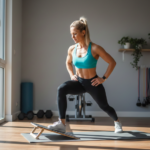

Introduction 🎯
The Terminal Knee Extension is a targeted stretch and exercise designed to zero in on the final, often stubborn, degrees of straightening your knee. It’s the key to restoring your knee’s complete flexibility and functional range of motion, especially after injury or periods of stiffness.
Key Benefits of Terminal Knee Extensions ✨
- Builds Crucial Stability: The Knee Twist strengthens the quadriceps and the vastus medialis obliquus (VMO) to “lock” your knee with confidence, supporting daily movements and athletic performance.
- Enhances Joint Health & Flexibility: Gently encourages full joint capsule flexibility, reducing stiffness and promoting better synovial fluid circulation for healthier knees.
- Accelerates Post-Injury Rehabilitation: A cornerstone exercise for recovering from ACL, meniscus, or knee surgery, specifically targeting the hard-to-achieve terminal extension of knee.
- Improves Movement Efficiency: Whether walking, running, or climbing stairs, achieving full extension makes every stride more powerful and efficient.
- Boosts Mind-Body Connection: This focused movement requires concentration, helping you reconnect with and better control the muscles around your knee.
Step-by-Step Instructions: Master the Movement 🧘♂️
What You Need: A resistance band (or a rolled towel for beginners) and a sturdy chair.
- Get Set Up: Sit tall on a chair with your feet flat on the floor. Loop the resistance band around a fixed object (like a table leg) and place the other end around the back of your lower calf, just above your ankle. Your knee should be bent at about a 30-degree angle to start.
- Anchor & Engage: Keep your thigh firmly pressed down on the chair. Place your hands on your thighs to keep them from lifting. This is your starting position.
- The Core Movement: Slowly and with control, straighten your leg against the band’s resistance. Focus on squeezing your quadriceps muscle hard at the very top.
- Hold & Feel the Stretch: Aim to hold the fully straightened position (terminal knee extension) for 2-3 seconds. You should feel a deep stretch and contraction in the front of your knee and thigh.
- Return with Control: Gently bend your knee back to the starting position, resisting the band the whole way. This builds strength through the entire range.
🔄 Modifications for All Levels
- For Beginners/High Sensitivity: Ditch the band. Simply place a rolled towel under your knee while seated. Press the back of your knee down into the towel, focusing on engaging the quad to achieve that terminal extension.
- For Advanced Users: Increase band resistance, perform the exercise while standing on one leg for a balance challenge, or add a 5-second isometric hold at full extension.
Safety Tricks & Common Mistakes to Avoid ⚠️
Safety First! (Your Knee’s Best Friends):
- Warm-Up is Non-Negotiable: Always perform light cardio (like marching in place) and dynamic leg swings for 5 minutes before starting your terminal knee extension exercises.
- Prioritize Form Over Force: The goal is a controlled movement and a strong muscle squeeze, not just moving your foot. Quality trumps quantity every time.
- Listen to Your Pain Signals: A deep stretch or muscle burn is normal; sharp, stabbing, or joint-line pain is a red flag. Stop immediately if you feel the latter.
Common Mistakes (Steer Clear!):
- Lifting the Thigh: Allowing your thigh to rise off the chair or surface shifts the work away from your knee. Keep it glued down!
- Hyperextending the Knee: Locking out is the goal, but forcing the knee backward past straight is harmful. Aim for a straight line from hip to ankle.
- Rushing the Reps: Swinging or using momentum defeats the purpose. Slow, mindful repetitions are the key to unlocking true flexibility.
- Ignoring the Squeeze: Forgetting to actively and forcefully contract your quads at the top means you’re missing the most critical part of the exercise.
FAQs on Terminal Knee Extensions ❓
Q: How often should I do these exercises?
A: For rehabilitation, daily practice (2-3 sets of 10-15 reps) is often recommended. For general maintenance, 2-3 times per week is great. Consistency is your secret weapon for flexibility!
Q: Can I do this if my knee is swollen?
A: Mild swelling is common, but significant swelling can inhibit muscle activation. It’s often advised to elevate and ice to reduce major swelling first, then perform gentle, band-free versions. Consult your physio.
Q: Why can’t I feel it in my VMO (inner quad)?
A: This is common! Think of “screwing” your foot slightly outward as you straighten your leg, and really visualize that inner quad muscle firing. A gentle touch with your finger on the VMO can also help your brain connect to the muscle.
Q: Is terminal knee extension the same as a leg extension at the gym?
A: They’re cousins! The machine leg extension works through a larger range. Still, the terminal knee extension specifically isolates and overloads the last 0-30 degrees, which is crucial for rehabilitation and that final bit of locking power.
💡 Pro Tip:
Visualize “zipping up” your quad from the kneecap to the hip as you extend. Gently flex your foot (toes toward shin) to maximize muscle activation. Use a mirror to ensure your heel lifts slightly at true terminal extension, that’s your real end-range. Breathe out as you squeeze at the top to engage your core and lock in that hard-earned flexibility.