
Levator Scapulae
The Complete Guide to Releasing Neck & Shoulder Tension
“That persistent knot where your neck meets your shoulder? That’s your levator scapulae begging for attention. The levator scapulae stretch is your ticket to releasing tech neck, easing headaches, and restoring pain-free movement.”
🔍 What Is the Levator Scapulae Stretch?
The levator scapulae muscle stretch targets the muscle that runs from the top of your neck down to your shoulder blade a muscle that becomes chronically tight from poor posture, stress, and hours of screen time. When this muscle shortens, it pulls your shoulder blade up toward your ear, creating that all-too-familiar “hunched” feeling and restricting neck flexibility.
Think of it as giving your shoulders permission to drop back down where they belong while restoring essential flexibility to your neck. Understanding upper trap vs levator scapulae stretch helps you target the right area the levator runs from your neck to shoulder blade, while the upper trap sits on top of your shoulder.
Levator Scapulae Stretches
📝 How to Stretch Levator Scapulae: Step-by-Step Instructions
🔹 1. Seated Levator Scapulae Stretch (Basic Version)
This classic seated levator scapulae stretch is perfect for office breaks and beginners.
Sit tall in a chair with your spine long and shoulders relaxed
Grasp the side of your chair with your right hand to anchor your shoulder blade
Slowly turn your head 45 degrees to the left (imagine looking toward your left armpit) this is key for how to stretch levator scapulae correctly
Gently tuck your chin down toward your chest similar to the chin tuck stretch position
Place your left hand on the back of your head for gentle assistance (no pulling just the weight of your hand)
Hold for 20-30 seconds, breathing deeply
Return to center slowly, then repeat on the opposite side
Modification for beginners: Skip the hand pressure; just let the weight of your head create the stretch.
Advanced option: Gently pull your head with your hand to increase the stretch, but never force.
🔹 2. Upper Trap and Levator Scapulae Stretch (Combined Version)
This upper trap and levator scapulae stretch targets both muscles simultaneously.
Sit or stand tall with good posture
Anchor your right hand under your thigh or grasp the chair seat
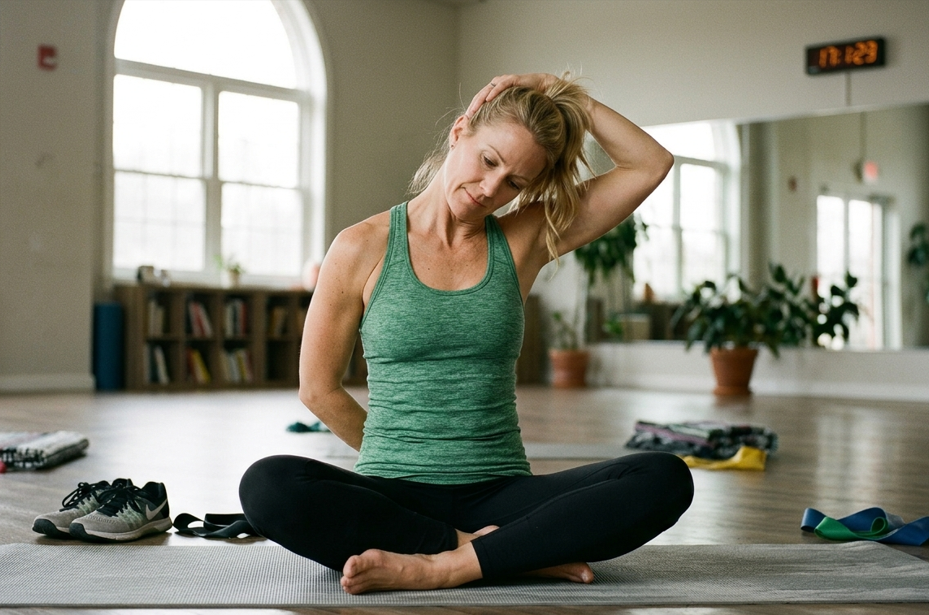
Tilt your head to the left, bringing your left ear toward your left shoulder
Slowly turn your chin slightly downward toward your chest
Feel the stretch travel from the side of your neck toward your shoulder blade
Hold for 20-30 seconds, then switch sides
Why this works: This upper trapezius and levator scapulae stretch releases both key tension areas that often tighten together, especially after an intense arms workout.
🔹 3. Chin Tuck Stretch
This essential chin tuck stretch targets the deep neck flexors while releasing the levator scapulae.
Sit or stand tall with good posture
Place your fingers on your chin
Gently glide your head straight back, creating a “double chin”
Hold for 5-10 seconds, feeling the stretch at the base of your skull
Release and repeat 5-10 times
Add a rotation for levator scapulae focus: after tucking, gently turn your head 45 degrees to one side
Why this works: The chin tuck stretch resets the position of your head on your neck, addressing the root cause of levator scapulae tightness.
🔹 4. Thread the Needle Stretch
This yoga-inspired thread the needle stretch releases the levator scapulae while opening the upper back.
Start on hands and knees in a tabletop position
Slide your right arm under your left arm, palm facing up
Rest your right shoulder and cheek on the floor
Keep your left hand planted or reach it slightly forward
Hold for 20-30 seconds, breathing into your upper back
Slowly release and switch sides
Why this works: The thread the needle stretch targets the levator scapulae from a different angle while also releasing the rhomboids and upper traps perfect after any arm fitness workout.
🔹 5. Cat Cow Stretch with Neck Focus
This variation of the classic cat cow stretch adds specific levator scapulae release.
Start on hands and knees in tabletop position
Inhale for Cow Pose: Drop belly, lift chest, and gently look up
Exhale for Cat Pose: Round spine, tuck chin, and on the next exhale, gently turn your head to look toward your right hip
Hold for one breath, feeling the stretch along the left side of your neck
Return to center on your next inhale
Repeat on the left side
Continue for 5-8 rounds, alternating sides
Why this works: Adding rotation to cat cow stretch specifically targets the levator scapulae through its full range of motion while warming up the entire spine.
📋 Quick Reference Table
| Muscles Worked | Difficulty Level |
|---|---|
| Levator Scapulae | Beginner-Friendly |
| Upper Trapezius | Easily Adjustable |
| Scalene Muscles | Progresses with You |
| Sternocleidomastoid | No Equipment Needed |
| Deep Neck Flexors | Can Use Props |
✨ Key Benefits of Levator Scapulae Stretching
✅ Relieves Chronic Neck Tension – Directly targets the muscle responsible for that stubborn knot at the base of your neck through specific levator scapulae stretching
✅ Reduces Headache Frequency – Tension headaches often originate in tight levator scapulae muscles; releasing them provides significant relief
✅ Improves Neck Flexibility – Restores your ability to turn your head fully, making driving and daily activities easier
✅ Corrects “Tech Neck” Posture – Counters the forward head position from phone and computer use with targeted stretches for levator scapulae
✅ Enhances Shoulder Mobility – Allows your shoulder blades to move freely, improving overall upper body function, especially during arms workout sessions
✅ Balances Upper Body – Understanding upper trap vs levator scapulae stretch helps you target both muscles appropriately
✅ Prepares for Upper Body Training – Essential warm-up before any arm fitness workout to prevent injury
🚫 Don’ts
✖ NEVER yank or pull aggressively on your head
Your neck contains delicate structures that can be injured by forceful movements. Your hand should provide gentle guidance, not force think of it as a “supporting weight” rather than a “pulling force.” Aggressive pulling triggers the stretch reflex, causing muscles to contract instead of release.
✖ Avoid lifting your shoulder during the stretch
If your shoulder creeps up toward your ear, you’re shortening the muscle on both ends and defeating the purpose. Anchor your shoulder down by gripping your chair or letting your arm hang heavy, and check periodically that it hasn’t crept up.
✖ Don’t hold your breath
Holding your breath triggers your fight-or-flight response, increasing muscle tension. Breathe steadily inhale for 4 counts, exhale for 6 counts and consciously soften the stretched muscles with each exhale.
✖ Never stretch through sharp pain
Sharp, stabbing, or shooting pain is your body’s alarm system. A gentle pull is normal; sharp pain means stop immediately. Stay within a comfortable 5-7 on a discomfort scale where 10 is unbearable.
✖ Don’t over-rotate your head
Aim for 45 degrees of rotation imagine looking toward your armpit, not over your shoulder. Over-rotation recruits other muscles and can strain your cervical spine.
✅ Do’s
✔ Anchor the shoulder on your stretching side
Fix the shoulder blade in place by gripping your chair or letting your arm hang heavy. This ensures the stretch targets the levator scapulae rather than just moving the shoulder.
✔ Move slowly into and out of the stretch
Take 3-5 seconds to enter, hold steadily, and 3-5 seconds to release. Quick movements trigger the stretch reflex; slow movements allow gradual lengthening.
✔ Breathe deeply, imagining tension leaving your neck
With each exhale, consciously soften the muscles you’re stretching. Visualize your breath traveling to the tight spot and carrying tension out with it.
✔ Perform both sides equally
Always stretch your tighter side first, then match that duration on your looser side. This gradually reduces imbalances rather than reinforcing them.
✔ Warm up lightly before deep stretching
A few gentle neck rolls or a mini cat cow stretch prepares the tissues for deeper release. Cold muscles don’t stretch well.
✔ Use props like towels or pillows for comfort
If your head doesn’t comfortably reach in lying stretches, use support. Props aren’t cheating they’re smart practice that allows you to relax into the stretch.
✔ Combine with chin tuck stretch for comprehensive neck health
The chin tuck stretch addresses the root postural cause of levator tightness while direct stretches release the muscle itself. Use both for complete results.
👥 Who Should Do Levator Scapulae Stretches?
🧑💻 Desk Workers and Computer Users
Why It’s Essential:
Hours of typing keep your shoulders hunched and levator scapulae shortened
Forward head posture chronically overstretches and weakens this muscle
Without levator scapulae stretching, it adaptively shortens, creating permanent tightness
How It Helps:
✅ Counters the “computer posture” that leads to chronic neck pain
✅ Releases the specific muscle that creates the “knot” at the base of your neck
✅ Improves posture for better breathing and focus
✅ Can be done during quick work breaks with seated levator scapulae stretch
✅ Complements chin tuck stretch for complete postural correction
📱 Heavy Phone Users (“Tech Neck” Sufferers)
Why It’s Essential:
Looking down at phones shortens the levator scapulae
The average head weighs 10-12 lbs looking down multiplies the load
Chronic phone use creates adaptive shortening
How It Helps:
✅ Counteracts the “tech neck” position
✅ Releases tension that contributes to tension headaches
✅ Restores natural neck flexibility lost to screen time
✅ Essential stretch levator scapulae routine for modern life
✅ Pairs perfectly with cat cow stretch for spinal mobility
🏋️ Weightlifters and Gym-Goers
Why It’s Essential:
Heavy shrugs and upright rows can overdevelop and tighten the levator scapulae
Poor form in shoulder exercises strains this muscle
Tight levator scapulae limits neck rotation for exercises like squats
How It Helps:
✅ Maintains neck mobility for better exercise form
✅ Releases tension from heavy upper traps work
✅Complements upper trapezius and levator scapulae stretch for balanced development
✅ Essential recovery after any arm fitness workout or arms workout
✅ Prevents tightness from pulling exercises
🧘 Yoga Practitioners
Why It’s Essential:
Many poses require neck freedom (inversions, backbends)
Tight levator scapulae limits expression of shoulder-opening poses
The neck connects to the entire fascial system
How It Helps:
✅ Deepens expression of poses like Shoulder Stand and Fish Pose
✅Complements thread the needle stretch for complete upper back release
✅ Enhances breath awareness through released neck tension
✅ Pairs beautifully with cat cow stretch for spinal mobility
📅 Daily Levator Scapulae Stretch Routine
🌅 Morning Wake-Up (3 minutes)
Upon Waking:
Gentle Neck Rolls: 30 seconds each direction to wake up the neck
Chin Tuck Stretch: 5-10 repetitions to reset head position
Seated Levator Stretch: Sit on the edge of your bed and perform gentle levator scapulae stretches for 30 seconds per side
Cat Cow Stretch: 5 slow rounds to mobilize the entire spine
Why Morning Matters: Your levator scapulae can tighten overnight, especially if you sleep in a curled position. Morning levator scapulae stretch exercise prevents the “stiff neck” start to your day.
🪑 Desk Break Routine (2 minutes)
Mid-Morning (10-11am):
Seated Levator Stretch: 30 seconds per side, focusing on the side that feels tighter
Chin Tuck Stretch: 5 repetitions to reset posture
After Lunch (1-2pm):
Standing Levator Stretch: 30 seconds per side while waiting for coffee
Upper Trap and Levator Scapulae Stretch: 30 seconds per side for combined release
Late Afternoon (3-4pm):
Seated Levator Stretch: 30 seconds per side
Thread the Needle Stretch: If you have privacy, 30 seconds per side
Neck Rolls: 30 seconds of gentle circles
🏋️ Pre/Post-Workout Integration
Before Upper Body Workout or Arms Workout:
Cat Cow Stretch: 5 rounds to warm up the spine
Chin Tuck Stretch: 5 repetitions
Gentle Levator Stretch: 15 seconds per side, light only
After Upper Body Workout or Arm Fitness Workout:
Seated Levator Stretch: 45 seconds per side
Upper Trapezius and Levator Scapulae Stretch: 45 seconds per side for deep release
Thread the Needle Stretch: 45 seconds per side
Lying Down Stretch: 60 seconds per side
Why This Matters: Your levator scapulae works during any arm fitness workout stretching after prevents it from tightening up and maintains flexibility.
🌙 Evening Wind-Down (3 minutes)
After Dinner:
Cat Cow Stretch: 5 slow rounds to release the spine
Lying Down Levator Stretch: 60 seconds per side on the floor or bed
Gentle Neck Rolls: 30 seconds each direction
Before Bed:
Thread the Needle Stretch: 30 seconds per side in pajamas
Deep Breathing: 5 breaths, imagining tension leaving your neck
FAQ's
Q1: How often should I do levator scapulae stretches?
A: For chronic tightness, aim for 2-3 times daily, especially during work breaks. These stretches for levator scapulae muscle are safe for frequent practice. Even 60 seconds multiple times a day produces noticeable results within weeks.
Q2: Why is my levator scapulae so tight?
A: Common causes include prolonged sitting, forward head posture, sleeping in awkward positions, stress, and imbalances in your arms workout routine. Regular levator scapulae muscle stretch helps counteract these factors.
Q3: What's the difference between upper trap and levator stretches?
A: Understanding upper trap vs levator scapulae stretch is key. Levator stretches require head rotation (45 degrees) plus chin tuck. Upper trap stretches involve ear-to-shoulder without rotation. The upper trapezius and levator scapulae stretch combines both.
Q4: How does chin tuck stretch help?
A: The chin tuck stretch resets the position of your head on your neck, addressing the root postural cause of levator scapulae tightness. It’s an essential complement to direct stretching.
Q5: What's the best stretch for levator scapulae?
A: The seated levator scapulae stretch (sitting tall, grasping the chair, turning head 45 degrees, tucking chin) is most accessible and effective for most people as a foundational levator scapulae stretching exercise.
Quick Tip:
When you enter any levator scapulae stretch, take three mindful breaths before deepening. First breath: simply arrive and notice where you feel the stretch. Second breath: consciously soften your neck and shoulders. Third breath: on the exhale, allow your head to relax 5-10% deeper. This simple technique prevents the stretch reflex that causes muscles to tighten, making your stretching more effective and comfortable.