
The Good Mornings exercise is a powerhouse move that strengthens your hamstrings, glutes, and lower back while improving flexibility perfect for athletes, lifters, or anyone wanting better posture and power!
🔥 Strengthens Posterior Chain: Targets hamstrings, glutes, and spinal erectors.
🔄 Boosts Hip Mobility: Enhances flexibility for squats and deadlifts.
🏋️♂️ Improves Core Stability: Teaches proper bracing under tension.
🚶♀️ Corrects Posture: Counters “desk hunch” by reinforcing spinal alignment.
🧠 Mind-Muscle Connection: Develops body awareness for safer lifting.
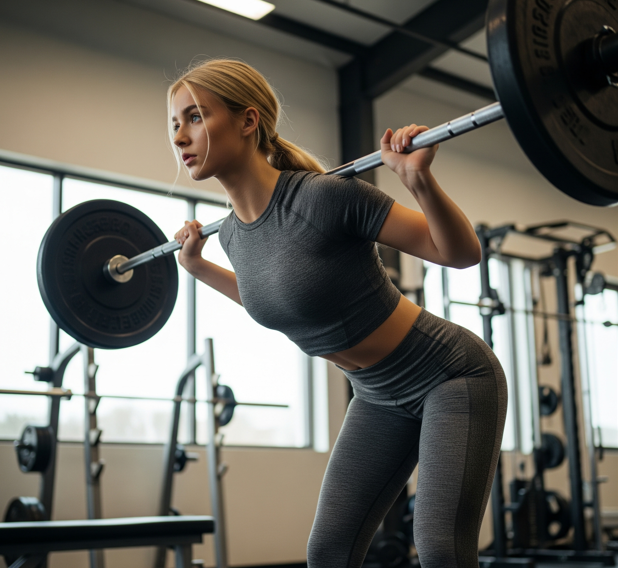
Stand feet shoulder-width, hands behind head or crossed on chest
Push hips back like closing a car door with your butt 🚗
Keep back flat until you feel hamstrings stretch (45° max for beginners).
Squeeze glutes to return upright (think “proud chest” posture).
Do 3 sets of 8-12 reps with control.
Muscles Worked | Difficulty Level |
Hamstrings, Glutes, Lower Back, Core | Intermediate to Advanced |
✅ Knees Soft – Avoid locking them like a stiff robot leg 🤖
✅ Neutral Spine – No hunching like a question mark ❓
✅ Slow Tempo – No “bouncing” like a pogo stick 🏀
✅ Engaged Core – Brace like expecting a gentle gut punch 🥊
✅ Pain-Free – Sharp pain = STOP (only tension should be felt).
Common mistakes:
🚫 Rounding the back like a scared cat.
🏋️♂️ overloading weight too soon, and
👀 staring at feet (keep a gaze forward!).
Good Mornings are a posterior chain powerhouse. They work multiple muscle groups simultaneously.
Primary Movers:
Hamstrings: The main drivers of the hip hinge. They control the descent and power the ascent, while also benefiting from the deep hamstring stretch at the bottom of the movement..
Glutes (Maximus): EExtend the hips as you rise. Squeeze hard at the top, which follows the deep glute stretch experienced during the descent phase.
Erector Spinae (Lower Back): Isometrically holds the spine stable throughout the movement.
Synergists & Stabilizers:
Adductors (Inner Thighs): Help stabilize the hip joint.
Core (Abs & Obliques): The Abs and Core brace tightly to prevent spinal flexion and protect the lower back throughout the movement.
Trapezius & Rhomboids: Hold the barbell (or load) in place on the upper back.
Good Mornings are versatile but require foundational strength and mobility.
Strength Athletes (Powerlifters, Weightlifters): Essential for strengthening the deadlift and squat lockout. Builds monstrous posterior chain power.
Runners & Sprinters: Strengthens hamstrings to prevent pulls and improve running mechanics. More resilient legs mean faster times.
Rehab Patients (with guidance): Under professional supervision, light Good Mornings can retrain the hip hinge pattern and strengthen the lower back after injury.
General Fitness Enthusiasts: Anyone wanting stronger glutes, better posture, and injury-proof legs should learn this movement.
Contraindications: Those with acute disc injuries, severe osteoporosis, or uncontrolled blood pressure should avoid until cleared by a professional.
Only if done poorly. With proper form, neutral spine, braced core, and controlled movement, Good Mornings actually strengthen the lower back and prevent injury. They teach the hip hinge better than any standing toe touch stretch ever could.
A seated hamstring stretch is passive flexibility work. Good Mornings are active strength training. They load the hamstrings and spinal erectors through a full range of motion, building resilience while stretching dynamically.
Yes, but start with bodyweight only. Master the hip hinge pattern first. Think of it like learning a hurdler hamstring stretch you wouldn’t force depth without flexibility. Same here: master form before adding weight.
1-2 times per week is plenty. They’re demanding on the central nervous system and posterior chain. Treat them like a main lift, not an accessory. Recovery is key for legs and lower back health.
Either your back is rounding, or your hamstrings are tight. If they lack flexibility, your back compensates. Add a standing toe-touch stretch to your warm-up to loosen your hamstrings first.
Stand facing away from a wall, about 6 inches away. Push your hips back to touch the wall without bending your spine. That’s a hip hinge. If you can’t reach the wall without rounding your back, you’re not ready for weighted Good Mornings. Practice this daily, and pair it with a seated hamstring stretch to loosen those tight legs. Your lower back will stay safe, and your workout gains will skyrocket.