
Indoor Cycling
Unlock Tight Hips & Hamstrings After Every Virtual Ride
After crushing that intense hill climb or HIIT interval on your stationary bike, your hip flexors and lower back are screaming for mercy. This 5-minute stretch targets the “cyclist’s crouch,” releasing built-up tension to restore flexibility and prevent that stiff, “waddling” feeling when you dismount.
🌟 Key Features (Physical & Mental Benefits)
🦵 Unlocks Tight Hip Flexors – Counteracts the constant knee drive, reducing lower back pain (like unkinking a garden hose).
⚡ Boosts Recovery Speed – Flushes out lactic acid so you’re less sore for tomorrow’s sprint session.
🚴 Improves Pedal Efficiency – Greater hamstring flexibility means a smoother, more powerful pedal stroke.
🧠 Calms the Fight-or-Flight Mode – Transitions your nervous system from “HIIT mode” to rest mode, lowering cortisol.
🦵 Protects Your Knees – Relieves tension in the quads and IT band, preventing that “grinding” sensation post-ride.
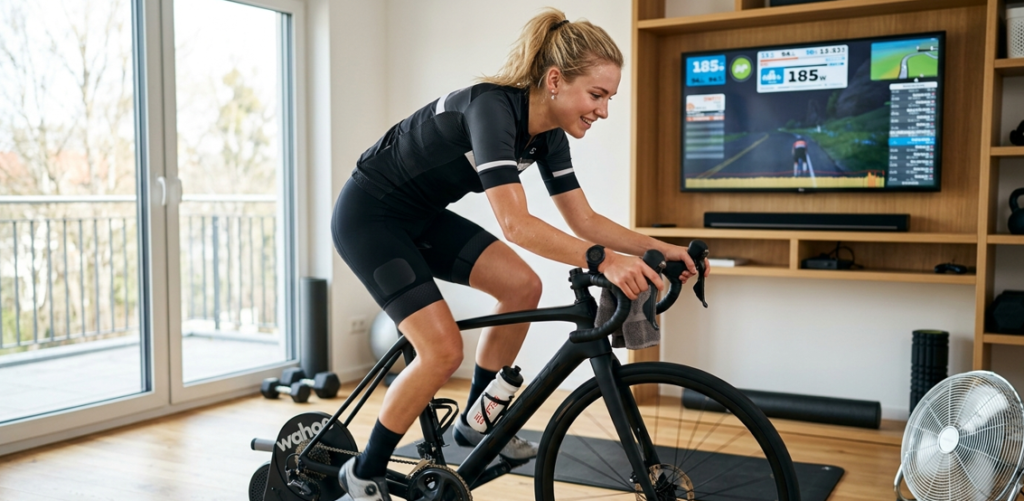
Indoor Bicycle Workout
🔑 Key Benefits
🧠 Mental Reset
Lowers heart rate and anxiety after adrenaline-heavy indoor cycling workouts.
Stretching activates the vagus nerve, telling your body “the danger is over.”
Analogy: Like closing 50 browser tabs after a chaotic workday – instant calm.
🦵 Longer Stride
Improved flexibility in hamstrings helps with walking, running, and climbing stairs.
Cycling shortens these muscles; stretching restores their natural length.
Result: No more waddling to the locker room like a cowboy.
🧘 Better Sleep
Stretching activates the parasympathetic nervous system (“rest and digest” mode).
Lowers core temperature and heart rate after evening cycling cardio workouts.
Result: Fall asleep faster and wake up less stiff.
🚲 Reduced Risk of Overuse Injuries
Keeps IT band, patella (kneecap), and psoas (deep hip flexor) happy.
Prevents common cyclist issues: knee pain, lower back strain, tight hips.
Analogy: A stretched muscle is like a well-oiled chain – no grinding, no breaking.
💪 Stronger Core Engagement
A flexible spine allows better posture on the bike.
When hips aren’t tight, you can maintain a flat back and engaged core through every pedal stroke.
Result: Less lower back ache during climbs and sprints.
❤️ Better Cycling Cardio Workout Results
Muscles that recover faster allow you to train harder tomorrow.
Stretching improves blood flow, flushing out lactic acid from HIIT cycling workouts.
Result: More high-quality sessions per week, less forced rest days.
🧘♀️ Less “Waddle” After Dismounting
You’ll walk normally instead of like a cowboy who just rode 50 miles.
Tight hip flexors cause that side-to-side shuffle; stretching releases them immediately.
Real-life win: Walk to the water fountain with dignity. Climb stairs without groaning.
👥 WHO SHOULD DO THIS? 🚴
🚴♂️ Indoor Cyclists
Every indoor cyclist – from beginners to advanced riders, regardless of bike type or brand.
Whether you ride a Peloton, Schwinn, or any stationary bike, your hips are in a fixed flexed position.
🎯 Spin Class Attendees
Especially those who skip the cool-down portion of class to rush to the shower.
High-energy classes with constant position changes still tighten the hip flexors significantly.
💺 Office Workers & Desk Professionals
People who sit for 8+ hours daily already have shortened hip flexors before even touching a bike.
Indoor cycling adds another 30-60 minutes of sitting-like motion to an already sitting-heavy day.
🏃♀️ Runners & Cross-Trainers
Those using cycling as aerobic cross-training need post-ride hip care to protect their running form.
Tight hips from cycling can shorten your running stride and cause lower back pain on the road.
🩹 Injury Recovery Individuals
People recovering from knee or lower back strain should stretch only after medical approval.
Gentle stretching improves blood flow to healing tissues without stressing injured areas.
👴👵 Adults Over 40
Maintaining hip flexibility prevents falls and keeps joints mobile as you age.
Natural flexibility decreases with age – consistent stretching slows this process significantly.
🔥 HIIT Cycling Workout Enthusiasts
High-intensity efforts create the most muscle tightness due to repeated explosive movements.
Sprinting and climbing intervals leave lactic acid and micro-tension deep in the hip muscles.
🦵 Cyclists with Lower Back Pain
Tight hips often pull on the lumbar spine after riding, causing dull or sharp back pain.
Releasing the psoas (deep hip flexor) can instantly reduce lower back tension.
🦆 The “Post-Ride Waddlers”
That side-to-side shuffle means your hips are screaming for flexibility work.
Waddling happens when tight hip flexors won’t let your legs extend fully behind you.
🧘♀️ Posture-Conscious Riders
Anyone who wants better alignment on and off the bike will benefit from hip flexibility.
A flexible pelvis allows your spine to stack naturally, reducing neck and shoulder strain.
📝 Step-by-Step Instructions
Perform these immediately after unclipping, while your muscles are still warm.
1. Standing Quadruple Stretch (The Flamingo) 🦩
Stand next to a wall. Grab your right ankle with right hand.
Pull heel toward glutes. Keep both knees touching.
Hold for 30 seconds. Switch legs.
More points:
Squeeze standing glute to avoid arching lower back.
If you feel knee pinching, ease off immediately.
Keep chest lifted – don’t lean forward.
Pull straight back, not sideways.
Beginner: Hold wall with both hands. Advanced: Reach opposite arm overhead.
2. Seated Forward Fold (The Handlebar Hang) 🚴
Sit with legs extended. Hinge at hips, reach toward toes.
Keep back flat – chest toward thighs, not nose to knees.
Hold for 45 seconds. Exhale as you deepen.
More points:
Don’t bounce. Move slowly.
Grab shins or ankles if you can’t reach toes.
Press thighs firmly into the floor.
If lower back rounds, bend knees more.
Beginner: Bend knees or use towel around feet. Advanced: Grab balls of feet and pull gently.
3. Lizard Lunge (The Spiderman Crawl) 🦎
From plank, step right foot outside right hand.
Lower left knee to floor. Sink hips forward.
Hold for 30 seconds. Repeat on other side.
More points:
Place towel under back knee if sensitive.
Breathe into front of left hip where cyclists get tightest.
Keep front knee aligned with second toe (no collapsing inward).
Engage core to protect lower back.
Beginner: Keep back knee lifted (hovering). Advanced: Drop onto forearms.
4. Supine Glute Stretch (The Figure-Four)
Lie on back, knees bent. Cross right ankle over left knee.
Grab back of left thigh. Pull toward chest.
Hold for 30 seconds per side. Switch legs.
More points:
Keep head and shoulders flat on floor.
Don’t pull on knee joint – hold thigh or shin.
Rest ankle above knee, not on kneecap.
Press lower back gently into floor.
Pro tip: Gently push bent knee away for extra leverage.
Beginner: Keep bottom foot flat on floor. Advanced: Thread arm through figure-four.
📊 Quick Reference Table
| Stretch Name | Muscle Groups Worked | Difficulty Level |
|---|---|---|
| Standing Quadruple Stretch (The Flamingo) | Quadriceps, Hip Flexors | 🌟 Easy-Medium |
| Seated Forward Fold (The Handlebar Hang) | Hamstrings, Lower Back, Calves | 🌟 Medium |
| Lizard Lunge (The Spiderman Crawl) | Hip Flexors (Psoas), Glutes, Groin | 🌟 Medium-Hard |
| Supine Glute Stretch (The Figure-Four) | Gluteus Maximus, Piriformis, Outer Hip | 🌟 Easy-Medium |
🧠 Safety Tricks & Common Mistakes
✅ Safety Tricks (Do This)
🔹 Warm muscles only – Do 2 minutes of easy pedaling first. Cold muscles tear instead of stretch.
🔹 Use a yoga mat or towel – Prevents slipping on sweat and cushions your knees and spine.
🔹 Breathe slowly – Exhale as you deepen each stretch. Holding your breath locks tension into the muscle.
🔹 Listen to asymmetry – If one side is tighter (e.g., left hip), give it 10 extra seconds to balance out.
🔹 Use props when needed – A towel, strap, or block helps maintain proper form without straining.
🔹 Stay hydrated – Dehydrated muscles cramp more easily during stretching.
🔹 Stretch in a clear area – Remove shoes, weights, or clutter to avoid tripping.
❌ Common Mistakes (Avoid This)
🔸 Bouncing – Ballistic stretching causes micro-tears. Hold each position static and still.
🔸 Rounding the lower back – In forward folds, keep a flat back. Imagine a rod along your spine.
🔸 Holding breath or clenching jaw – Signals “danger” to your nervous system, making muscles tighter.
🔸 Racing through reps – 10 seconds per stretch does almost nothing. Commit to 30-45 seconds.
🔸 Overstretching to sharp pain – A “comfortable tug” is good. Sharp pain = stop immediately.
🔸 Forgetting to stretch both sides equally – Uneven stretching creates muscle imbalances over time.
🔸 Stretching on a hard floor – Concrete or tile offers no cushion. Always use a mat or thick towel.
FAQ's
Can I combine indoor cycling with dance workouts on the same day? 🩰
Absolutely. Many people do a morning dance workout for cardio and coordination, then an evening indoor cycling session for endurance. However, your hips will need extra stretching. Use this routine after both activities your dance workouts warms you up, and cycling cools you down. Just add 2 extra minutes of hip openers.
Is indoor cycling better than kickboxing for weight loss? ⚖️
Both are excellent. Kickboxing burns more calories per minute (up to 750/hour) due to full-body explosive movements, while indoor cycling (500-700/hour) is lower impact on joints. For best results, alternate days kickboxing on Monday/Wednesday, cycling on Tuesday/Thursday, and a water aerobics session on Friday for active recovery.
How soon after indoor cycling should I stretch?
Immediately after dismounting, while your muscles are still warm. The first 5-10 minutes post-ride is the optimal window for improving flexibility. Waiting until your muscles cool down makes stretching less effective and more uncomfortable.
Can I do this routine every day?
Yes. In fact, daily stretching is ideal for indoor cyclists who ride 4-6 times per week. Even on rest days, a light version of this routine maintains your flexibility gains.
Why do my lower back hurts after indoor cycling?
Tight hip flexors often pull on your lumbar spine. When your psoas (deep hip flexor) is tight, it tilts your pelvis forward, arching your lower back. This routine directly releases those tight hip flexors.
Quick Tip:
Recovery and wellness feel lighter with company. Invite a friend to download the same app. Share your streaks. Send encouragement. Use community features like Finch’s “Tree Town” or I Am Sober’s milestone forums. Accountability doubles your chances of sticking with it. You heal faster when you are not healing alone.