
Water Aerobics
🏊♀️ Unlock Your Flexibility with Water Aerobics
Imagine stretching your body while feeling weightless like a floating dancer or a leaf drifting on a calm lake. This water aerobics stretch targets your core, shoulders, hip flexors, and lower back, using the natural resistance and buoyancy of water to deepen your stretch without pain. Whether you’re doing water aerobic exercises for rehab after an injury or high-energy pool aerobic workouts for fat loss, this move builds flexibility safely and effectively. It also works beautifully as part of your warm ups before more intense pool activities, preparing your muscles for movement without shock or strain.
What is water aerobics?
It’s not just “swimming without swimming.” It’s a deliberate, controlled form of fitness water aerobics that uses water’s unique properties (resistance, buoyancy, hydrostatic pressure) to build strength, cardio, and flexibility simultaneously. And the best part? No swimming skills required!
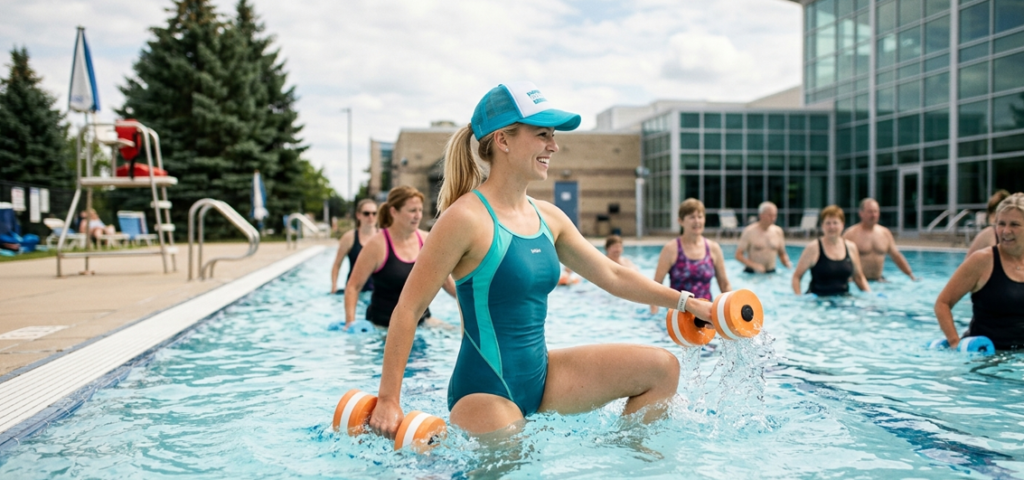
Water Aerobic Exercises
🌟 Key Benefits of This Water Aerobics Stretch
💪 Reduces joint strain – Water supports 90% of your body weight, making water aerobics fitness accessible for arthritis, back pain, or injury recovery.
🧠 Boosts mental flow – The rhythmic pressure of water lowers cortisol by up to 25%, leaving you calm yet focused.
🔥 Burns more calories than you think – Did you know calories burned water aerobics can equal brisk walking (400–500 calories/hour)? This stretch activates large muscle groups to increase metabolic burn.
🤸♀️ Improves functional flexibility – Better range of motion for daily tasks like bending to tie shoes, reaching high shelves, or playing with kids/grandkids.
😴 Enhances sleep quality – Gentle pool workouts reduce muscle tension and trigger parasympathetic nervous system activity, helping you fall asleep faster.
💓 Lowers resting heart rate – Regular water aerobics activities train your cardiovascular system to work more efficiently.
🧘 Teaches body awareness – You’ll feel muscles you forgot existed (hello, deep obliques!).
👶 Safe for all ages – From kids to 90-year-olds, water aerobic exercises adapt to every body.
⏱️ When to Perform “The Floating Reach” (Water Aerobics Stretch)
🟢 Best Times to Do This Stretch
| Time | Why It Works | Duration |
|---|---|---|
| As a warm-up (first 5 minutes in water) | Cold muscles are stiff. Water buoyancy protects them while you gently wake up your obliques and shoulders. | 2–3 minutes |
| Mid-workout (between cardio sets) | Resets your posture after water jogging or leg swings. Prevents muscle tightening during rest periods. | 1–2 minutes |
| As a cool-down (last 5 minutes before exiting) | Flushes lactic acid. Your muscles are warm and pliable flexibility gains happen fastest here. | 3–4 minutes |
| On rest days (gentle pool session only) | Active recovery. No intensity, just movement. Keeps blood flowing without fatigue. | 5 minutes max |
📋 Step-by-Step Instructions: “The Floating Reach” (Detailed Version)
This is the signature water aerobics stretch for building flexibility safely. Do it in chest-deep water (water level between your collarbone and armpits).
🟢 Before You Begin (Setup – 30 seconds)
Find your depth – Stand where the water reaches just below your shoulders. If you have to tiptoe, you’re too deep.
Feet position – Place feet hip-width apart. Imagine you’re standing on two bathroom scales trying to balance the weight evenly.
Core engagement – Gently pull your belly button toward your spine. Not a hard suck-in, just a light “zipper up” feeling.
Three test breaths – Inhale deeply through your nose, exhale through your mouth. If you feel relaxed, you’re ready.
🧠 Why this matters: Water hides poor posture. If you start slouched, the stretch hits your lower back instead of your obliques.
🔵 The 5-Step Movement (Detailed)
Step 1: Inhale & Lift 🌊
Action: Raise both arms straight overhead, palms facing forward. Keep your biceps next to your ears.
Detail: Imagine you’re pushing two inflatable beach balls up from the bottom of the pool. Feel the water resistance against your forearms.
Breathing: Inhale slowly for 3 seconds as your arms rise.
Common mistake: Letting your ribs flare forward. Keep your lower ribs knitted together.
Step 2: Exhale & Side Bend Right 🌿
Action: Keeping hips facing forward, slowly lean your upper body to the right. Your right arm stays overhead, left arm follows slightly.
Detail: Picture a pool noodle floating on the water to your right. You’re trying to reach over it without moving your hips. Your left ribs should feel a gentle opening.
Breathing: Exhale completely through your mouth for 4–5 seconds as you lean. Imagine fogging up a mirror.
Range of motion: Only lean 15–20 degrees (about the angle of a gently tilted phone screen). Water will naturally limit you.
Step 3: Hold & Feel 🧘
Action: Stay in the side bend position.
What you should feel: A mild, pleasant pull along your left side from your hip bone up to your armpit. If you feel sharp pain or pinching in your lower back, you’ve leaned too far.
Duration: Hold for 2 full breath cycles (inhale + exhale = 1 cycle). That’s about 8–10 seconds total.
Pro tip: Imagine your left side is a wet sponge being gently wrung out. Let go of tension with each exhale.
Step 4: Inhale Back to Center ⬆️
Action: Slowly straighten your spine, bringing your torso upright. Arms stay overhead.
Detail: Move at half the speed you think you need. Water will push you if you rush. Think “melting back up” rather than “snapping up.”
Breathing: Inhale for 3–4 seconds as you rise.
Check-in: Are your shoulders still relaxed? Many people unconsciously hunch here. Let your shoulder blades slide down your back.
Step 5: Repeat on Left Side 🔄
Action: Exhale and lean left, following the same pattern.
Detail: Most people are tighter on one side (usually the side you sleep on or carry a bag on). Don’t force the tighter side to match the looser side. Let it be its own stretch.
Breathing: Same rhythm exhale on the lean, inhale back to center.
Repeat the full sequence (right + left) 5–6 times. That’s one set.
📊 Quick Reference Table
| Muscle Groups Worked | Difficulty |
|---|---|
| Obliques, shoulders, hip flexors, deep core | 🌟 Beginner–Intermediate |
⚠️ Safety Tricks & Common Mistakes (Expanded)
🛡️ 4 Safety Tricks (Do These Every Time)
🏊 Always enter slowly – Sit on pool edge, lower yourself in step by step. Sudden cold water can spike blood pressure.
📏 Stay in shallow end – Feet should touch bottom until you master pool workouts breathing rhythm and balance.
👂 Watch for slippery deck – Use aqua socks or non-slip sandals. Tile pools are deceptively slick when wet.
💧 Hydrate anyway – You sweat in water! Drink 16 oz of water 30 minutes before and after your water aerobics workout.
🧴 Use waterproof sunscreen – If outdoors, UV rays reflect off water surface and hit you twice. SPF 50 minimum.
👂 Protect your ears – If prone to infections, use silicone earplugs or dry ears thoroughly after.
❌ 5 Common Mistakes (Don’t Do These)
🦶 Locking knees – Reduces blood flow, increases injury risk, and makes flexibility gains impossible. Keep a soft, microbent knee (like you’re about to sit in a chair).
🌬️ Holding breath – Leads to dizziness, lightheadedness, and even fainting in water. Exhale fully during the stretch phase. Sing underwater if you forget!
🚫 Bouncing in the stretch – Water amplifies momentum. Bouncing = micro-tears in cold muscles. Use slow, static holds only.
👚 Wearing cotton – Cotton becomes heavy, cold, and droopy when wet. Use chlorine-resistant swimwear or synthetic athletic fabric.
🦻 Overreaching with poor posture – If you collapse your ribs or round your back, the stretch moves from obliques to spine ligaments. Keep chest open like a proud penguin.
⏩ Rushing the movement – Water’s resistance is your friend. Count “one-one-thousand, two-one-thousand” for each phase.
👥 Who Should Do This?
✅ Seniors with joint pain
✅ Pregnant women (2nd/3rd trimester – ask doctor)
✅ Runners needing low-impact cross-training
✅ Office workers with tight hips
✅ Anyone recovering from injury
✅ People who hate sweating
✅ Absolute fitness beginners
🗓️Weekly Water Aerobics Quick Plan
| Day | Activity | Time |
|---|---|---|
| Mon | Floating Reach + water walking | 20 min |
| Wed | Same + leg swings | 20 min |
| Fri | Full routine | 25 min |
| Sun | Gentle stretching only | 10 min |
FAQ's
Q1: How often should I do water aerobics classes to see results?
A: 3–4 times per week for 4 weeks. You’ll notice better flexibility after just 4 sessions.
Q2: Can I lose belly fat with water aerobics exercises?
A: Yes! While spot reduction is a myth, full-body pool workouts burn overall fat. Combine with a slight calorie deficit for best results.
Q3: Is water aerobics safe for bad knees?
A: Absolutely. Many orthopedic surgeons specifically prescribe best swimming pool workouts for knee osteoarthritis. The water supports your weight while the resistance strengthens surrounding muscles.
Q4: How many calories burned water aerobics compared to running?
A: Running burns ~100 calories/mile. Vigorous water aerobics fitness burns ~400–500 calories/hour. Moderate water walking burns ~250–300/hour.
Q5: Do I need to know how to swim?
A: No. All moves here are done in chest-deep water where your feet touch the bottom. Water aerobics activities are designed for non-swimmers.
Quick Tip:
To maximize resistance without straining your joints, slightly cup your hands into small paddles as you move through the water. This increases surface area, making every push and pull more effective. Also, focus on maintaining a tall, braced core never slouch to keep your spine neutral and engage your abs throughout the entire routine