

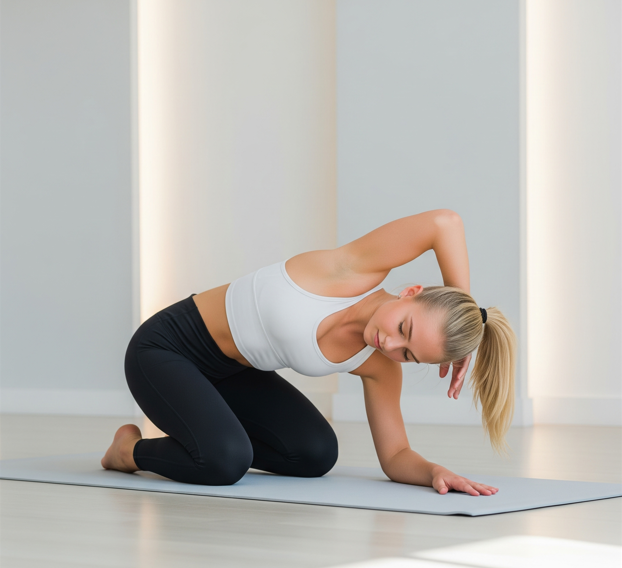
The Thread the Needle Stretch is a dynamic movement that targets your upper back (thoracic spine), shoulders, and lats, while significantly improving rotational flexibility. 🌀 Imagine your spine like a corkscrew this stretch helps unwind tightness while enhancing mobility for daily movements and workouts alike!
This movement is especially helpful for people who spend long hours sitting or working at a desk, as it gently restores natural rotation in the upper spine. By encouraging controlled twisting and deep breathing, it helps release tension, improve posture, and support healthier shoulder mechanics.
Regular practice can enhance overall mobility, reduce stiffness, and make everyday movements feel smoother and more comfortable. It also prepares the upper body for activities that involve reaching, twisting, or lifting, making it a valuable addition to both warm-ups and recovery routines.
Key Benefits of the Thread the Needle Stretch
1. Improves Thoracic Spine Mobility
The thread the needle stretch enhances rotational flexibility in the upper and mid-back, helping the spine move more naturally during daily activities and workouts.
2. Relieves Upper-Back and Shoulder Tension
This stretch gently releases stiffness in the shoulders, neck, and upper back, making it ideal for people who sit for long hours or experience postural strain.
3. Stretches the Latissimus Dorsi and Posterior Shoulders
The threading needle stretch targets the lats, rear deltoids, and upper-back muscles, improving overall flexibility and reducing tightness.
4. Supports Better Posture
By increasing thoracic mobility, the thread the needle stretch helps reduce rounded shoulders and promotes a more upright, aligned posture.
5. Enhances Functional Movement and Athletic Performance
Improved rotational range of motion benefits activities like lifting, reaching, swinging, and twisting, making this stretch useful for both athletes and everyday movement.
The thread the needle stretch targets several important upper-body muscles while improving thoracic spine mobility.
Thoracic spine muscles – Promotes rotation and flexibility in the upper and mid-back.
Latissimus dorsi (lats) – Stretches the large back muscles along the sides of the torso.
Posterior deltoids – Releases tension in the back of the shoulders.
Rhomboids – Helps loosen the muscles between the shoulder blades.
Trapezius – Reduces stiffness in the upper back and neck region.
This stretch is suitable for most people and is especially helpful for those with upper-body stiffness.
Office workers who sit for long hours
Athletes needing better rotational mobility
People with mild upper-back or shoulder tightness
Yoga and mobility practitioners
Anyone building a daily stretching routine
Knees under hips, hands under shoulders.
Inhale as you lift your right arm toward the ceiling, opening your chest.
Exhale, rotate your torso, and slide your right arm under your left armpit (palm up).
Hold for 15-30 seconds, breathing deeply into the stretch.
Repeat on the left.
Holding the stretch for the proper duration ensures safe and effective results.
Beginners: 15-20 seconds per side
Intermediate: 20-30 seconds per side
Advanced: 30-45 seconds per side
Repeat 2-3 rounds per side, focusing on slow, controlled breathing to enhance relaxation and mobility.
Muscles Worked | Difficulty Level |
Thoracic Spine (mid-back) | Beginner-Friendly |
Rotator Cuff & Shoulders | Improves Flexibility |
Latissimus Dorsi (lats) | Adjustable Intensity |
Intercostals (ribs) | Enhances Breathing |
✔ Move Slowly – Control = better flexibility gains (no jerking!).
✔ Engage Your Core – Protects your lower back during rotation.
✔ Breathe Into Tight Spots – Exhale as you deepen the stretch.
✔ Use a Yoga Block – Place under your supporting hand if needed.
✖ Collapsing Your Chest – Keep your upper back active, not rounded.
✖ Forcing the Rotation – Let your flexibility guide you, not momentum.
✖ Holding Your Breath – Oxygen helps muscles relax deeper.
✖ Rushing – Slow, mindful movements yield better results.
The Thread the Needle Stretch is more than a simple upper-body movement. It combines spinal rotation, shoulder mobility, and controlled breathing to improve both flexibility and muscle coordination. Because it targets the thoracic spine — an area that often becomes stiff from prolonged sitting — this stretch helps restore natural movement patterns. When performed slowly and mindfully, it supports posture, circulation, and nervous system relaxation without placing excessive strain on the joints.
Improves Thoracic Rotation – Encourages mobility in the mid-back, which is essential for twisting and reaching movements.
Enhances Shoulder Stability – Supports healthy scapular movement and reduces stiffness around the shoulder blades.
Promotes Better Postural Alignment – Helps counteract rounded shoulders caused by desk work or screen time.
Encourages Mindful Breathing – Deep breathing during the stretch relaxes tight muscles and improves oxygen flow.
Boosts Circulation to Upper Back Muscles – Controlled movement increases blood flow and reduces tension buildup.
Supports Long-Term Joint Health – Regular practice helps maintain mobility and reduces the risk of stiffness over time.
Practicing this stretch consistently can improve upper-body control, reduce discomfort, and support smoother movement in daily activities and workouts.
This stretch mainly targets the thoracic spine, shoulders, and latissimus dorsi, while also engaging the rhomboids and trapezius. To further improve upper-back mobility, you can combine it with the upper back cat cow stretch.
Yes, it helps improve thoracic rotation and reduces stiffness caused by prolonged sitting. Over time, it can support better posture and shoulder alignment. It works well alongside the upper back trunk rotation exercise.
You can perform this stretch daily, especially if you experience upper-back or shoulder tightness. For a more complete routine, combine it with the child’s pose stretch for added relaxation and flexibility.
Yes, the movement is gentle and beginner-friendly. Just avoid forcing the rotation and focus on slow, controlled breathing. You can start with simpler movements like the seated spinal twist before progressing.
It works well as a warm-up, cool-down, or quick mobility break during the day. Many people perform it after long sitting periods, along with the chair stretch for upper back to relieve stiffness.
This stretch is a game-changer for flexibility and mobility especially if you feel “stuck” in your upper back! Add it to your warm-ups or cooldowns to move and breathe more freely.