

Bird Dog Exercise
Boost Balance and Core Stability
The Bird Dog stretch is a low-impact, high-reward movement that targets your core, back, and glutes while dramatically improving balance, posture, and spinal stability. In simple terms, it’s like your body’s built-in anti-wobble training just as a tightrope walker uses precise counterbalancing to stay upright, this exercise teaches your muscles to work in perfect harmony. Whether you’re an athlete looking to enhance performance, an office worker combating back stiffness, or someone seeking better functional flexibility, this move delivers serious benefits without straining your joints. It’s the ultimate “do-anywhere” exercise that builds strength where you need it most!
The Bird Dog exercise earns its playful name from the position it mimics – a hunting dog pointing toward its prey, with one leg lifted and one arm extended. But beneath this simple image lies one of the most effective and fundamental exercises for core stability, back health, and whole-body coordination.
For a complete approach to core development, understanding how this exercise complements foundational movements like pelvic tilts can help you build a balanced routine that addresses both stability and mobility.
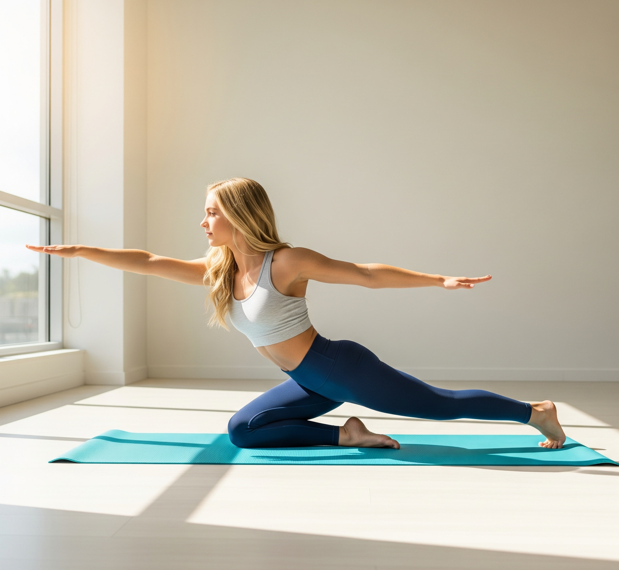
Bird Dog Stretch
✨ Key Benefits of Bird Dog Stretch
✅ Builds Rock-Solid Core Strength – Engages deep abdominal muscles for better stability.
✅ Improves Spinal Flexibility & Alignment – Encourages controlled, fluid movement.
✅ Enhances Balance & Coordination – Trains your body to work in harmony (like a dancer’s grace!).
✅ Reduces Lower Back Pain – Strengthens support muscles to prevent strain.
✅ Boosts Mind-Body Awareness – Requires focus, making it a moving meditation.
✅ Develops Glute Strength – Activates the often-underused gluteus maximus and medius, essential for hip stability and power
✅ Improves Shoulder Stability – Strengthens the rotator cuff and supporting muscles around the shoulder girdle
✅ Enhances Postural Endurance – Trains muscles to maintain good posture for longer periods, not just in the moment
✅ Prevents Falls in Older Adults – Builds the balance and coordination needed to recover from stumbles and maintain independence
✅ Cross-Trains the Brain – Challenges the nervous system to coordinate opposite limb movements, improving neural pathways
⏱️ When to Perform This Exercise
| Time | Benefit | Best Practice |
|---|---|---|
| Morning | Activates core and glutes for the day ahead | Gentle, controlled reps as part of wake-up routine |
| Pre-Workout | Wakes up stabilizers before loading | 8-10 reps per side as part of warm-up |
| Midday Break | Counters desk posture, reactivates glutes | Quick 2-minute reset |
| Post-Workout | Reinforces stability after main lifts | Slower, hold-focused reps |
| Evening | Gentle core activation without overstimulation | Combine with deep breathing |
For a complete morning routine, combine this exercise with ten morning stretches that awaken your entire body.
How To Perform The Bird Dog Stretch
1️⃣ Starting Position (Tabletop)
- Kneel on all fours, hands under shoulders, knees under hips.
- Keep your spine neutral (imagine balancing a book on your back).
2️⃣Engage Your Core
Gently draw belly button toward spine (like zipping up a snug jacket).
3️⃣Extend Arm & Leg
- Slowly reach right arm forward and left leg back, keeping both parallel to the floor.
- Avoid arching your back – maintain a straight line from fingertips to toes.
4️⃣ Hold & Return
- Pause for 2-3 seconds (like a statue!), then smoothly return to start.
- Repeat on the opposite side.
🔥 Modifications:
- Beginner: Tap hand/knee to floor between reps for stability.
- Advanced: Add ankle weights or pulse extended limbs slightly.
📊 Recommended Hold Times Quick Reference
| Your Goal | Hold Duration | Reps Per Side | Focus |
|---|---|---|---|
| Foundational control | 2-3 seconds | 6-8 | Form perfection |
| General strength | 3-5 seconds | 8-10 | Muscle activation |
| Muscular endurance | 5-10 seconds | 6-8 | Sustained engagement |
| Advanced stability | 10-15 seconds | 4-6 | Challenge limits |
| Rehabilitation | Breath-based | 6-8 | Mind-body connection |
📊 Quick Reference Table
Muscles Worked | Difficulty Level |
Core, Glutes, Back, Shoulders | Beginner to Advanced |
⚠️Safety Tricks
🔹 Move Like Molasses – Slow, controlled motions prevent injury.
🔹 Keep Hips Square – Avoid twisting; pretend you’re balancing a tray.
🔹 Neck Neutral – Gaze slightly ahead, don’t crane your neck up.
🔹 Wrist Comfort – If your wrists feel strained, make fists and support yourself on your knuckles, or use dumbbells to hold onto for a neutral wrist position
🔹 Knee Padding – If your knees feel pressure on hard floors, place a folded towel or use a thicker mat for cushioning
🔹 Avoid Breath Holding – Exhale during the extension, inhale during the return. Steady breathing fuels your muscles and maintains core engagement
🔹 Stop If You Feel Sharp Pain – Muscle burn is fine; sharp, shooting, or joint pain means stop and reassess your form
❌ Common Mistakes:
🔸 Sagging Back – Keep core engaged to avoid “swayback”.
🔸 Rushed Movements – Quality > speed (it’s not a race!).
🔸 Holding Breath – Breathe steadily to power your muscles.
🔸 Lifting Too High – Raising your leg above hip height or arm above shoulder height compromises form and can strain your back. The line from fingertips to toes should be straight, not high
🔸 Twisting Through Hips – If your hips rotate open as you lift your leg, you’re losing the core stability challenge. Keep both hip bones facing the floor
🔸 Shifting Weight – Your supporting knee and hand should stay rooted in place. If you wobble or shift, reduce the range of motion until you can maintain stability
🔸 Looking Up – Craning your neck to look forward strains the cervical spine. Keep your gaze directed at the floor just ahead of your hands
FAQ
How many reps of Bird Dog should I do?
For beginners, aim for 8-10 controlled reps per side. As you get stronger, work up to 12-15 reps or 2-3 sets. Quality matters more than quantity – 5 perfect reps are better than 15 sloppy ones. For a complete core routine, combine with other exercises from our ab workouts guide.
Can I do Bird Dog every day?
Yes! It’s safe for daily practice because it’s a low-impact, bodyweight exercise. In fact, daily practice builds the neuromuscular coordination and muscular endurance that leads to lasting postural changes. Just listen to your body – if you’re sore, take a rest day.
Why is it called Bird Dog?
The name comes from the position mimicking a hunting dog pointing toward prey – one leg lifted, one arm extended, body stable and alert. It’s a perfect description of the final pose!
Should I feel Bird Dog in my lower back?
You should feel your lower back muscles working to maintain stability, but you shouldn’t feel pain. If you feel sharp lower back discomfort, you may be arching excessively or not engaging your core enough. Drop your leg slightly and focus on drawing your belly in.
How is this different from a Superman exercise?
Superman is performed lying on your stomach, lifting all four limbs simultaneously. Bird Dog is on all fours, lifting opposite limbs. Both are excellent; Bird Dog is generally safer for those with back issues because it’s easier to maintain neutral spine.
Quick Tip:
For extra flexibility benefits, gently arch and round your back between reps (cat-cow style) to keep your spine supple.