
Dance Aerobics
🕺The Ultimate Dance Workouts Stretch Routine
This dynamic stretch targets your hips, hamstrings, and lower back the power centers for every dance workouts move you make. Think of it as oiling your body’s joints before a high-energy aerobic dance session, so you glide like water instead of creaking like an old door.
✨ Key Features of This Stretch Routine
🦵 Hip-focused dynamics – Activates rotator muscles used for side steps, grapevines, and zumba dance workout turns.
🌊 Spinal wave motion – Preps your back for undulating moves in aerobics dance exercise (body rolls, isolations, and shimmies).
🩰 Ankle mobility drills – Essential for Water Aerobics (water resistance challenges ankles) and land-based pivots.
💨 Breath-synced movement – Trains you to exhale on effort, preventing the “gasping for air” look during Best Cardio Workout.
⚖️ Balance challenges – Single-leg ankle rolls improve stability for aerobic dance workout kicks without wobbling.
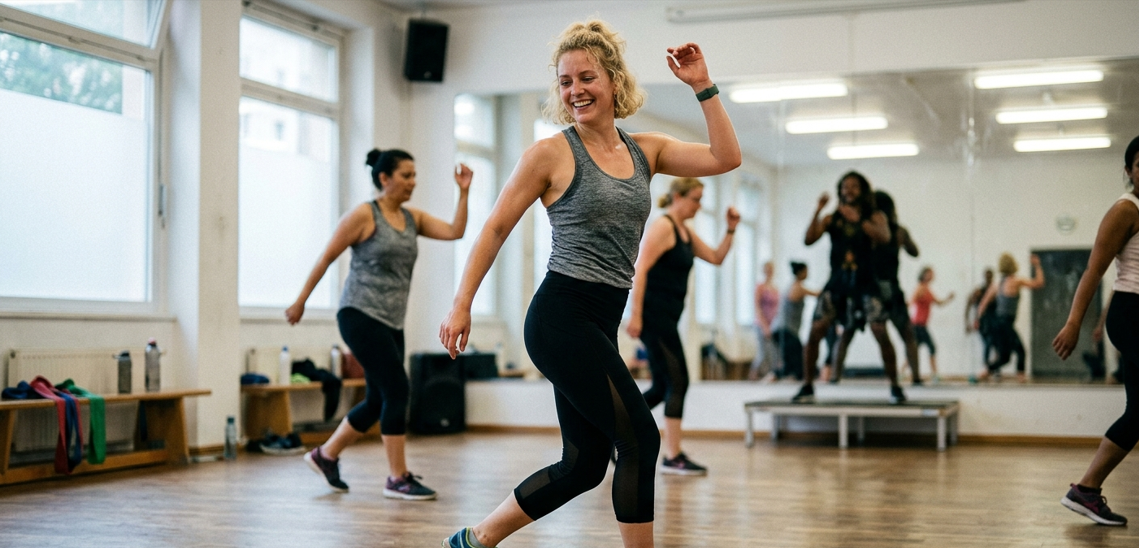
Zumba Dance Workout
✨ Key Features of This Stretch Routine
🦵 Hip-focused dynamics
Activates rotator muscles used for side steps, grapevines, and zumba dance workout turns.
More detail: Your hips have six deep rotator muscles that most stretches ignore. This routine specifically wakes them up by combining circles, lunges, and twists. Think of it as “unlocking” your hip socket so side steps feel effortless instead of clunky.
Why it matters: Prevents that “stuck in cement” feeling during fast lateral moves.
🌊 Spinal wave motion
Preps your back for undulating moves in aerobics exercise (body rolls, isolations, and shimmies).
More detail: A wave starts at your neck and travels down each vertebra like a ripple in a silk scarf. You’ll practice it standing, slowly at first, then linked to arm swings.
Why it matters: Most people have stiff upper backs from sitting. This restores segment-by-segment movement so body rolls look fluid, not jerky.
🩰 Ankle mobility drills
Essential for Water Aerobics (water resistance challenges ankles) and land-based pivots.
More detail: Water pushes against your feet from all directions, which can fatigue small ankle stabilizers quickly. These drills strengthen the full rangepoint, flex, circle inward, circle outward.
Why it matters: Strong ankles = no twisted ankles on wet pool decks or sticky studio floors. Also improves relevés and pivots in dance cardio.
💨 Breath-synced movement
Trains you to exhale on effort, preventing the “gasping for air” look during Best Cardio Workout.
More detail: You’ll learn a simple rule: exhale when you twist, lunge, or sweep down. Inhale when you return to center or rise up. Practice it 5 times and it becomes automatic.
Why it matters: Holding your breath spikes blood pressure and kills endurance. Breath-synced movement keeps oxygen flowing so you finish the song strong, not face-down on the mat.
⚖️ Balance challenges
Single-leg ankle rolls improve stability for aerobic dance workout kicks without wobbling.
More detail: While rolling one ankle, you’re balancing on the opposite leg. Start with eyes open, then try eyes closed or on a slightly bent standing leg.
Why it matters: Dance cardio involves lots of single-leg moves (kicks, knee lifts, side lunges). Better balance means cleaner form and fewer “oops, I almost fell” moments.
🧩 Beginner-to-advanced modifications
Same 5 moves work for aerobic dance workout for beginners at home AND experienced dancers.
More detail: Each exercise has two clear paths. Beginners get smaller ranges, planted feet, and optional wall support. Advanced dancers get pivots, pulses, and full spinal waves. You choose your level every day.
Why it matters: One routine grows with you. No need to learn new stretches as you improve just dial up the intensity.
🕒 Time-efficient
Entire routine takes only 5–7 minutes, perfect before any dance workouts session.
More detail: *That’s one or two songs on your playlist. Compare that to a 15-minute random stretch you might skip. Short enough to feel “I have time for this,” thorough enough to actually work.*
Why it matters: The best stretch routine is the one you actually do. 5 minutes removes every excuse.
💧 Land & water compatible
Same warm-up works before Water Aerobics (on the pool deck) AND aerobic dance (in a studio or living room).
More detail: No equipment adjustments needed. On land, you’ll feel gravity. On the pool deck, you’ll feel lighter but still get the same joint preparation. Just watch your footing on wet tiles.
Why it matters: Swapping routines between environments is confusing. This one stays consistent, so muscle memory builds faster.
🙋 Who Should Do This? (Find Your Dance Tribe)
This stretch routine is for anyone who loves to move to a beat whether you’re in a pool, a living room, or a studio. But let’s get specific. Below is your personal invitation.
🕺 Zumba & Aerobic Dance Lovers
The scenario: You’re 10 minutes into a fast-paced song with salsa steps, grapevines, and a surprise squat sequence. Suddenly your hip clicks. Or your lower back complains.
Why this stretch helps: Zumba and aerobic dance involve repetitive lateral (side-to-side) movements that hammer your hip rotators and obliques. This routine wakes up those exact muscles before the pounding starts.
What you’ll feel differently: Smoother turns, less hip stiffness the next day, and no more “ouch” when twisting to the left.
💧 Water Aerobics Enthusiasts
The scenario: You love the zero-impact feel of water, but after 20 minutes of kicking and arm circles, your ankles feel like jelly. Or stepping out onto the wet pool deck feels genuinely risky.
Why this stretch helps: Water creates resistance in every direction, which fatigues small stabilizing muscles (especially ankles and shins) faster than land. These stretches strengthen your ankle range-of-motion before you add water resistance.
What you’ll feel differently: Stronger kicks, less ankle fatigue mid-class, and confident footing when exiting the pool.
🏠 Beginners Doing Aerobic Dance Workout for Beginners at Home
The scenario: You found a “beginner dance workout” on YouTube. By minute 5, you’re lost, winded, and your hamstrings feel tight just from marching in place.
Why this stretch helps: Most beginners skip warm-ups because they don’t know what to do. These 5 moves are simple, repeatable, and take only 5 minutes. Think of them as “training wheels” for your body they teach your muscles the shapes they’ll make during the actual dance.
What you’ll feel differently: Less frustration, more confidence, and actually finishing a full video without pausing.
🔥 Best Cardio Workout Seekers
The scenario: You’re not a dancer. You’re a cardio person HIIT, step aerobics, maybe a Best Cardio Workout from an app. You want max calorie burn, minimum downtime.
Why this stretch helps: Cold muscles + explosive moves (jumps, lunges, high knees) = high injury risk. This routine raises your core temperature and lubricates joints in under 7 minutes. It’s not “extra work” it’s an efficiency tool.
What you’ll feel differently: You can push harder in the first 10 minutes because your body is already warm. Less “I need 5 minutes just to get going.
🧘 Desk Workers & Stiff Bodies
The scenario: You sit 8+ hours a day. Your hips feel “locked,” your lower back aches, and the idea of a zumba dance workout sounds fun but also terrifying because you can barely touch your shins.
Why this stretch helps: Sitting shortens your hip flexors and hamstrings. This routine slowly, gently stretches them in a dynamic (moving) way not aggressive static holds that might hurt. You don’t need existing flexibility to start. You just need to try.
What you’ll feel differently: After 1 week, standing up from your desk feels easier. After 2 weeks, you might actually look forward to dancing.
📝 Step-by-Step Instructions (with Modifications)
Perform these WARM UPS right before your aerobics dance workout. Total time: 5–7 minutes.
1. Torso Twist & Reach 🤸
Stand feet hip-width, arms out to sides like a T. Twist your upper body left, reaching right arm across your chest. Keep hips facing forward.
New detail: Imagine you’re looking over your shoulder to check who just walked in but only your ribs and head move, not your pelvis.
Beginner: Keep feet planted flat; small twist (10–20 degrees only).
Advanced: Add a slight knee bend and pivot on both toes, letting hips rotate slightly.
Feel it in: Obliques and mid-back.
2. Dynamic Hamstring Sweep 🦵
Step forward with right leg, keeping it as straight as comfortable. Hinge at hips (like a stiff-legged deadlift), sweep both hands toward the floor beside your foot, then slowly rise back up.
New detail: Keep a micro-bend in the standing back leg. Don’t force your hands to the floor aim for mid-shin if you’re tight. The stretch is in the back of your thigh, not your lower back.
Beginner: Bend the standing (back) knee more deeply; only lower hands to knees.
Advanced: Sweep hands past your foot, press them to the floor, then reach dramatically overhead at the top.
Feel it in: Hamstrings (back of upper thigh) and glutes.
3. Hip Circle & Lunge Combo 💃
Place hands on hips like a disco dancer. Make 5 big circles clockwise (imagine drawing a hula hoop with your pelvis), then step directly into a shallow forward lunge. Repeat counterclockwise, then lunge with the other leg forward.
New detail: Don’t rush the circles each one should take 2 seconds. The lunge should keep your front knee over your ankle, not past your toes.
Beginner: Make tiny circles (size of a dinner plate); skip the lunge and just step side to side.
Advanced: Make wide circles (size of a car steering wheel); add a pulse at the bottom of each lunge.
Feel it in: Hip joints, inner thighs, quads.
4. Ankle Rolls & Point Flex 🩰
Lift one foot a few inches off the floor. Roll ankle slowly 5x clockwise, then 5x counterclockwise. Then point your toes away (like a ballerina) and flex them back toward your shin. Repeat on other foot.
New detail: Imagine drawing tiny circles with your big toe. The slower you roll, the more you’ll feel the small stabilizing muscles wake up.
Beginner: Hold onto a wall or chair; keep the lifted knee bent at 90 degrees.
Advanced: Do this on a slightly bent standing leg; close your eyes for extra balance challenge.
Pro trick: This massively improves stability for Water Aerobics floor movements (slick pool decks + wet feet = roll risk).
Feel it in: Ankle joint, arches of feet, shins.
5. Arm Swing & Spinal Wave 🌊
Stand tall. Swing arms front-to-back (not side-to-side) in opposition to your legs right arm forward as left leg steps in place. Gradually add a spinal wave: as arms swing, ripple your spine from neck down to tailbone, like a gentle wave moving through water.
New detail: Start with no wave for 10 seconds. Then add a tiny head nod first, then let the wave travel down. Think “cat stretch” but standing and moving.
Beginner: Just swing arms; skip the spinal wave entirely.
Advanced: Add a slight knee dip with each arm swing; time the wave so it peaks when your arm is fully forward.
Essential for: Aerobics dance exercise flow, rhythm, and those “seamless” transitions between moves.
Feel it in: Shoulders, upper back, entire spine.
📊 Quick Reference Table (Markdown Format)
| Muscle Groups Worked 🔍 | Difficulty Level 📈 |
|---|---|
| Hamstrings, Hip Flexors, Glutes | Easy (Beginner-friendly) |
| Obliques, Lower Back, Ankles | Moderate (Adds flexibility challenge) |
| Shoulders, Core stabilizers | Adaptive for Best Cardio Workout intensity |
⚠️ Safety Tricks & Common Mistakes
🧠 Safety Tricks
1. Warm up dynamically never static stretch cold muscles.
March in place for 60 seconds first. Add gentle arm swings. Cold muscles = pulled muscles.
2. Breathe like a dancer: Exhale on the twist/lunge, inhale on release.
Set a rhythm: exhale for effort, inhale for recovery. It’s free oxygen delivery.
3. Use a mirror to check alignment (knees over ankles, not toes).
In lunges, your front knee should hide your toes from view. No mirror? Film a quick 5-second video.
4. Start with low-impact moves if you’re new to aerobic dance.
Even Water Aerobics principles apply on land smaller steps, softer landings, controlled pauses.
5. Listen to your “stop” signal, not your ego.
Sharp pain = stop. Mild tension = good. Burning = warning. Dancing through real pain sets you back weeks.
6. Wear non-slip shoes or go barefoot on grippy surfaces.
Socks on hardwood = accident waiting to happen. For Water Aerobics transitions, dry your feet completely before stretching poolside.
7. Give yourself 2–3 minutes between stretching and jumping.
Your nervous system needs a moment to translate “warm-up” into “explosive power.” Walk in place or do slow side steps as a bridge.
8. Hydrate 15 minutes before you stretch.
Dehydrated muscles are tighter and tear more easily. Just 6–8 oz of water makes a measurable difference in tissue pliability.
❌ Common Mistakes (Avoid!)
1. Bouncing or jerking during the stretch.
This triggers a stretch reflex (muscle fights back) and leads to micro-tears. Smooth and controlled = safe.
2. Locking knees in hamstring sweeps.
Locks reduce flexibility, strain joints, and transfer tension to your lower back. Always keep a micro-bend.
3. Holding breath kills rhythm and oxygen flow for zumba dance workout energy.
Holding breath spikes blood pressure and starves muscles. If you can’t breathe steadily, you’re going too hard or too fast.
4. Skipping the cooldown after cardio.
Your flexibility gains happen when muscles are warm post-workout. That’s when static stretching actually helps. Skipping = lost opportunity.
5. Rushing through ankle rolls like a chore.
Fast, sloppy circles do nothing. Slow, intentional rolls (3 seconds per circle) wake up stabilizers. Speed is the enemy here.
6. Arching your lower back during spinal waves.
A spinal wave is a forward ripple, not a backbend. If your belly pushes forward, you’ve lost the move. Keep ribs slightly tucked.
7. Comparing your range of motion to others.
Someone else’s “small twist” might be your “full range.” Comparison leads to overstretching and injury. Your body, your rules.
8. Doing this routine on a full stomach.
Digestion diverts blood flow away from muscles. Wait 45–60 minutes after a meal. A small banana 15 minutes before is fine.
FAQ's
How long should I hold each stretch?
You don’t hold them at all this is a dynamic (moving) stretch routine. Each move repeats 5–10 times continuously, like a slow dance. Think “flow,” not “pause.” If you want static holds (like touching your toes and staying there), do those after your cardio, not before.
Can I do this before Water Aerobics on a wet pool deck?
Yes, but with two safety rules. First, dry your feet completely before stretching—wet skin + concrete = slip risk. Second, wear water shoes or non-slip sandals if available. The moves themselves work perfectly on land or pool deck, but the surface matters.
Do I need to be flexible to start?
Absolutely not. That’s like saying you need to be rich to open a savings account. Flexibility is the result of doing this routine, not a requirement. Start with beginner modifications (smaller ranges, bent knees, wall support). Within 2–3 weeks, you’ll notice a difference.
Can I do this to music?
Please do! Pick a song with 100–120 beats per minute (think: warm-up tempo, not peak cardio). Match your breath to the beat—exhale on the downbeat. Good options: “Uptown Funk” (Mark Ronson), “Levitating” (Dua Lipa), or any Latin pop song for that zumba dance workout energy.
How many times per week should I do this?
Before every dance workouts session. If you dance 4 days a week, stretch 4 days a week. On non-dance days, you can still do this routine alone as active recovery it’s gentle enough for rest days but effective enough to maintain mobility.
Quick Tip:
During any zumba dance workout or aerobics dance exercise, imagine your feet are stuck to the floor with honey slow, deliberate, sticky. Most beginners lift their feet too high, losing energy and rhythm. Instead, let your feet slide or pivot on the balls, never fully leaving the floor. This saves 30% more energy and makes you look like you’ve been dancing for years.