

Chest Stretch Against Wall
Unwind Tight Muscles & Boost Flexibility
Turn any wall into your mobility coach! This simple chest stretch against the wall undoes hunching and opens tight pectoral muscles.
The chest stretch against the wall specifically releases your pectoralis major/minor and anterior deltoids – perfect for counteracting “desk hunch” or post-workout tightness.
If you spend hours at a computer, driving, or looking down at your phone, your chest muscles are in a constant state of mild contraction. Over time, this shortened position becomes your “normal,” pulling your shoulders forward and rounding your upper back. The result? A cascade of issues: neck pain, tension headaches, limited overhead mobility, and even shallow breathing.
The chest stretch against the wall is one of the simplest yet most effective ways to reverse this pattern. Unlike stretches that require equipment or a partner, all you need is a flat wall and 30 seconds. By placing your forearm against the wall and gently rotating your body away, you’re lengthening the very muscles that have been shortened by modern life.
This stretch doesn’t just feel good – it creates mechanical change. When your chest opens, your shoulders can settle back into their natural position, your upper back can relax, and your rib cage can expand for deeper breaths. For a complete posture correction routine, combine this stretch with doorway stretch, scapular retractions, and upper trap stretch
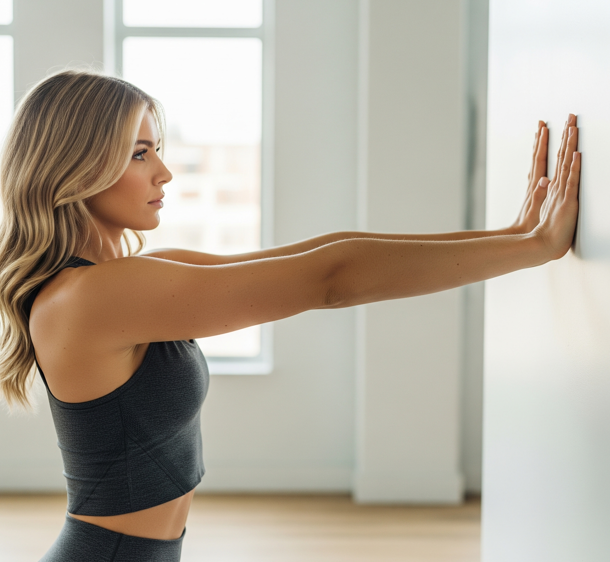
Chest Stretch
✨ Key Benefits
The chest stretch against the wall is one of the most effective ways to reverse the effects of prolonged sitting and smartphone use. By opening the front of your body, you create space for better breathing, improved posture, and pain-free shoulder movement.
✅ Counters rounded shoulders from computer work
✅ Improves breathing capacity by opening the chest
✅ Relieves upper back tension through reciprocal relaxation.
✅ Enhances flexibility for pushing movements.
✅ No equipment needed, just a flat surface
✅ Reduces Tension Headaches – Tight chest muscles contribute to forward head posture, a primary cause of tension headaches
✅ Prepares for Upper Body Workouts – Essential before push exercises, chest workouts at home, and wall push-ups
✅ Improves Shoulder Mobility – Allows the rotator cuff to move freely without restriction
✅ Supports Better Posture – Creates space for scapular retractions and chin tuck stretch to work effectively
✅ Enhances Breathing – Opens the rib cage, allowing for deeper diaphragmatic breaths
When your chest is open, everything above it aligns better – your shoulders, your neck, even your jaw. Add this stretch to your daily routine and feel the difference in how you stand, breathe, and move.
🧠 Anatomy Deep Dive: The Muscles of the Chest and Shoulders
The chest stretch against the wall targets several key structures that become tight from modern lifestyles:
| Muscle Group | Location | Function | Why It Gets Tight |
|---|---|---|---|
| Pectoralis Major | Large, fan-shaped muscle covering the upper chest | Adducts and internally rotates the shoulder; draws arm across the body | Prolonged sitting, bench pressing without stretching, poor posture |
| Pectoralis Minor | Smaller muscle beneath the major, attaches to ribs | Stabilizes the shoulder blade; assists in breathing | Chronic forward shoulder posture; stress and shallow breathing |
| Anterior Deltoid | Front of the shoulder | Lifts the arm forward | Overdeveloped from pressing movements without stretching |
| Biceps Brachii (Short Head) | Front of the upper arm | Assists in shoulder flexion | Overuse in pulling and lifting |
| Subclavius | Small muscle beneath the collarbone | Stabilizes the clavicle | Tight from rounded shoulder posture |
📋 How to Do Child’s Pose Stretch
1️⃣ Find Your Position
- Stand facing parallel to a wall
- Place palm and forearm flat against wall at shoulder height
Keep your elbow at a comfortable angle (90-120 degrees)
2️⃣ Rotate Away
- Gently turn your body away from the wall
- Keep entire arm in contact with the surface
Feel the stretch along your chest and front shoulder
3️⃣ Deepen the Stretch
- Step forward with the opposite foot to increase tension
- Maintain tall posture – don’t lean forward
Keep your shoulders down and back
4️⃣ Hold & Breathe
- Hold for 20-30 seconds per side
- Focus on deep diaphragmatic breathing
Exhale as you gently deepen the stretch
Modifications:
- Beginner: Reduce rotation angle; stand closer to the wall
- Advanced: Add a slight backward lean; raise arm higher or lower to target different chest fibers
Quick Reference Table
| Stretch Variation | Muscles Worked | Difficulty Level | Key Benefit |
|---|---|---|---|
| Standard Chest Stretch | Pectoralis major, anterior deltoid, biceps brachii | Beginner | Opens chest; counters rounded shoulders |
| Lower Chest Stretch | Pectoralis major (lower fibers), pectoralis minor | Beginner to Intermediate | Targets lower chest; complements doorway stretch |
| Upper Chest Stretch | Pectoralis major (upper fibers), subclavius | Beginner to Intermediate | Targets upper chest; improves shoulder alignment |
| Dynamic Chest Stretch | Pectorals, anterior deltoid | Intermediate | Gentle pulsing to increase range of motion |
🧠 Muscles Worked in Chest Stretch Against Wall
The chest stretch against the wall targets several important muscles in the chest, shoulders, and arms:
Pectoralis Major – the large chest muscle that pulls the shoulders forward when tight
Pectoralis Minor – the smaller chest muscle that attaches to the ribs and shoulder blade
Anterior Deltoid – the front shoulder muscle, stretched during the rotation
Biceps Brachii – the front arm muscle, gently lengthened during the stretch
Subclavius – the small muscle beneath the collarbone that stabilizes the shoulder girdle
If your chest feels tight, you can also include doorway stretch, shoulder stretch with stick, and upper trap stretch before or after to release tension and improve overall upper body mobility.
👥 Who Should Do the Chest Stretch Against Wall
This stretch is ideal for:
Desk workers and remote professionals – counteracts 8+ hours of slouching
Weightlifters and gym-goers – balances pressing movements with flexibility
Smartphone users – fights “text neck” and rounded shoulders
Yoga practitioners – prepares the chest for backbends like Cobra and Wheel
Runners and cyclists – opens the chest for deeper breathing and better arm swing
Older adults – maintains upright posture and reduces age-related forward rounding
Anyone with tension headaches – releases chest tightness that contributes to forward head posture
Anyone recovering from shoulder impingement – gentle stretch for chest tightness
Gamers – prevents the hunched posture developed during long gaming sessions
Anyone wanting better posture – essential daily maintenance
It works especially well when combined with doorway stretch, scapular retractions, chin tuck stretch, and upper trap stretch for complete posture correction.
Safety Check
✅ Warm up with arm circles first – Light movement before stretching
✅ Keep core gently engaged – Protects the lower back during rotation
✅ Progress gradually day by day – Increase depth over weeks, not minutes
✅ Breathe deeply – Exhale as you rotate; oxygen helps muscles relax
✅ Stop if sharp pain occurs – Mild tension is normal; sharp pain is a stop signal
🚫 Common Mistakes
✖ Force painful positions – Mild discomfort only; sharp pain means STOP
✖ Lift shoulders toward ears – Keep shoulders down and back throughout
✖ Hold your breath – Breathe steadily to oxygenate muscles
✖ Rush the movement – Slow, controlled rotation protects the shoulder
✖ Hunch forward – Keep chest proud and spine tall
✖ Neglect the other side – Stretch both sides equally for balance
FAQ
How often should I do the chest stretch against the wall?
For posture correction, aim for 2-3 times daily, especially if you have a desk job. Hold each stretch for 20-30 seconds, repeating 2-3 times per session. Incorporate into your 5-minute daily stretching routine for consistency.
Can this stretch help with rounded shoulders?
Absolutely. Rounded shoulders are often caused by tight chest muscles pulling the shoulders forward. The chest stretch against the wall directly counteracts this by lengthening the pectorals. For complete correction, combine with scapular retractions, rhomboid muscle stretch, and chin tuck stretch.
Why do I feel the stretch in my shoulder more than my chest?
This is common, especially if you have very tight shoulders or incorrect form. Ensure your elbow is at or slightly below shoulder height, and focus on keeping your shoulders relaxed – not shrugged up toward your ears. For additional shoulder mobility, explore shoulder stretch with stick and wall angel stretch.
Is this stretch safe for people with shoulder injuries?
If you have a history of shoulder impingement, rotator cuff issues, or labral tears, approach this stretch cautiously. Start with a shallow rotation and minimal arm elevation. Stop immediately if you feel sharp pain. For guided rehabilitation, consider rotator cuff exercises designed for recovery.
Can the chest stretch against the wall improve my bench press or push-up form?
Yes. Tight pectorals limit the range of motion and can contribute to shoulder strain during pressing movements. Regular stretching allows for a more natural bar path and reduces injury risk. Pair with push exercises, wall push-ups, and chest workouts at home for balanced development.
Quick Tip:
Pair this chest stretch against the wall with upper back exercises for balanced posture!