Don’t let shoulder pain hold you back! These rotator cuff exercises target the four small but mighty muscles that stabilize your shoulder joint, helping prevent injuries and improve overall shoulder flexibility.
If you’ve ever felt a pinch when reaching overhead, struggled to lift your arm to the side, or experienced nagging shoulder pain after a workout, your rotator cuff may be the culprit. The rotator cuff is a group of four muscles that surround the shoulder joint, keeping the head of your humerus securely in the shallow socket. When these muscles are weak or injured, even simple movements become painful.
Rotator cuff exercises are essential for anyone who uses their arms – which is everyone. Whether you’re an overhead athlete, a weightlifter, a desk worker, or someone recovering from an injury, strengthening these stabilizer muscles improves shoulder health, prevents impingement, and enhances performance in everything from push exercises to chest workouts at home.
The good news is that rotator cuff exercises don’t require heavy weights or expensive equipment. With light resistance bands or small dumbbells, you can build resilient shoulders that support you in the gym and in daily life.
For a complete shoulder routine, pair rotator cuff exercises with shoulder stretch with stick, doorway stretch, and upper trap stretch.
 What Rotator Cuff Exercises Target
Rotator cuff exercises focus on strengthening the supraspinatus, infraspinatus, teres minor, and subscapularis, the crucial muscles that act as your shoulder’s “stabilizer crew” for smooth, pain-free movement and improved flexibility.
Unlike larger muscles like the deltoids or pectorals, the rotator cuff muscles are small and designed for stability, not heavy lifting. This means they respond best to light resistance, high repetitions, and perfect form.
 Key Benefits of Good Rotator Cuff Exercises
Your rotator cuff is the unsung hero of shoulder health. These small muscles keep your shoulder stable during every arm movement. Strengthening them prevents injury, reduces pain, and improves performance.
 Prevents shoulder injuries by strengthening stabilizer muscles
Improves shoulder flexibility and range of motion
Reduces pain from existing rotator cuff issues
Enhances athletic performance in throwing and overhead sports
Supports daily activities like reaching and lifting
Improves Posture – Strong rotator cuffs help pull your shoulders back, counteracting forward hunch from desk work. Combine with chin tuck stretch and scapular retractions for complete posture correction.
Enhances Lifting Performance – Shoulder stability is essential for push exercises, chest workouts at home, and kettlebell workouts
Reduces Risk of Impingement – Balanced rotator cuff strength keeps the humeral head centred in the socket, preventing painful pinching
Supports Recovery from Injury – Gentle rotator cuff exercises are the foundation of shoulder rehabilitation
Complements Upper Back Work – Pairs perfectly with rhomboid muscle stretch, trap workouts, and pull day exercises
 Anatomy Deep Dive: The Four Rotator Cuff Muscles
The rotator cuff consists of four muscles that work together to stabilize the shoulder:
| Muscle | Location | Primary Function | Common Injury |
|---|---|---|---|
| Supraspinatus | Top of the shoulder blade | Initiates arm abduction (lifting arm away from body) | Most commonly torn rotator cuff muscle |
| Infraspinatus | Back of the shoulder blade | External rotation (turning arm outward) | Weakness leads to impingement |
| Teres Minor | Below infraspinatus | Assists external rotation | Often injured with infraspinatus |
| Subscapularis | Front of the shoulder blade | Internal rotation (turning arm inward) | Can be torn in traumatic injuries |
When all four muscles are strong and balanced, they work together to keep the humeral head centered in the socket during arm movement. When one or more are weak, the joint becomes unstable, leading to impingement, tendinitis, and tears.
For complementary shoulder work, explore shoulder stretch with stick, doorway stretch, and upper trap stretch.
 Who Should Do Rotator Cuff Exercises
This routine is ideal for:
-
Overhead athletes – baseball, softball, tennis, volleyball, swimming
-
Weightlifters – improves stability for push exercises, chest workouts at home, and kettlebell workouts
-
Desk workers – counteracts rounded shoulder posture
-
Anyone with shoulder pain – gentle strengthening reduces discomfort
-
Older adults – maintains shoulder function for daily activities
-
Anyone recovering from shoulder injury – essential rehabilitation
-
Yoga practitioners – prepares shoulders for weight-bearing poses
-
Runners – improves arm swing and upper body posture
-
Anyone wanting better posture – strong rotator cuffs pull shoulders back
-
Anyone who reaches overhead regularly – painters, electricians, construction workers
It works especially well when combined with scapular retractions, rhomboid muscle stretch, trap workouts, and pull day exercises for complete upper back and shoulder health.
 Step-by-Step At-Home Rotator Cuff Exercises
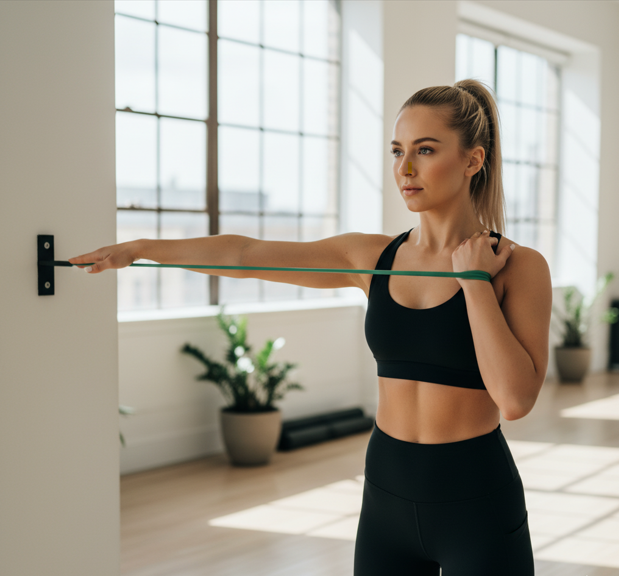
 External Rotation with Band
-
- Stand with a resistance band anchored at elbow height
-
- Keep your elbow tucked at 90 degrees, close to your side
-
- Rotate the forearm outward against resistance
-
- Return slowly to the starting position
-
- 3 sets of 12-15 reps per arm
 Internal Rotation
-
- Use a band anchored at the opposite side of the body
-
- Keep elbow at 90 degrees, close to ribs
-
- Pull the band across your body
-
- Control the return movement
-
- 3 sets of 12-15 reps per arm
 Scapular Retractions
-
- Stand tall with arms at your sides
-
- Squeeze shoulder blades together
-
- Hold for 3 seconds, then release
-
- Keep your shoulders down from your ears
-
- 3 sets of 15 reps
 Empty Can Exercise
-
- Raise arms to shoulder height at a 45-degree angle
-
- Thumbs pointing down (like emptying cans)
-
- Lift arms slightly higher, then lower
-
- Use light weights or no weight
-
- 3 sets of 10-12 reps
Modifications:
-
- Beginner: No weights, focus on perfect form
-
- Advanced: Increase resistance, add isometric holds
Quick Reference Table
| Exercise | Primary Muscles | Difficulty | Equipment | Key Benefit |
|---|---|---|---|---|
| External Rotation | Infraspinatus, teres minor | Beginner to Intermediate | Resistance band | Strengthens external rotators; prevents impingement |
| Internal Rotation | Subscapularis | Beginner to Intermediate | Resistance band | Balances internal/external rotation strength |
| Scapular Retractions | Rhomboids, middle traps | Beginner | None | Improves posture; stabilizes shoulder blade |
| Empty Can | Supraspinatus | Beginner to Intermediate | Light dumbbell or none | Targets most commonly torn rotator cuff muscle |
| External Rotation (Side-Lying) | Infraspinatus, teres minor | Intermediate | Light dumbbell | Isolates external rotators; no band needed |
 Safety Tips & Common Mistakes
 Don’ts
 Use heavy weights (light resistance is key!) Lift shoulders toward ears during exercises Push through sharp pain (discomfort is okay!)
Do’s
 Start with light resistance and perfect form Move slowly and with control Stop immediately if you feel pinching
FAQs
Q: What are good rotator cuff exercises for beginners?
A: Start with scapular retractions and internal/external rotations using just bodyweight or very light resistance bands.
Q: How often should I do rotator cuff exercises?
A: 2-3 times weekly, allowing at least one day of rest between sessions for optimal recovery and shoulder flexibility.
Q: Can I find rotator cuff exercises with pictures online?
A: Yes! Search for “rotator cuff exercises pictures” or “rotator cuff exercises with pictures” to see proper form and technique.
Q: Are at-home rotator cuff exercises effective?
A: Absolutely! At home, rotator cuff exercises using resistance bands or light dumbbells can significantly improve shoulder strength and flexibility.
Q: How long until rotator cuff exercises reduce pain?
A: Most people notice improvement within 4-6 weeks of consistent practice, but individual results vary based on the severity of the issue.
 Pro Tip
Incorporate these rotator cuff exercises into your regular workout routine 2-3 times weekly. Strong rotator cuffs mean happier shoulders and better overall upper body flexibility!