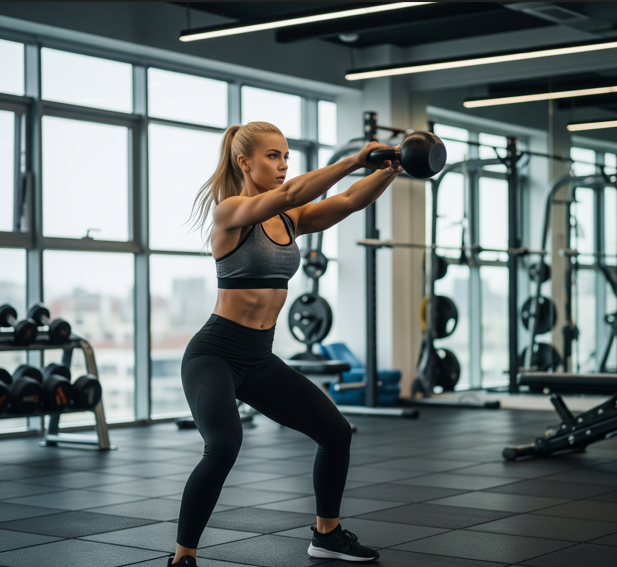
Swing, press, and squat your way to fitness! Kettlebell workouts combine strength, cardio, and flexibility in one dynamic package, targeting everything from your glutes to your grip.
If you’ve ever felt like your workouts are missing something – or you’re bored with dumbbells and machines – kettlebells might be the answer. The unique offset weight of a kettlebell forces your stabiliser muscles to work harder, engaging your core, shoulders, and hips in ways that traditional weights can’t replicate.
Kettlebell workouts are one of the most time-efficient ways to build functional strength, torch calories, and improve mobility. A single 20-minute kettlebell session can elevate your heart rate, challenge your muscles, and leave you feeling stronger and more agile. That’s why they’re a staple in best cardio workouts at home, best workout routines, and HIIT training.
The ballistic nature of kettlebell exercises – especially the swing – develops explosive power while improving hip mobility and cardiovascular endurance. Whether you’re an athlete, a busy professional, or someone wanting to get in shape, kettlebells deliver results.
For a complete training approach, pair kettlebell workouts with bodyweight exercises, reverse lunges, and jump squats.
🔍 What Kettlebell Workouts Target
Kettlebell workouts engage your entire body, building functional strength in your glutes, core, shoulders, and back while boosting cardiovascular endurance and improving overall flexibility and mobility.
Unlike isolation exercises, kettlebell movements are compound – they recruit multiple muscle groups simultaneously, making them incredibly efficient for building real-world strength.
✨ Key Benefits of Kettlebell Workouts
Kettlebell workouts are the ultimate combination of strength, cardio, and mobility. They build functional power, torch calories, and improve flexibility – all in less time than traditional workouts.
✅ Torch calories – Combines strength and cardio for maximum burn
✅ Builds functional strength – Mimics real-world movements like lifting and swinging
✅ Improves grip strength and stability – Thanks to the unique offset weight
✅ Enhances flexibility – Dynamic moves promote full-range motion
✅ Time-efficient – Full-body workouts in 20-30 minutes
✅ Improves Explosive Power – The kettlebell swing develops hip-driven power essential for jump squats, burpees, and reverse lunges
✅ Strengthens the Posterior Chain – Kettlebell swings and deadlifts target glutes, hamstrings, and lower back—muscles often neglected in traditional training
✅ Enhances Shoulder Stability – Overhead presses and Turkish get-ups build resilient shoulders, reducing injury risk during push exercises and chest workouts at home
✅ Boosts Cardiovascular Endurance – High-rep kettlebell circuits spike your heart rate, improving aerobic capacity
✅ Develops Core Strength – Every kettlebell movement requires core engagement, building a stable midsection for ab workouts and core workouts
Consistency is key. Training with kettlebells 3-4 times per week with proper form and progressive overload will transform your strength, endurance, and body composition over time.
🧠 Anatomy Deep Dive: Muscles Worked in Kettlebell Workouts
Kettlebell workouts target multiple muscle groups across the entire body:
| Exercise | Primary Muscles | Secondary Muscles | Key Benefit |
|---|---|---|---|
| Kettlebell Swing | Glutes, hamstrings, lower back | Core, shoulders, grip | Explosive hip power |
| Goblet Squat | Quads, glutes, core | Hamstrings, calves, upper back | Lower body strength |
| Single-Arm Row | Lats, rhomboids, traps | Core, biceps, grip | Upper back thickness |
| Kettlebell Press | Shoulders, triceps | Core, upper traps | Overhead stability |
| Turkish Get-Up | Full body, stabilizers | Core, shoulders, hips | Total body coordination |
| Kettlebell Deadlift | Hamstrings, glutes, lower back | Core, grip, traps | Posterior chain strength |
When you perform kettlebell exercises, you’re not just working individual muscles – you’re training movement patterns. The hip hinge of the swing, the squat depth of the goblet squat, and the stability of the overhead press all translate to real-world activities and athletic performance.
For complementary strength work, explore leg workouts, back workouts with dumbbells, and pull day exercises.
👥 Who Should Do Kettlebell Workouts
This routine is ideal for:
-
Fat loss seekers – kettlebell workouts burn maximum calories in minimum time
-
Athletes – develops explosive power and conditioning
-
Busy professionals – full-body workouts in 20-30 minutes
-
Weightlifters – builds functional strength and endurance
-
Runners – strengthens glutes and hamstrings for better stride power
-
Older adults – start with lighter bells; focus on form over weight
-
Anyone bored with traditional weights – kettlebells add variety and challenge
-
Anyone wanting better grip strength – the offset weight forces grip engagement
-
Anyone with limited equipment – a single kettlebell can do it all
-
Anyone wanting to improve mobility – dynamic movements increase range of motion
It works especially well when combined with bodyweight exercises, reverse lunges, jump squats, and push exercises for complete full-body conditioning.
🏋️ Kettlebell Workouts for Glutes: Step-by-Step
1️⃣ Kettlebell Swings
- Stand feet shoulder-width apart, kettlebell on floor
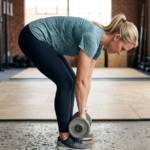
- Hinge at hips to grab kettlebell with both hands
- Drive hips forward explosively for a powerful glutes stretch, swinging bell to chest height
- Let momentum lower bell back between legs
- Complete 3 sets of 15-20 reps
2️⃣ Goblet Squats
- Hold kettlebell at chest with both hands
- Lower into a deep squat stretch, keeping chest up for this fundamental squat workout
- Drive through heels to stand, engaging glutes
- Perform 3 sets of 12-15 reps
3️⃣ Single-Arm Kettlebell Rows
- Hinge forward, support yourself with one hand on bench
- Pull kettlebell to ribcage, elbow close to body
- Lower with control
- 3 sets of 10-12 reps per arm
Modifications:
- Beginner: Use lighter kettlebell, focus on form
- Advanced: Add reps, use heavier bell, or combine moves into circuits
Quick Reference Table
| Exercise | Primary Muscles | Difficulty | Equipment | Key Benefit |
|---|---|---|---|---|
| Kettlebell Swings | Glutes, hamstrings, core | Intermediate | Kettlebell | Explosive power, cardio |
| Goblet Squats | Quads, glutes, core | Beginner to Intermediate | Kettlebell | Lower body strength |
| Single-Arm Rows | Lats, rhomboids, traps | Intermediate | Kettlebell, bench | Upper back thickness |
| Kettlebell Press | Shoulders, triceps, core | Intermediate | Kettlebell | Overhead stability |
| Turkish Get-Up | Full body, stabilizers | Advanced | Kettlebell | Total body coordination |
| Kettlebell Deadlift | Hamstrings, glutes, lower back | Beginner to Intermediate | Kettlebell | Posterior chain strength |
⚠️ Safety Tips & Common Mistakes
🚫 Don’ts
✖ Use your arms to swing the kettlebell (it’s all in the hips!)
✖ Round your back during swings or rows
✖ Choose a weight that’s too heavy too soon
✅ Do’s
✔ Start with a lighter kettlebell to master form
✔ Keep your core engaged throughout movements
✔ Focus on hip hinge mechanics for swings
❓FAQs
Q: Are kettlebell workouts good for weight loss?
A: Absolutely! Kettlebell workouts combine strength and cardio, torching calories and boosting metabolism long after your workout ends.
Q: How often should I do kettlebell workouts?
A: 3-4 times per week, allowing rest days between intense sessions. Cardio with kettlebell workouts can be done more frequently.
Q: Can kettlebell workouts build muscle?
A: Yes! Especially kettlebell workouts for glutes and legs. The unique weight distribution challenges muscles differently than dumbbells.
Q: Where can I find printable kettlebell workouts?
A: Many fitness websites offer printable kettlebell workouts for home use. Look for beginner-friendly routines with clear form cues!
Q: What size kettlebell should I start with?
A: Women often start with 8-12kg, men with 12-16kg. Focus on proper form before increasing weight.
🌟 Pro Tip
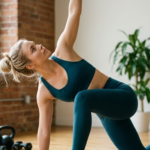
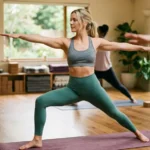
Pair your kettlebell workouts with dynamic stretching to maintain flexibility and prevent injury. The stronger you get, the more mobile you’ll become!