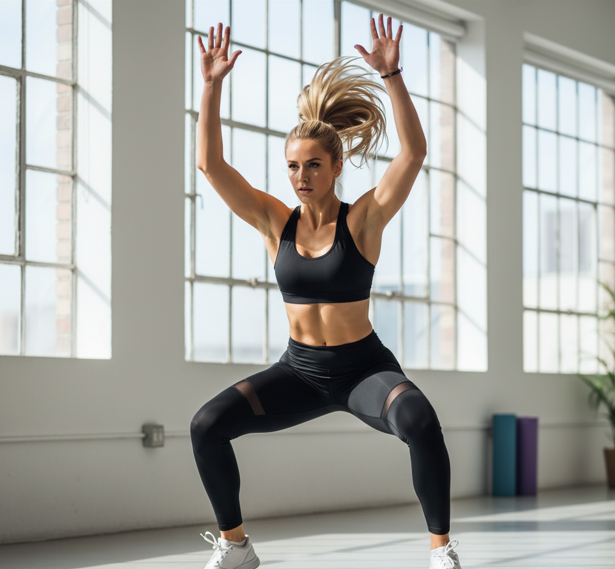
Take your squats to new heights! Jump squats combine strength and cardio in one explosive movement, targeting your legs, glutes stretches, and core while boosting power and flexibility.
If you’re looking to add explosiveness to your athletic performance, torch calories faster than traditional strength training, and build lower body power that translates to real-world activities, jump squats are your answer. Unlike standard squats that focus on controlled strength, jump squats incorporate the element of plyometrics – training your muscles to generate maximum force in minimal time.
Jump squats are one of the most effective exercises for developing explosive power, improving cardiovascular endurance, and sculpting powerful, athletic legs. Whether you’re a basketball player trying to jump higher, a runner seeking more stride power, or someone wanting to burn fat quickly, this move delivers results.
The beauty of jump squats lies in their simplicity. No equipment needed, no gym required – just your body weight and a safe landing surface. But don’t let that simplicity fool you; when performed correctly, jump squats challenge your muscles, heart, and lungs like few other exercises.
For a complete lower body routine, pair jump squats with reverse lunges, kettlebell workouts, and leg workouts.
🔍 What Jump Squats Target
Jump squats exercise focuses on developing explosive power in your quadriceps, glutes, and calves while improving cardiovascular endurance and lower body flexibility. Think of it as a regular squat’s energetic cousin that builds athleticism!
Unlike traditional squats that emphasize slow, controlled strength, jump squats train the stretch-shortening cycle of your muscles – the ability to store and release energy quickly. This is what gives athletes their explosive power.
✨ Key Benefits of Jump Squats
Jump squats are the ultimate combination of strength training and cardio. They build explosive power, torch calories, and sculpt athletic legs – all in one explosive movement.
✅ Builds explosive power for sports and daily activities
✅ Torches calories with high-intensity cardiovascular benefits
✅ Improves lower body flexibility and range of motion
✅ Enhances bone density through impact training
✅ Boosts metabolic rate long after your workout ends
✅ Develops Athletic Performance – Essential for sports requiring jumping, sprinting, and quick direction changes
✅ Improves Coordination – The movement requires precise timing between arms, core, and legs
✅ Strengthens Stabilizer Muscles – Landing requires control from ankles, knees, and hips
✅ Enhances Fat Loss – High-intensity nature burns more calories per minute than steady-state cardio
✅ Builds Mental Toughness – Explosive movements require focus and commitment
Consistency is key. Adding jump squats to your routine 2-3 times per week will transform your lower body power, cardiovascular fitness, and body composition over time.
🧠 Anatomy Deep Dive: Muscles Worked in Jump Squats
Jump squats target multiple muscle groups across the lower body and core:
| Phase | Muscles Worked | Primary Action |
|---|---|---|
| Descent (Eccentric) | Quads, glutes, hamstrings, core | Controlled lowering, storing elastic energy |
| Explosion (Concentric) | Quads, glutes, calves, core | Rapid force production for upward propulsion |
| Flight | Core, hip flexors, stabilizers | Body control in the air |
| Landing (Eccentric) | Quads, glutes, hamstrings, calves | Absorbing impact, controlling descent |
When you perform jump squats, you’re training the entire kinetic chain – from your feet to your core. This integration is what makes them superior for athletic development compared to isolation exercises.
For complementary lower body work, explore leg workouts, reverse lunges, and calf stretches.
👥 Who Should Do Jump Squats
This exercise is ideal for:
-
Athletes – basketball, volleyball, soccer, football players need explosive power
-
Fat loss seekers – high-intensity calorie burn
-
Runners – improves stride power and leg stiffness
-
Weightlifters – develops explosive power for Olympic lifts
-
Anyone bored with traditional squats – adds variety and challenge
-
Dancers – develops power and control
-
Anyone wanting athletic legs – builds powerful, defined quads and glutes
-
Anyone with no equipment – bodyweight only
-
Older adults – start with squat jumps (minimal air time) to reduce impact
-
Anyone wanting to improve vertical jump – essential training tool
It works especially well when combined with reverse lunges, kettlebell workouts, jump rope workout, and burpees for complete athletic conditioning.
🏋️ How To Do Jump Squats Exercise
1️⃣ Starting Position
- Stand with feet shoulder-width apart, toes pointed slightly out
- Keep chest up, shoulders back, and core engaged
- Arms can be at the sides or in the “ready” position
2️⃣ The Descent
- Lower into a squat position, pushing hips back
- Keep knees aligned with toes, back straight
- Descend until thighs are parallel to the floor (or comfortable depth)
3️⃣ The Explosion
- Drive powerfully through your heels
- Explode upward, extending hips, knees, and ankles
- Swing arms upward for momentum
4️⃣ The Landing
- Land softly on the balls of your feet, rolling to your heels
- Bend knees to absorb impact immediately
- Return directly to squat position for next rep
Modifications:
- Beginner: Jump squats, alternative Squat jumps (less height) or step-back lunges
- Advanced: Add tuck jump or increase repetition speed
Quick Reference Table
| Phase | Primary Muscles | Difficulty | Key Focus |
|---|---|---|---|
| Starting Position | Core, posture muscles | Beginner | Proper alignment |
| Descent (Eccentric) | Quads, glutes, hamstrings | Beginner to Intermediate | Controlled lowering |
| Explosion (Concentric) | Quads, glutes, calves, core | Intermediate | Maximum force production |
| Flight | Core, hip flexors, stabilizers | Intermediate | Body control |
| Landing | Quads, glutes, calves, core | Intermediate | Soft, controlled impact |
| Squat Jump (Modified) | Quads, glutes, core | Beginner | Low-impact alternative |
FAQs🔥
Q: Are jump squats better than regular squats for weight loss?
A: Jump squats torch more calories per minute due to their high-intensity nature, making them excellent for fat loss. However, regular squats allow heavier loading for muscle building. Combine both for the best results!
Q: Can beginners do jump squats safely?
A: Yes, but start with squat jumps (minimal air time) and focus on perfect landing form. Build base strength with regular squats first, and always warm up properly.
Q: How many jump squats should I do per day?
A: Start with 3-4 sets of 8-10 reps, 2-3 times weekly. Quality over quantity – focus on explosive power and controlled landings rather than high reps.
Q: Do jump squats build bigger legs?
A: They build powerful, athletic legs rather than bulky muscles. For size, combine them with heavy squats. For definition and power, jump squats are perfect!
Q: What’s the best jump squats alternative for bad knees?
A: Try box squats or resistance band squats instead. These reduce impact while still building lower-body strength. Always consult a doctor for knee issues.
Q: Can I do jump squats every day?
A: Not recommended, your joints need recovery time. Limit to 3-4 times weekly max, and listen to your body. Active recovery days are crucial!
⚠️ Safety Tips & Common Mistakes
🚫 Don’ts
✖ Land with straight legs (always bend knees!)
✖ Let knees collapse inward (keep them aligned!)
✖ Round your back during descent (maintain neutral spine!)
✅ Do’s
✔ Warm up thoroughly with dynamic stretches
✔ Focus on soft, controlled landings
✔ Start with low reps and build gradually
✔ Use proper footwear with good cushioning
🌟 Pro Tip
Incorporate jump squats into your routine 2-3 times weekly, and consider them as a jump squats alternative to regular squats when you want to add cardio benefits to your strength training!