Introduction
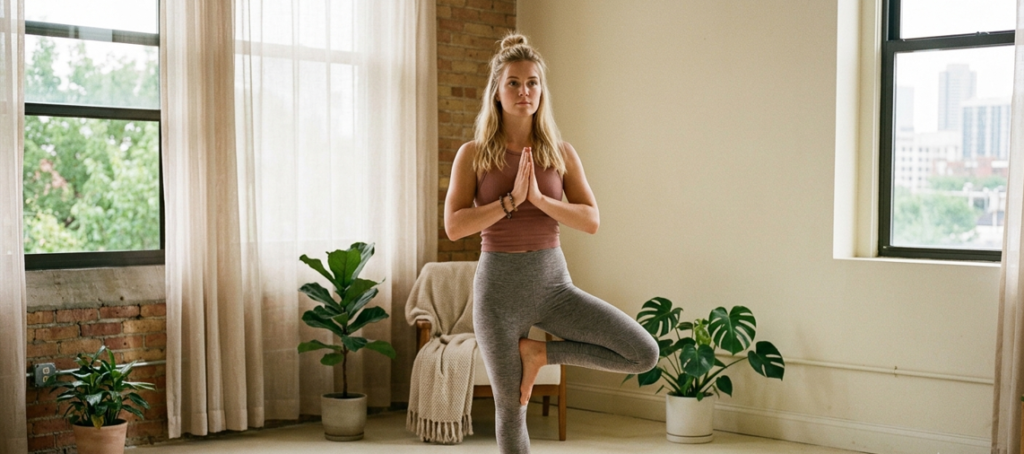
Have you ever noticed how a tree stands firmly rooted in the earth, yet sways gracefully with the wind? That’s the essence of Tree Pose a grounding yet uplifting yoga tree pose that teaches you to find stability amidst life’s wobbles. Known in Sanskrit as Vrksasana (vrik-SHAH-sah-nah), this classic tree pose in yoga is the perfect starting point for anyone wanting to improve their balance, regardless of age or experience. It’s a gentle yet powerful posture that helps you feel centered by connecting the strength of your standing leg with the flexibility of your hips. As you stand on one foot, the pose challenges your focus and concentration, reminding you that steadiness is not a fixed destination but a dynamic, moment-to-moment practice. Whether you’re a beginner or an experienced practitioner, the tree yoga pose offers a beautiful opportunity to build a foundation of strength from the ground up, with a posture that’s as unique as your own body. 🌱
Beyond balance, Tree Pose also serves as an excellent gateway to other standing postures. Once you’ve found your stability here, you can seamlessly transition into a standing side bend to open your ribcage and stretch your obliques, or a standing quadriceps stretch to release tension in your thighs. And don’t be fooled by its serene appearance holding this pose actively engages your abdominal muscles, making it a fantastic standing core workout that tones your midsection while improving posture. Each variation deepens your practice, turning a simple balance pose into a full-body conditioning experience.
✨ Key Benefits of Tree Pose
Why should you incorporate the tree pose into your routine? Beyond the obvious physical benefits, this posture is like a workout for your mind and spirit:
-
⚖️ Improves Balance & Stability: Tree pose is a fantastic way to train your physical balance, which is a key indicator of long-term health. By strengthening the small, stabilizing muscles in your ankles, feet, and legs, it enhances your overall coordination and helps prevent falls.
-
🦵 Strengthens Lower Body & Core: The pose works your standing leg, glutes, ankles, and core muscles. Your lifted leg also gets a good stretch, improving flexibility in your hips and groin . It’s a comprehensive lower-body workout!
-
🧘♀️ Boosts Focus & Concentration: Finding your balance requires a calm, focused mind. Tree pose trains you to block out distractions, improving your concentration and mental resilience . It’s moving meditation.
-
🤸♀️ Opens the Hips: The external rotation of the lifted leg helps to gently open the hip joint, counteracting the effects of prolonged sitting and releasing tension in the lower back and pelvis .
📝 Step-by-Step Instructions
Think of your body as a tree: your standing foot is the root, your legs are the trunk, and your arms are the branches. Follow these steps to grow your own tree pose:
-
🌲 Start in Mountain Pose: Stand tall with your feet together, arms relaxed by your sides. Spread your toes and press your feet firmly into the mat to build a solid foundation .
-
🦩 Shift Your Weight: Gently shift your weight onto your left foot. Keep your standing leg strong but avoid locking your knee .
-
🌿 Place the Lifted Foot: Bend your right knee and bring the sole of your right foot to rest against your left leg. Crucially, place it either on the inner calf (below the knee) or the inner thigh (above the knee), but never directly on the knee joint itself, as this can cause injury . If your hips are tight, keeping the foot lower is perfectly fine.
-
🙏 Find Your Focus: Once you feel steady, bring your hands together in front of your chest in a prayer position (Anjali Mudra). Fix your gaze (Drishti) on a non-moving point directly in front of you. This steady gaze is your anchor for balance .
-
🌳 Grow Your Branches: For an added challenge, inhale and stretch your arms overhead like branches reaching for the sun. You can keep your palms together or spread them apart .
-
🧘 Stay & Breathe: Keep your spine straight and your core engaged. Breathe deeply and evenly for 5-10 breaths, feeling the subtle sway of your body like a tree in the breeze .
-
↩️ Release: On an exhale, gently lower your arms and foot, returning to Mountain Pose. Repeat on the other side.
🧩 Modifications for Every Body
-
For Beginners: Place the toes of your lifted foot on the ground, resting just the heel against your standing ankle. This acts like a “kickstand” for extra support . You can also practice with your back or hand against a wall until you build confidence .
-
For Advanced: Once stable, try closing your eyes to remove your visual anchor . You can also bring your lifted foot higher onto your thigh or transition into a different arm variation like a full “cactus” arms.
🧘 Quick Reference Table
| Muscle Groups Worked | Difficulty Level |
|---|---|
| Strengthened: Ankle stabilizers, Gluteus medius (standing leg), Quadriceps, Core (abdominals & back), Intrinsic foot muscles | Beginner to Intermediate |
| Stretched: Adductors (inner thigh of lifted leg), Hip flexors, Latissimus dorsi, Shoulders |
⚠️ Safety Tricks & Common Mistakes
To ensure a safe and effective practice, keep these expert tips in mind:
-
❌ The Knee Danger: Mistake: Placing the sole of your foot against the knee of your standing leg. Safety Trick: This puts lateral pressure on the joint and can cause injury. Always place your foot on the calf or thigh, above or below the knee .
-
❌ Hips Out of Alignment: Mistake: “Popping” the hip of your lifted leg out to the side, causing your pelvis to tilt. Safety Trick: Keep your hips level and squared forward. Only rotate your leg as far as your hip flexibility allows without moving your pelvis .
-
❌ Clenching Toes: Mistake: Gripping the mat with your toes of your standing foot. Safety Trick: This creates tension. Relax your toes and instead, spread them wide to create a larger, more stable base of support .
-
❌ Locking the Standing Knee: Mistake: Hyper-extending your standing leg’s knee. Safety Trick: Keep a micro-bend in the knee to engage your quadriceps and protect the joint .
-
❌ Wandering Eyes: Mistake: Looking around the room. Safety Trick: Your eyes are connected to your vestibular system. A fixed gaze (drishti) is essential for balance. Focus on a single, unmoving spot .
❓ Frequently Asked Questions (FAQs)
Q: Why do I keep falling out of Tree Pose?
A: Falling is completely normal and part of the learning process! Balance fluctuates daily based on factors like tiredness, stress, and diet. Don’t get frustrated; the practice is in wobbling and calmly coming back into the pose . Your balance will improve over time.
Q: Is Tree Pose bad for your knees?
A: It can be if done incorrectly. The rule is simple: never place your foot on your knee. As long as you keep the foot on the calf or thigh, the pose is very safe and can even help strengthen the muscles that support the knee .
Q: Can I do Tree Pose with high blood pressure?
A: Yes, but with caution. It is often recommended to avoid raising your arms above your head, as this can slightly elevate blood pressure. Keeping your hands in a prayer position at your heart is a safer option .
Q: What is the best modification for Tree Pose if I have weak knees?
A: A great option is to practice the pose while lying down. This allows you to experience the hip opening and leg placement without putting any weight on the standing knee . You can also practice against a wall for support .
💡 Quick Tip for Success
It’s easy to get caught up in the “perfect” expression of tree pose, fixated on how high your foot goes. Instead, shift your focus to your foundation. Actively press your standing foot down into the earth, imagining roots growing from it. This downward action creates a powerful energetic lift, naturally straightening your spine and making you feel lighter. Flexibility is not just about stretching; it’s about creating space and strength in your posture. By engaging the ground, you build a stable base that allows your upper body to grow tall and strong, just like a majestic tree finding its balance not by being rigid, but by being deeply rooted. So next time you practice yoga tree pose, concentrate less on the branch and more on the root your standing leg is the true source of your stability. 🍃