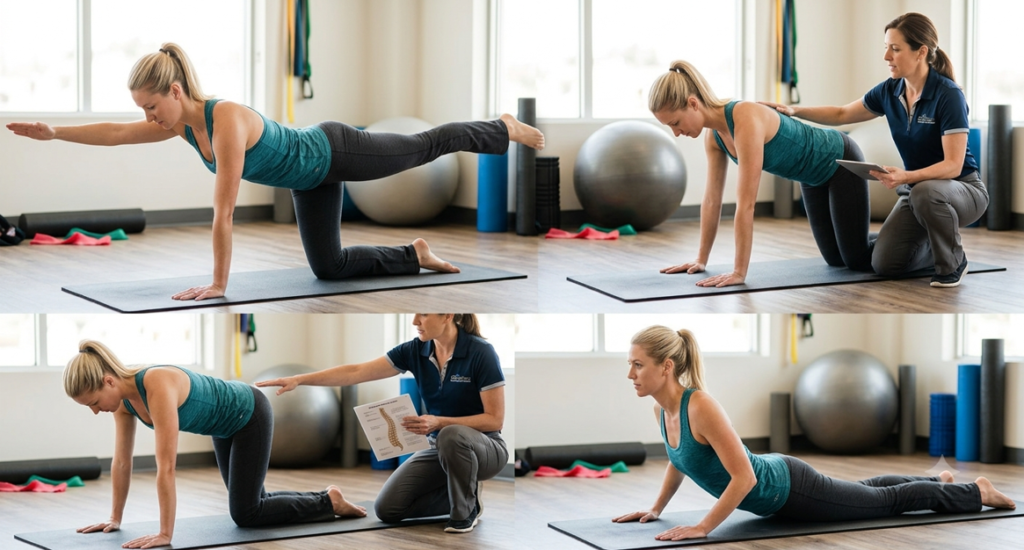
📖 Introduction: herniated disc exercises
If you’ve ever felt a sharp, shooting pain running down your leg or a dull ache in your lower back that just won’t quit, you may be dealing with a herniated disc, sometimes called a “slipped” or “bulging” disc. Think of your spinal discs like jelly donuts sandwiched between your vertebrae: when the soft jelly center pushes through the tougher outer ring, it can press on nearby nerves and cause pain, numbness, or tingling that radiates into your hips, buttocks, or even down to your feet. This condition affects millions of people worldwide, and while it sounds scary, the good news is that most cases improve with conservative care, with no surgery required. The gentle herniated disc exercises below are designed to decompress the spine, reduce nerve pressure, and restore flexibility in the surrounding muscles so your back can heal naturally. These moves focus on your lower back, core, hips, and hamstrings the key players in spinal support and stability. Think of your core as the scaffolding around a building: when it’s strong, everything stays aligned; when it’s weak, the structure suffers. Best of all, these exercises are low-impact, beginner-friendly, and can be done at home with just a mat and a few minutes of your day. 🛏️
🌟 Key Benefits
-
🦴 Relieves Nerve Pressure: Gentle traction and extension movements create space between vertebrae, taking pressure off pinched nerves and reducing that electric-shock feeling in your leg.
-
💪 Strengthens Spinal Support: A stronger core acts like a natural back brace, protecting your discs during daily activities like bending, lifting, and twisting.
-
🤸 Improves Flexibility: Regular stretching restores flexibility in tight hamstrings and hip flexors that pull on the lower back, helping you move more freely and comfortably.
-
😌 Reduces Pain & Stiffness: Improved circulation brings oxygen and nutrients to healing tissues, easing aches and promoting faster recovery.
-
🧠 Boosts Mental Well-Being: Mindful movement lowers stress hormones like cortisol, and less pain means better sleep, sharper focus, and a brighter mood overall.
-
🚶 Enhances Daily Function: With consistent practice, you’ll find it easier to sit, stand, walk, and even tie your shoes without wincing.
📝 Step-by-Step Instructions
1. 🌬️ Prone Breathing (Warm-Up)
Lie face down on a mat with your forehead resting on your hands. Take slow, deep breaths into your belly for 2–3 minutes, letting your lower back muscles relax completely. This simple move sets the tone for the entire routine by calming your nervous system and preparing your spine for gentle movement.
-
Beginner: Place a thin pillow under your hips for comfort.
-
Advanced: Gently press your pubic bone into the floor with each exhale to deepen the stretch.
2. 🐍 Prone Press-Ups (McKenzie Extension)
Keep your hips on the floor and place your hands under your shoulders. Slowly press your upper body up, allowing your back to arch gently. Hold for 2 seconds, then lower. Do 10 reps. This exercise is like gently opening a stuck door it creates space and relieves pressure on the disc.
-
Beginner: Prop up on your elbows only.
-
Advanced: Press up fully until arms are straight, if pain allows.
3. 🐈 Cat-Cow Stretch
On hands and knees, alternate between arching your back up (cat) and dipping it down (cow). Move slowly with your breath 10 rounds. The cat-cow stretch is one of the most effective and gentle herniated disc exercises you can do at home because it mobilizes every segment of your spine without adding compression. Imagine your spine as a wave rolling gently from tailbone to neck; this rhythmic motion lubricates the joints and eases stiffness. The cat-cow stretch also improves flexibility in your lower back and helps restore natural spinal movement after periods of inactivity. Whether you’re dealing with a bulging disc or just everyday back tightness, this cat-cow stretch is a must-add to your daily routine.
-
Beginner: Smaller range of motion; focus on breath rather than depth.
-
Advanced: Add a gentle hip circle at each end of the movement.
-
Pro Tip: Sync each movement with your breath: inhale for cow, exhale for cat.
4. 🦵 Knee-to-Chest Stretch
Lie on your back and pull one knee toward your chest, holding for 20–30 seconds. Switch sides, then hug both knees. Repeat 3 times per side. This is a go-to for lower back flexibility and one of the most soothing stretches for a cranky disc.
-
Beginner: Use a towel around your thigh to pull gently.
-
Advanced: Gently rock side to side in the double-knee hold.
5. 🌉 Glute Bridge
Lie on your back with knees bent and feet flat. Squeeze your glutes and lift your hips until your body forms a straight line. Hold for 5 seconds, lower slowly. Do 10 reps. The glute bridge is one of the best herniated disc exercises for building the posterior chain strength your spine craves. Your glutes are the engine of your lower body when they’re strong, your back doesn’t have to work overtime. Think of the glute bridge as a foundation repair: by strengthening your hips and glutes, you take pressure off your lumbar discs and improve overall flexibility in your hip flexors. The glute bridge is also a key part of exercises for a herniated disc in the lower back because it promotes stability without compressing the spine. Unlike sit-ups or crunches, the glute bridge keeps your spine neutral while still firing up your core, making it a safe, effective choice for anyone doing back stretching exercises for herniated disc recovery.
-
Beginner: Lift only halfway.
-
Advanced: Hold for 10 seconds or do single-leg bridges.
6. 🧎 Bird Dog
From hands and knees, extend your right arm and left leg simultaneously, keeping your core tight. Hold 5 seconds, switch sides. Do 10 reps per side. The bird dog is a staple among herniated disc exercises because it builds core stability without loading or twisting the spine. This move teaches your core and back to work together like a well-trained dance duo, balanced, controlled, and stable. Think of the bird dog as your spine’s security system: the moment your core engages, your lower back is protected from sudden movements that could aggravate a bulging disc. The bird dog also improves coordination and flexibility in the hips and shoulders, making it a smart addition to any exercises for a herniated disc lower back routine. Unlike crunches, the bird dog keeps your spine in a neutral position, which is exactly what you want when recovering from a slipped disc. Whether you’re doing back stretching exercises for herniated disc recovery or building long-term back resilience, the bird dog earns its place in your daily practice.
-
Beginner: Lift just the leg, then just the arm; master each separately before combining.
-
Advanced: Add a slow elbow-to-knee touch between reps to challenge your balance and control.
-
Pro Tip: Imagine balancing a glass of water on your lower back no wobbling, no sagging.
7. 🧘 Child’s Pose (Cool-Down)
Kneel and sit back on your heels, extending your arms forward and lowering your torso. Breathe deeply for 1–2 minutes to release tension and end your session with calm flexibility work. The child’s pose is the perfect finisher to any herniated disc exercise routine because it gently lengthens the spine and creates space between the vertebrae. Think of the child’s pose as your spine’s way of saying “thank you” after a job well done it’s a full-body sigh of relief. This restorative child’s pose stretch also calms the nervous system, which is crucial when you’re dealing with nerve pain from a bulging disc. Among exercises for a herniated disc in the lower back, the child’s pose stands out as one of the few that combines spinal decompression with deep relaxation. Whether you’re winding down from back stretching exercises for herniated disc recovery or simply need a moment of calm, the child’s pose delivers both physical and mental relief.
-
Beginner: Place a pillow under your hips or between your heels and glutes for extra support.
-
Advanced: Walk your hands to one side for a gentle side-body stretch, then switch sides.
-
Pro Tip: Focus on slow, belly-deep breaths; each exhale helps your muscles release a little more.
📊 Quick Reference Table
| Muscle Groups Worked | Difficulty Level |
|---|---|
| Lower back (erector spinae), core (abdominals), glutes, hamstrings, hip flexors | 🟢 Beginner-Friendly (with modifications for all levels) |
🔥FAQs
❓ Can I do these exercises if my pain is severe right now?
Always check with your doctor or physical therapist first. During an acute flare-up, stick to gentle moves like prone breathing and knee-to-chest, and avoid anything that increases shooting pain.
❓ How often should I do herniated disc exercises?
Most people benefit from 1–2 short sessions daily. Consistency beats intensity; think of it like brushing your teeth for your spine. 🦷
❓ Will stretching alone fix a herniated disc?
Stretching improves flexibility and reduces pain, but combining it with core strengthening and good posture gives the best results.
❓ Which exercises should I avoid?
Skip deep forward bends, heavy squats, sit-ups, and any twisting under load; these can worsen a herniated disc.
❓ How long until I see results?
Many people notice improvement in 2–4 weeks with consistent, gentle practice. Healing timelines vary, so be patient with your body. ⏳
⚠️ Safety Tricks
-
🛑 Stop if pain worsens a mild stretch is fine; sharp pain is not.
-
🐢 Move slowly no bouncing or jerking motions.
-
🩺 Get professional guidance before starting any new routine.
-
🧊 Use ice afterward if you feel sore or inflamed.
🚫 Common Mistakes
-
Pushing through pain instead of listening to your body.
-
Skipping the warm-ups and jumping into deep stretches.
-
Holding your breath instead of breathing steadily.
-
Doing too much too soon; progress gradually, not aggressively.
💡 Quick Tips
-
🕐 Do exercises in the morning and evening for best results.
-
💧 Stay hydrated; discs are mostly water!
-
🚶 Walk for 10–15 minutes daily to complement your routine.
-
🪑 Take posture breaks every 30 minutes if you sit for work.
-
🔥 Apply heat before stretching to loosen tight muscles.