
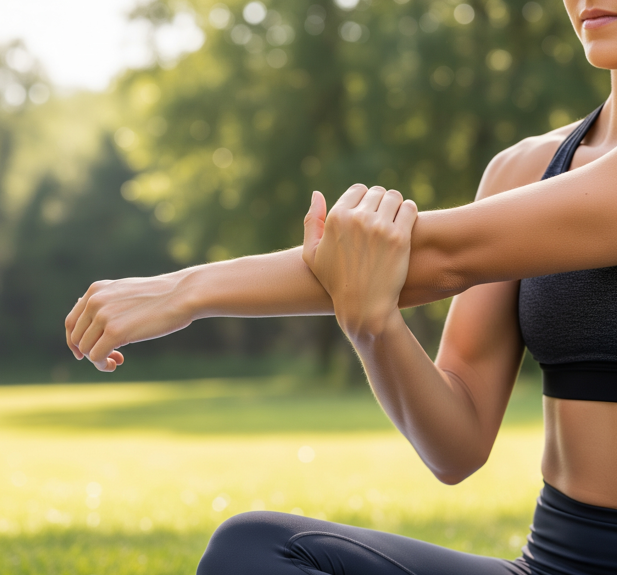

Forearm Flexor Stretch

Forearm Stretches to Relieve Arm and Wrist Pain

Whether you’re typing all day, lifting weights, or recovering from strain, forearm stretching exercises are your secret weapon for better flexibility, reduced stiffness, and pain-free movement. Let’s loosen up those tight muscles!

Tight forearms don’t just affect your hands – they create tension that travels up your arms, into your shoulders, and even contributes to neck stiffness. When your wrist flexors and extensors are tight, they alter how you perform everyday movements like typing, gripping a kettlebell, or holding a plank. Over time, this can lead to compensations that affect your form during pull day exercises and push exercises, reducing efficiency and increasing injury risk.

Regular forearm stretching also plays a key role in managing conditions like tennis elbow and carpal tunnel syndrome. The muscles of the forearm connect directly to the elbow joint and influence the median and ulnar nerves. Keeping them flexible reduces compression on these nerves, improves blood flow, and supports recovery. For a complete upper body approach, combine these stretches with scapular retractions to improve shoulder blade stability and upper trap stretch to release tension that often accompanies forearm tightness.

Forearm Flexor stretch

Forearm Flexor Stretching

Key Benefits of Forearm Stretches 🌟

Boosts Flexibility – Improves range of motion for daily tasks and workouts.

Relieves Tension – Eases tightness from repetitive motions (typing, gripping).

Prevents Injury – Reduces risk of tendonitis and carpal tunnel syndrome.

Enhances Recovery – Promotes blood flow to sore or overworked muscles.

✅ Mental Relaxation – Stretching can help reduce stress and improve focus.

✅ Improves Grip Strength – Flexible forearms allow for better engagement duringpull day exercises, back workouts with dumbbells, and kettlebell workouts

✅ Reduces Elbow Pain – Relieves tension in muscles that attach to the medial and lateral epicondyles (golfer’s elbow, tennis elbow)

✅ Supports Keyboard & Mouse Comfort – Essential for anyone spending 6+ hours daily at a computer

✅ Enhances Upper Body Workouts – Proper forearm flexibility improves form in push exercises, wall push-ups, and chest workouts at home

✅ Prevents Chronic Wrist Issues – Regular stretching reduces the risk of carpal tunnel syndrome and tendonitis

🧠 Anatomy Deep Dive: The Muscles of Your Forearm

The forearm contains over 20 muscles that control wrist, hand, and finger movement. These are divided into two main groups:

Muscle GroupLocationFunctionWhy It Gets Tight
Forearm FlexorsInner (palm-side) forearmBend wrist forward; control gripTyping, gripping, phone use, climbing
Forearm ExtensorsOuter (top) forearmBend wrist backward; open handMouse use, weightlifting, repetitive extension
BrachioradialisThumb-side forearmAssists elbow flexionOveruse in lifting and gripping
Pronator TeresInner elbow areaRotates forearm palm-downDesk work, repetitive rotation

🧠 Muscles Worked in Forearm Stretching Exercises

The forearm stretching exercises target several important muscles in the lower arm, wrist, and hands. These include:

  • Flexor Carpi Radialis & Ulnaris – muscles on the inner (palm-side) forearm that bend the wrist forward and control grip

  • Extensor Carpi Radialis & Ulnaris – muscles on the outer (top) forearm that extend the wrist backward and open the hand

  • Brachioradialis – the thick muscle on the thumb-side of the forearm that assists in elbow flexion

  • Pronator Teres – the muscle near the inner elbow that rotates the forearm palm-down

  • Flexor Digitorum Superficialis & Profundus – deep muscles that control finger flexion, essential for gripping and typing

👥 Who Should Do Forearm Stretching Exercises

This stretch is ideal for:

  • Desk workers and remote professionals

  • Weightlifters and gym-goers

  • Smartphone users and gamers

  • Musicians (guitarists, pianists, string players)

  • Rock climbers and gymnasts

  • Yoga practitioners

  • Runners and cyclists

  • Anyone recovering from wrist strain or tendonitis

  • Crafters, knitters, and artists

  • Anyone with tight forearms from repetitive gripping or typing

It works especially well when combined with stretches like arm stretcheswrist exercises, and triceps stretches for complete upper arm and wrist mobility.

Forearm Stretching Exercises

cross arm stretch

Cross Arm Stretch

A simple yet effective stretch that targets forearm flexors and wrists. Perfect for quick tension relief after long hours of typing or gripping.

forearm extensor stretch

Forearm Extensor Stretch

Focuses on the top of the forearm to alleviate tightness from repetitive motions like mouse use or weightlifting

Overhead Arm Stretch

Overhead Arm Stretch

Stretches the entire arm, including shoulders and triceps, while improving overall upper-body flexibility

arm circle stretch

Arm Circles Stretch

A dynamic warm-up that boosts blood flow and mobility in the shoulders, arms, and forearms.

How To Do Forearm Stretching Exercises 🧘‍♀️

1️⃣ Cross Arm Stretch (Basic)

  • Extend one arm straight in front of you, palm up.
  • Use the opposite hand to gently pull fingers downward.
  • Hold for 15–30 seconds, then switch to the other arm.
  • Modification: Less pull for beginners; deeper stretch for advanced.

2️⃣ Forearm Extensor Stretch

  • Raise one arm straight out, palm facing down.
  • Bend your wrist downward, using the other hand to press lightly.
  • Hold for 20 seconds, feeling the stretch along the top forearm.

3️⃣ Overhead Arm Stretch

  • Raise one arm overhead, elbow bent (fingers toward the shoulder blade).
  • Gently push the elbow back with the opposite hand.
  • Hold 15–20 sec, then switch.

4️⃣ Arm Circles Stretch

  • Extend arms straight out to the sides.
  • Make small circles (10 forward, 10 backward).
  • Gradually increase circle size.

Quick Reference Table

Muscles Worked

Difficulty Level

Forearm flexors/extensors

Beginner-Friendly

Wrist & finger tendons

Adjustable Intensity

Shoulders (lightly)

No Equipment Needed

Safety Tricks 🛡️

✔ Warm Up First – Light movement (e.g., arm circles stretch) prevents strains.

✔ Breathe Deeply – Avoid holding your breath; relax into each stretch.

✔ Progress Slowly – Increase stretch depth gradually for better flexibility.

Avoid These Mistakes

✖ Overstretching – Sharp pain means STOP; aim for mild tension.

✖ Locking Joints – Keep elbows slightly bent in stretches like the cross-body arm stretch.

✖ Rushing – Hold each stretch 15–30 seconds for effectiveness.

FAQ

How often should I do forearm stretches?

For prevention, aim for 2-3 times daily, especially if you type, game, or lift weights. Hold each stretch for 15-30 seconds. Incorporate into your 5-minute daily stretching routine for consistency and long-term flexibility gains.

Yes. Gentle stretching of the forearm flexors reduces pressure on the median nerve. Combine with wrist exercises, wrist flexor stretch, and arm stretches for a complete wrist and hand mobility routine.

Push-ups and wall push-ups heavily engage the forearm flexors for stabilization. Stretching post-workout maintains flexibility. Include triceps stretches and upper back work in your cool-down to balance upper body tension.

Absolutely. Tight flexors limit your ability to close and maintain grip. Flexible forearms improve performance in kettlebell workouts, pull day exercises, and back workouts with dumbbells.

The kinetic chain connects everything. Tight forearms can lead to elbow tension, which affects shoulder positioning and neck posture. For complete upper body relief, combine with upper trap stretch, chin tuck stretch, and wall angel stretch.

Quick Tip:

Mix these forearm flexor stretch and extensor stretch moves into your routine for stronger, more mobile arms. Whether it’s the cross-arm stretch for quick relief or the overhead arm stretch for deep tension release, consistency is key!