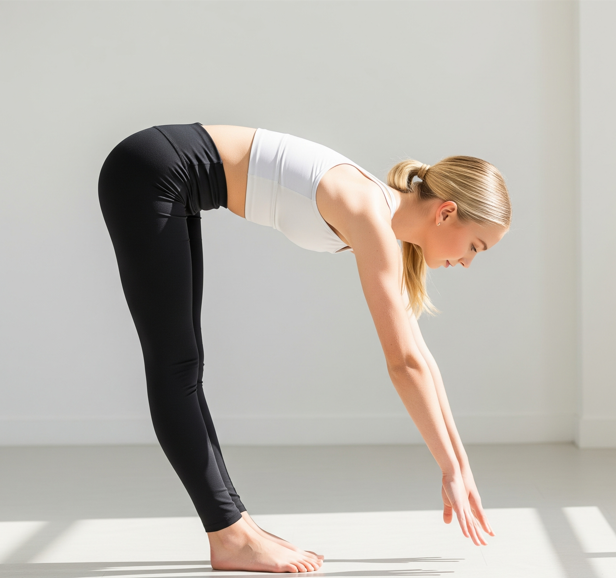
The Forward Bend Lower Back Stretch is like pressing the reset button on your spine. It gently decompresses tight lower back muscles, improves flexibility, and helps relieve stiffness from sitting or standing too long. Perfect for athletes, desk workers, or anyone needing quick relief!
The Forward Bend Lower Back Stretch, often called a standing forward fold in yoga traditions, is one of the most fundamental and effective movements for releasing tension along your entire posterior chain-the muscles running from your heels to the base of your skull. By simply folding forward with gravity, you create space between the vertebrae, elongate shortened hamstrings, and encourage the spine to decompress after hours of compression.
This stretch is particularly valuable for those who spend long hours seated, as it directly counteracts the hip flexor tightening and back muscle shortening that occurs during desk work. For a complete approach to releasing lower body tension, consider how this movement complements other foundational exercises like the lying hip flexor stretch , which targets the front of the hips in a opposite but equally important way.
The Forward Bend Lower Back Stretch delivers far more than a simple hamstring release-it’s a full-body reset that targets everything from tight muscles to mental tension in one gentle movement.
✅ Relieves Lower Back Tightness – Eases tension from prolonged sitting or physical activity
✅ Enhances Spinal Flexibility – Lengthens tight hamstrings and back muscles
✅ Improves Posture – Counters slouching by stretching the posterior chain
✅ Calms the Mind – Combines deep breathing with mindful movement
✅ Boosts Circulation – Encourages blood flow to stiff muscles
✅ Stimulates Digestive Organs – The gentle compression of the abdomen during folding can massage and stimulate digestive function for better gut health
✅ Relieves Tension Headaches – Releases tightness in the suboccipital muscles at the base of the skull, reducing headache frequency and intensity
✅ Prepares Body for Activity – Dynamic forward bending warms up the posterior chain, making it an excellent preparation for squats, deadlifts, or running
✅ Encourages Body Awareness – Regular practice trains you to recognize tension patterns and imbalances in your hamstrings, back, and hips
✅ Supports Healthy Aging – Maintaining the ability to bend forward safely preserves independence for daily tasks like tying shoes or picking up objects
Together, these ten benefits make the Forward Bend Lower Back Stretch a complete reset for your body and mindreleasing tension, improving mobility, and restoring calm in just minutes.
To truly master the Forward Bend, it helps to understand the intricate chain of muscles and structures you’re engaging and elongating. This isn’t just a “back stretch”- it’s a full posterior chain mobilization.
| Structure | Role in the Stretch | Why It Matters |
|---|---|---|
| Hamstrings | Primary target; lengthen under tension | Tight hamstrings pull on the pelvis, causing lower back strain |
| Erector Spinae | Spinal muscles release and elongate | Chronic tension here contributes to stiffness and pain |
| Gluteus Maximus | Stretches as hips flex forward | Tight glutes limit forward bend depth |
| Thoracolumbar Fascia | Connective tissue releases | This large web of tissue influences entire back function |
| Spinal Discs | Decompress anteriorly | Creates space and nutrient flow |
When you perform this stretch correctly, you’re not just pulling muscles—you’re encouraging healthy fluid exchange in your spinal discs and resetting the resting length of muscles that have adapted to shortened positions. This is why the stretch is often recommended in physical therapy exercises for headaches , as tension in the suboccipital muscles at the base of the skull can be traced all the way down the fascial line to the hamstrings.
Feet hip-width apart, knees slightly bent (no locking!).
Fold forward, leading with your chest (like a slow-motion swan dive).
Hands can rest on shins, ankles, or the floor (wherever comfortable).
Imagine your spine lengthening like a stretched rope
Breathe deeply each exhale helps deepen the stretch.
Vertebra by vertebra to avoid dizziness.
(Add this as a new section)
While nearly everyone can benefit, these groups find the Forward Bend Lower Back Stretch especially transformative:
🧑💼 Desk Workers & Remote Employees – Sitting for 6+ hours daily shortens hamstrings and compresses the lower back. This stretch provides immediate counter-tension and can be performed multiple times throughout the day. Pair it with a chair workout for complete office-based mobility.
🏃♀️ Runners & Athletes – Tight hamstrings are a common limitation in runners, affecting stride length and increasing injury risk. Regular forward bending maintains flexibility and aids recovery after intense training sessions. For runners, combining this with calf stretches creates balanced lower leg mobility.
🏋️♂️ Weightlifters – Deadlifts, squats, and good mornings all demand hamstring flexibility. This stretch prepares you for these movements and aids recovery afterward. It’s an excellent addition to any leg workouts routine.
🧓 Older Adults – Maintaining the ability to bend forward safely is crucial for daily tasks like tying shoes or picking up objects. This stretch preserves that functional mobility when performed with proper form and knee bending.
🤰 New Mothers – After pregnancy, the back and hamstrings often need gentle rehabilitation. This stretch (with knees deeply bent) can help restore flexibility once your doctor approves exercise. It complements core workouts designed for postpartum recovery.
🧘 Yoga Practitioners – This is the foundation for many forward folds and standing poses. Mastering it improves every aspect of your practice and deepens your understanding of hip-hinging mechanics.
Timing your forward bend practice can significantly impact its effectiveness. Here’s when to incorporate it:
| Time | Benefit | Pair With |
|---|---|---|
| Morning | Gently wakes up the spine and hamstrings after sleep stiffness | ten morning stretches for full-body awakening |
| Pre-Workout | Prepares hamstrings and back for activity; improves movement quality | Dynamic warm-ups like leg swings |
| Post-Workout | Calms nervous system; begins recovery process for worked muscles | full body stretching routine |
| Midday Break | Relieves accumulated tension from sitting; resets posture | standing hamstring stretch for variety |
| Evening | Releases day’s stress; prepares body for rest | Calming child’s pose to complete wind-down |
Aspect | Details |
Muscles Worked | Hamstrings, Lower back, Hips |
Difficulty | Beginner-friendly |
Best For | Flexibility, Posture, Stress relief |
🦵 Knee Buffer – Keep a slight bend in knees (like “soft springs”) to protect hamstrings
🌊 Wave-Like Motion – Fold forward from hips first, then let spine follow (like a rolling wave)
🎯 Focus on Hips – Imagine pivoting at hip joints, not rounding your spine
🤸♀️ Bouncing – Smooth holds > jerky pulsing (think “slow-motion waterfall”)
📉 Over-Rounding – Keep spine long; the stretch comes from hip hinge, not crunching
👂 Neck Strain – Let head hang heavy (don’t tuck chin forcefully)
It depends on your specific condition. For some disc issues, flexion (forward bending) can aggravate symptoms. Consult your healthcare provider first. They may recommend exercises for lower back pain that avoid deep flexion.
Touching toes is not the goal – quality of stretch is. Flexibility depends on hamstring length, hip structure, and consistent practice. Many people never touch their toes and still have healthy backs. Focus on feeling a lengthening sensation, not reaching a specific distance.
Mild calf stretch is normal, especially if you keep your legs straighter. If calf tightness limits your forward bend, incorporate dedicated calf stretches into your routine.
Standing forward fold uses gravity differently and challenges balance slightly. Seated folds (like the seated hamstring stretch ) provide more support and isolate the hamstrings differently. Both are valuable.
Absolutely! It’s safe for daily practice and actually works best with consistency. Daily practice maintains flexibility and prevents tightness from accumulating.
If you feel pinching in your lower back, bend knees more or reduce depth this should feel like a gradual release, not strain!