

Lunges Exercise
Your Ultimate Guide to Legs Day Workout
The lunge exercise is a foundational movement that brilliantly targets your entire lower body, acting as a master key 🔑 for unlocking strength, stability, and serious flexibility in your lunge exercise legs. Understanding the primary lunges muscles worked is key to maximizing its benefits.
If you’ve ever struggled with knee pain during squats, felt tightness in your hips after a long day, or noticed one leg is stronger than the other, lunges are your solution. Unlike bilateral exercises like squats that work both legs simultaneously, lunges isolate each leg, revealing and correcting imbalances you might not even know you had.
The lunge is more than just a leg exercise – it’s a movement pattern you perform every day. Walking up stairs, stepping off a curb, even getting out of a car all require the same hip and knee mechanics as a lunge. By mastering this movement, you’re not just building stronger legs for the gym – you’re building resilience for life.
Regular lunging also improves hip flexibility, counteracting the tightness that develops from prolonged sitting. The deep stretch at the bottom of a lunge opens the hip flexors, which are often shortened in desk workers. For a complete lower body routine, combine lunges with reverse lunges, single leg RDL, and leg workouts.
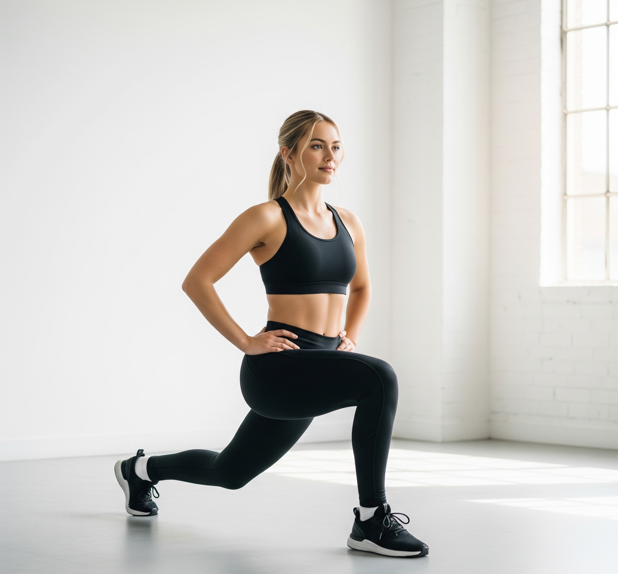
Lunges Muscles Worked
Key Benefits: Why You’ll Love Lunges
Lunges are one of the most functional exercises you can do – they build strength in a movement pattern you use every day. Whether you’re an athlete, a desk worker, or someone wanting to move better, mastering the lunge pays dividends in both performance and injury prevention.
✅Builds Functional Strength & Stability: Mimics everyday movements like walking and climbing stairs, making you stronger in real-life scenarios.
✅Enhances Muscle Definition: Sculpts and tones your quads, glutes, and hamstrings (the main lunges muscles worked), making it one of the best lunge exercises for building powerful, defined legs.
✅Improves Balance & Coordination: Challenges your stabilizer muscles, sharpening your proprioception (your body’s awareness in space).
✅Boosts Hip Flexibility: The deep stretch helps increase your range of motion, combating tightness from sitting all day and promoting overall flexibility.
✅Unilateral Training: Corrects muscle imbalances by working each side independently, ensuring one leg doesn’t do all the heavy lifting.
✅ Strengthens Core & Stabilizers – The lunge requires core engagement to maintain balance, building functional core strength.
✅ Improves Knee Stability – Proper lunge form strengthens the muscles around the knee, reducing injury risk during jump squats and burpees.
✅ Enhances Athletic Performance – Essential for runners, soccer players, and anyone who needs explosive lower body power.
✅ Supports Back Health – Strengthens glutes and hamstrings, which support the lower back during good mornings and deadlifts.
✅ Scalable for All Levels – From bodyweight to weighted, lunges can be adapted for beginners to advanced athletes.
Unlike squats that work both legs together, lunges reveal your weak side and force it to improve. This makes them essential for anyone serious about balanced lower body development.
🧠 Anatomy Deep Dive: The Muscles Worked in Lunges
The lunge is a compound movement that engages multiple muscle groups across the lower body and core:
| Muscle Group | Location | Function | How the Lunge Works It |
|---|---|---|---|
| Quadriceps | Front of the thigh | Extends the knee | The front leg’s quad controls the descent and powers the return |
| Gluteus Maximus | Buttocks | Extends the hip | Drives you back up from the bottom position |
| Hamstrings | Back of the thigh | Flexes the knee; extends the hip | Assists in hip extension and stabilizes the movement |
| Calves (Gastrocnemius & Soleus) | Back of the lower leg | Plantar flexes the ankle | Stabilizes the ankle and assists in push-off |
| Core (Transverse Abdominis, Obliques) | Abdomen and waist | Stabilizes the spine | Maintains upright posture throughout the movement |
| Hip Adductors | Inner thigh | Stabilizes the hip | Keeps the knee aligned during the lunge |
🧠 Muscles Worked in Lunges
The lunge exercise targets several important muscles in the lower body and core:
Quadriceps – the primary knee extensors; control the descent and drive the ascent
Gluteus Maximus – the main hip extensor; powers you back to standing
Hamstrings – assist in hip extension and stabilize the knee
Gastrocnemius & Soleus – the calf muscles; stabilize the ankle and assist in push-off
Core Muscles – maintain upright posture and spinal stability
Hip Adductors – stabilize the knee and prevent inward collapse
If your hips feel tight, you can also include hip flexor stretch, glute stretches, and calf stretches before or after lunges to release tension and improve overall lower body mobility.
👥 Who Should Do Lunges
This exercise is ideal for:
Athletes – runners, soccer players, basketball players need unilateral strength
Weightlifters – builds functional leg strength for squats and deadlifts
Desk workers – counters hip tightness from prolonged sitting
Runners – improves stride mechanics and knee stability
Older adults – maintains functional movement for daily activities
Anyone recovering from knee or hip issues – controlled movement rebuilds strength
Dancers – develops strength, balance, and flexibility
Anyone with muscle imbalances – reveals and corrects weak sides
Weight loss seekers – lunges are excellent for building muscle and burning calories
Anyone wanting better balance – challenges proprioception and stability
It works especially well when combined with reverse lunges, single leg RDL, jump squats, and leg workouts for complete lower body development.
How To Do Lunges Workout📝
Figuring out how to lunge exercise correctly is simple. Follow these steps for perfect form to learn exactly how to do lunges correctly:
1️⃣ Find Your Stance
Stand tall, feet hip-width apart. Engage your core. This is your starting position.
2️⃣ Step Forward
Take a controlled step forward. Your stride should allow both knees to form 90-degree angles when you lower down.
3️⃣ Lower Your Hips
Slowly descend, lowering your back knee toward the floor. Keep your front knee directly over your ankle.
4️⃣ Find Your Depth
Lower until your back knee is just above the ground and your front thigh is parallel to the floor.
5️⃣ Push Back
Drive through the heel of your front foot to powerfully return to the starting position.
6️⃣ Repeat
Complete all reps on one side before switching, or alternate legs for walking lunges
Exploring Different Types of Lunges:
- For Beginners: Lunge exercises for beginners can start with bodyweight only or use a chair for balance. Other great types of lunges to start with include reverse lunges (stepping back instead of forward) and static lunges.
- For Advanced Users: Add dumbbells, a barbell, or a kettlebell for resistance. Try lunge exercise variations like jumping lunges for power, curtsy lunges to target the inner thighs, or lateral lunges, which are fantastic types of lunges for hip mobility.
Quick Reference Table
Aspect | Details |
Primary Muscle Groups | Quadriceps, Glutes, Hamstrings (the main lunge exercise muscles) |
Secondary Muscles | Calves, Core, Hip Stabilizers |
Difficulty Level | Beginner to Advanced (easily modified) |
Equipment | None (Bodyweight) or Dumbbells/Kettlebells/Barbell |
Best For | Building leg strength, improving balance, and increasing flexibility |
🚨 Safety Tricks & Common Mistakes
✅ Eyes Up 👀: Look forward, not down, to keep your spine neutral and balance steady.
✅ Brace Your Core 💪: Tighten your stomach like you’re expecting a light poke this shields your back.
✅ Mind Your Step 📏: A too-long step strains hips; a too-short step hurts knees. Find the Goldilocks zone!
Avoid These! ❌
❌ Knee Cave-In 🦵: Keep knee aligned over ankle.
❌ The Hunchback 🙆♂️: Chest up, don’t lean forward.
❌ Toe Takeoff 👣: Drive through your HEEL.
❌ Bouncy Reps 🔁: Move slowly with control. No bouncing!
FAQ
How often should I do lunges?
For strength and balance, aim for 2-3 times per week with 2-3 sets of 10-12 reps per leg. For mobility and maintenance, you can perform bodyweight lunges daily. Incorporate into your leg workouts and warm-ups.
Can lunges help with knee pain?
When performed correctly, lunges strengthen the muscles around the knee, improving stability and reducing pain. Keep your front knee aligned with your ankle, and avoid letting it drift inward. If you have existing knee issues, start with reverse lunges, which are often easier on the knees.
What's the difference between forward and reverse lunges?
Forward lunges place more emphasis on the quadriceps and challenge balance more. Reverse lunges shift more load to the glutes and hamstrings and are often gentler on the knees. Both are excellent; use both in your routine for balanced development.
How do lunges improve hip flexibility?
The deep stretch at the bottom of a lunge lengthens the hip flexors – muscles that become tight from prolonged sitting. Regular lunging improves range of motion, making activities like jump squats, single leg RDL, and reverse lunges more effective.
Can I do lunges if I have lower back pain?
Consult a healthcare provider first. When performed with proper form (core braced, torso upright), lunges can strengthen the glutes and hamstrings, which support the lower back. Avoid leaning forward or rounding the spine. Start with bodyweight reverse lunges.
Quick Tip:
For maximum glute activation and knee safety, imagine you’re trying to press the floor away from you with your entire front foot, but focus the power through your HEEL! This ensures you engage the right muscles and protect your joints. 💥👣