What Exactly Are Scapular Push Ups? 🧐
Imagine your shoulder blades (scapulae) as train cars that need to glide smoothly along the tracks of your ribcage. Scapular push-ups are a subtle but powerful exercise that train this exact movement. Unlike standard push exercises that focus on your chest and triceps, this move is all about protraction (rounding) and scapular retractions (squeezing) of your shoulder blades. Mastering both the protraction and scapular retractions phases is key to developing balanced, healthy shoulders. It’s the ultimate warm-up and prehab tool to build a stable, strong, and flexible foundation for any pushing movement. 🏋️♂️
Why You Should Be Doing Scapular Push Ups (The Benefits) 🚀
Adding scapular push-ups to your routine offers a treasure trove of benefits for both your physical performance and mental focus. Think of it as the “spark plug” for your upper body.
-
🏆 Shoulder Health & Injury Prevention: This exercise strengthens the serratus anterior and lower traps, the muscles responsible for keeping your shoulder blades stable. This is crucial for preventing impingement and rotator cuff issues, especially if you spend a lot of time sitting or doing push exercises.
-
💪 Enhanced Performance in Other Exercises: By improving scapular control, you will instantly feel stronger and more stable during wall pushups, bench presses, and planks. A stable base means more power transfer.
-
🧘 Improved Posture: Regular practice helps “set” your shoulder blades in a better position, counteracting the dreaded “forward head” posture. You’ll stand taller and more confidently.
-
🧠 Mind-Body Connection: The slow, controlled movement forces you to focus on a very specific muscle group. This enhances your body awareness, or proprioception, making you more flexible in your approach to other complex movements.
Step-by-Step Guide: How to Do Scapular Push Ups Perfectly 🗺️
Here’s the ultimate, no-nonsense guide to performing the perfect scapular push-up. Remember, the movement is tiny but mighty! Think of it like trying to push the floor away without bending your elbows, or like creating a small “hump” and “valley” between your shoulder blades.
Step 1: Set Up Your Base
-
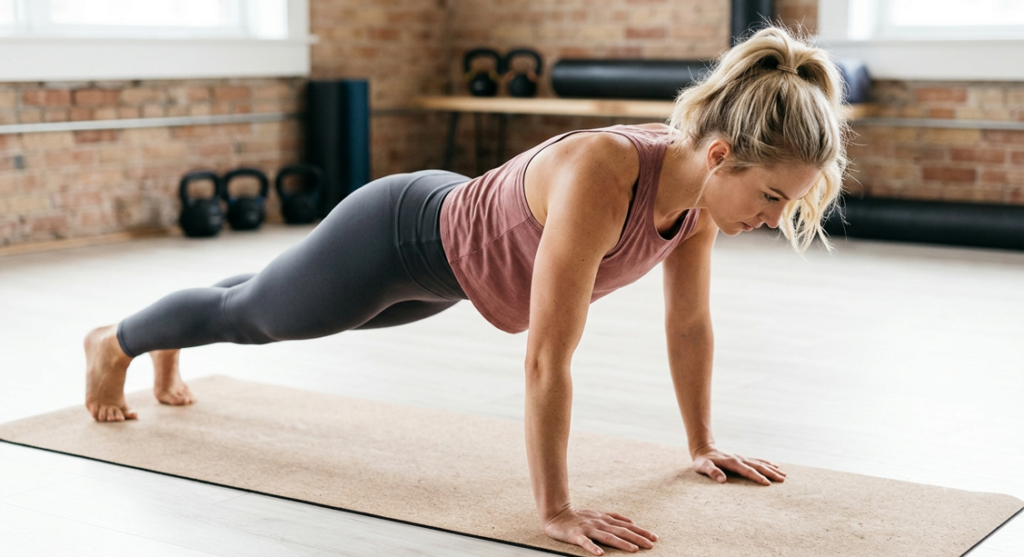
Start on all fours with your hands directly under your shoulders and your knees under your hips.
-
Step your feet back one at a time until you are in a high plank position. Your body should form a perfectly straight line from the crown of your head down to your heels.
-
Pro Check: Your hands should be shoulder-width apart, fingers pointing forward. Spread your fingers wide to distribute weight evenly.
Step 2: Engage Your Core and Glutes
-
Before you move an inch, brace your core like you are about to take a punch. Squeeze your glutes tightly.
-
Why? This locks your pelvis and lower spine in place, ensuring the movement happens ONLY in your shoulder blades, not your lower back.
Step 3: The Retraction Phase (The “Squeeze”)
-
Keep your arms completely straight do not bend your elbows at any point.
-
Slowly allow your chest to sink gently toward the floor by squeezing your shoulder blades together (this is called retraction).
-
Imagine you are trying to hold a thick marker or a pencil vertically between your shoulder blades. Your upper back will round slightly, and your head will naturally tuck in a little.
-
Movement Range: This is only about 2 to 3 inches of downward movement. Don’t force it!
Step 4: The Protraction Phase (The “Push”)
-
Now, reverse the motion with control. Push the floor away from you as hard as you can, forcefully spreading your shoulder blades apart (this is called protraction).
-
Focus on pushing through your mid-back, not just your hands. Your upper back will flatten out, and you should feel a deep stretch and contraction in the muscles right below your armpits (your serratus anterior).
-
At the very top, hold for a brief second and feel your shoulder blades wrap around your ribcage.
Step 5: Repeat with Rhythm
-
Exhale as you push into protraction, and inhale as you sink into retraction.
-
Perform 3 sets of 10 to 15 slow, controlled reps. Quality over quantity is the golden rule here!
Modifications for All Levels 🧘♀️
-
Beginner (Wall Pushups Variation): If a full plank is too challenging, perform the same movement against a wall. Place your hands on the wall at shoulder height, arms straight. Gently move your chest towards the wall (retraction) and push away (protraction). This is a fantastic way to master the sensation of a scapular push-up safely. You can also perform these on your knees.
-
Intermediate: Perform the exercise on your knees instead of your toes. This reduces the load while allowing you to focus on the form.
-
Advanced: For an extra challenge, perform this exercise with your feet elevated on a bench or chair. This increases the load on the shoulder blades and forces your core to work harder. To further test your stability, try a scapular push up with a slight pause (3 seconds) at the top of the protraction phase.
Scapular Push Ups Quick Reference Table 📊
| Muscle Groups Worked 💪 | Difficulty Level 📈 |
|---|---|
| Primary: Serratus Anterior, Lower Trapezius | Beginner to Intermediate |
| Secondary: Rhomboids, Core (Abs & Obliques) | Can be easily scaled up or down using modifications. |
Safety First: Common Mistakes to Avoid 🛑
The scapular push up is generally safe, but doing it wrong can lead to lower back pain or neck strain. Here are the most common pitfalls to watch out for:
-
❌ Mistake: Bending the Elbows.
-
The Fix: This is the most common error. Remember, your arms stay straight. The movement comes entirely from your shoulder blades gliding on your ribcage. If your elbows bend, you’re doing a regular push-up.
-
-
❌ Mistake: Letting Your Lower Back Sink.
-
The Fix: Keep your core tight and glutes squeezed. Imagine your body is a stiff, straight plank of wood. If your hips sag, the exercise loses its effectiveness and can stress your spine. Film yourself from the side to check.
-
-
❌ Mistake: Using Momentum or Going Too Fast.
-
The Fix: Perform the movement slowly and with control. Count 2 seconds down (retraction) and 2 seconds up (protraction). Slow and steady wins this race. Jerky movements recruit the wrong muscles.
-
-
❌ Mistake: Shrugging Your Shoulders Up Toward Your Ears.
-
The Fix: Keep your neck long and your shoulders depressed (pulled down away from your ears). Think about sliding your shoulder blades sideways across your back, not upward.
-
-
❌ Mistake: Not Breathing.
-
The Fix: It’s easy to hold your breath during focused movements. Inhale as you let your chest sink (retraction) and exhale powerfully as you push the floor away (protraction). This engages your core for stability.
-
Frequently Asked Questions (FAQs) About Scapular Push Ups ❓
1. How many scapular push ups should I do?
-
Aim for 3 sets of 10 to 15 repetitions as a warm-up or as part of your core/stability work. Since it’s more of an activation and mobility exercise than a strength builder, you can do them daily. Listen to your body if you feel a deep burn, you’re on the right track!
2. Can I do scapular push ups every day?
-
Absolutely! Because scapular push-ups are low-impact and focus on movement quality and joint health rather than muscle breakdown, they are safe to perform daily. In fact, doing them every morning is a fantastic way to “wake up” your shoulders and improve your posture throughout the day.
3. Are scapular push ups the same as wall pushups?
-
No, they are different exercises with different goals. Wall pushups are a full-body push exercise that builds chest and arm strength, scaled down for beginners. A scapular push-up is a targeted mobility exercise. However, the wall pushup variation of the scapular push-up (where you just move your shoulder blades against the wall) is a great beginner modification to learn the feeling.
4. Why do my scapular push ups feel so difficult?
-
It’s normal! Most people have weak and underactive serratus anterior and lower trap muscles due to prolonged sitting. These muscles are small but crucial. Be patient, start with the wall or knee modifications, and focus on slow, perfect form. Within a couple of weeks, your control and endurance will improve dramatically. Your shoulder blades will feel more flexible and responsive.
5. Do scapular push ups build muscle?
-
They build endurance and stability in the smaller stabilizing muscles of the shoulder girdle rather than large, showy muscles like your pecs or lats. Think of them as “sculpting” your foundation. They will make your other push exercises much more effective by providing a rock-solid base to push from.
6. Can scapular push ups fix my shoulder pain?
-
They are an excellent preventative and rehabilitative tool, especially for shoulder impingement and instability. However, they are not a cure-all. If you have acute or severe shoulder pain, always consult a physical therapist or doctor before starting any new exercise routine.
3 Bonus Pro Tips for Perfect Form 🧠
-
💡 Imagine a Spotlight: Think of a spotlight shining directly down on your shoulder blades. The goal is to move them closer together and then further apart under that light without letting any other part of your body steal the show. This mental cue helps you isolate the right muscles.
-
💡 Master the Wall First: Don’t be shy about starting with wall pushups (the scapular variation) to dial in the movement pattern. It’s the best way to build confidence and the mind-muscle connection before adding your body weight.
-
💡 Focus on the “Serratus Punch”: At the top of the protraction, imagine you are throwing a punch with your shoulder blade. This cues the serratus anterior to fully engage, pushing your shoulder blades as far apart as possible.
Remember, the goal is not to do as many reps as possible, but to perform high-quality, controlled movements. Aim for 3 sets of 10-15 reps to build a rock-solid, flexible, and resilient foundation for all your other push exercises. Good luck, and enjoy the burn! 🔥