

The Seated Spinal Twist is like wringing out a sponge for your spine; it targets tight back muscles, improves flexibility, and can even help with digestion. Perfect for desk workers, athletes, or anyone craving a quick midday reset!
The Seated Spinal Twist is a foundational movement in yoga and mobility training for good reason. It targets the often-neglected rotational capacity of your spine – a range of motion that’s essential for everything from looking over your shoulder while driving to swinging a golf club or simply checking blind spots.
Unlike standing twists that require balance, this seated version allows you to focus entirely on the rotation, isolating the spine while keeping your pelvis grounded and stable. For those new to spinal mobility work, understanding how this stretch complements foundational movements like the cat-cow stretch can help you build a complete routine that addresses flexion, extension, and rotation in one balanced practice.
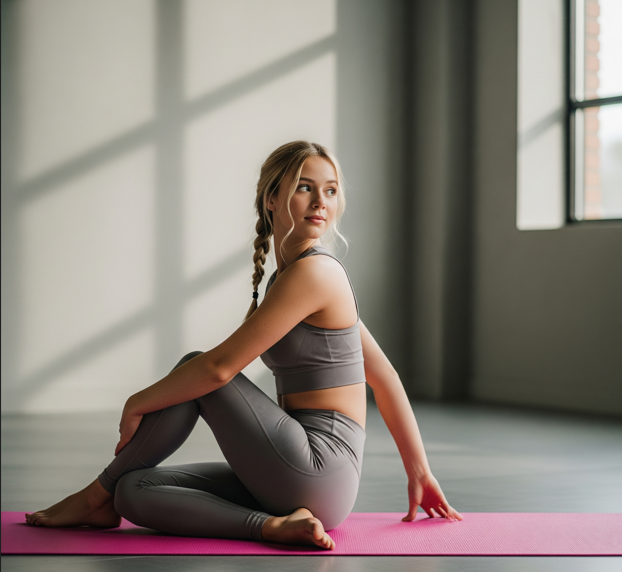
The Seated Spinal Twist might look simple, but its effects ripple through your entire torso – releasing tension, mobilizing joints, and even influencing internal function with every mindful rotation.
✅ Spinal Flexibility – Lubricates vertebrae for smoother rotation
✅ Posture Rescue – Counters hunching from sitting all day
✅ Digestive Aid – Gentle twist stimulates internal organs
✅ Stress Relief – Calms the mind with mindful breathing
✅ Hip & Shoulder Mobility – Loosens tight areas that limit movement
✅ Core Strength Activation – Engages obliques and deep spinal stabilizers, building functional strength while you stretch
✅ Neck Tension Release – Gently mobilizes the cervical spine, relieving stiffness from “tech neck” and poor screen posture
✅ Sciatic Nerve Comfort – Creates space in the lower back and glutes, reducing pressure on the sciatic nerve pathway
✅ Balance & Coordination – Trains the brain to coordinate rotation between upper and lower body, improving overall body awareness
✅ Respiratory Function – Expands the ribcage during twists, encouraging deeper, more efficient breathing patterns
From spinal flexibility to deeper breathing, these ten benefits transform a simple seated twist into a comprehensive tool for physical and mental health – addressing the whole person, not just isolated muscles.
While nearly everyone benefits, these groups find the Seated Spinal Twist especially transformative:
🧑💼 Desk Workers – Hours of sitting compress the spine and limit rotation. This stretch counteracts that damage and can be performed right at your desk. Pair it with a chair workout for complete office-based mobility.
🏃♀️ Runners – Running is a linear, forward-only movement. The rotational nature of this stretch balances the body and prevents the stiffness that leads to injury. Use it after your run alongside calf stretches for complete lower body recovery.
🏋️♂️ Weightlifters – Squats and deadlifts build strength in the sagittal plane. Adding rotational work maintains mobility and prevents the “blocky” feeling that limits athletic movement. It’s an excellent addition to any leg workouts cooldown.
🧓 Older Adults – Maintaining spinal rotation is crucial for functional independence—turning to look behind you, reaching for items, and driving all require this range of motion. This seated version is safe and accessible.
🧘 Yoga Practitioners – This is a foundational pose that prepares the body for deeper twists and binds. Mastering it improves every aspect of your practice.
🚗 Frequent Travelers – Long drives or flights leave the spine stiff and compressed. This stretch requires minimal space and fits perfectly in airplane seats or car rest stops.
💊 Chronic Back Pain Sufferers – Gentle, controlled rotation can help manage discomfort and improve mobility over time. For a comprehensive approach, explore our exercises for lower back pain guide.
Legs extended, spine straight (imagine a string lifting your head).
Place your right foot outside your left thigh.
Left elbow outside right knee, right hand behind you.
Grow taller through your spine.
5️⃣ Exhale Twist
Rotate right, looking over your shoulder. Hold 20-30 sec.
6️⃣ Repeat Left
Switch sides for balanced flexibility.
| Time | Benefit | Best Practice |
|---|---|---|
| Morning | Wakes up stiff spine, prepares for day | Gentle, don’t force; muscles are cold |
| Midday Break | Relieves accumulated desk tension | Quick 2-minute reset |
| Post-Workout | Maintains flexibility, aids recovery | Hold 30-45 seconds per side |
| Evening | Releases day’s stress, prepares for sleep | Combine with deep breathing |
| After Long Drive/Flight | Immediate spinal decompression | Stretch as soon as possible |
For a complete morning routine, combine this stretch with ten morning stretches that awaken your entire body.
To truly master the Seated Spinal Twist, it helps to visualize the structures involved. This isn’t just a “back stretch” – it’s a coordinated mobilization of multiple muscle groups and joints.
| Structure | Role in the Stretch | Why It Matters |
|---|---|---|
| Thoracic Spine | Primary rotation point | Most spinal rotation should occur here, not lower back |
| Erector Spinae | Elongates on one side, contracts on other | Balances muscle tension along spine |
| External/Internal Obliques | Control and deepen rotation | Core engagement protects lower back |
| Quadratus Lumborum (QL) | Stabilizes during twist | Tight QL limits rotation; stretching it relieves lower back tension |
| Piriformis & Glutes | Anchor the twist from below | Tight hips restrict spinal rotation |
| Rib Cage | Expands and contracts | Breath capacity directly influences twist depth |
When you perform this stretch correctly, you’re encouraging healthy fluid exchange in your spinal discs, mobilizing the ribs for better breathing, and releasing tension patterns that may have accumulated over years of repetitive movement. This is why the twist is often recommended in full body stretching routines – it affects everything from your neck to your hips in one efficient movement.
Aspect | Details |
Muscles Worked | Spine, Obliques, Shoulders |
Difficulty | Beginner-friendly |
Best For | Flexibility, Posture, Digestion |
1️⃣ Those with severe spinal injuries or recent back surgery.
2️⃣ Pregnant women (opt for open twists after 1st trimester).
3️⃣ Individuals with acute disc herniation – Flexion combined with rotation can aggravate certain disc conditions. Consult a professional first.
4️⃣ Those with untreated high blood pressure – Deep twists can temporarily increase blood pressure. Move gently and keep breathing.
5️⃣ People with recent abdominal surgery – Twisting puts pressure on the abdominal wall. Wait for full healing and doctor approval.
6️⃣ If you feel sharp, shooting pain – Stop immediately. The stretch should feel like a gentle pull, never sharp or electric.
1️⃣ Forcing the Twist – Move only within a comfortable range.
2️⃣ Collapsing Chest – Keep heart lifted, don’t hunch.
3️⃣ Holding Breath – Breathe deeply to deepen the stretch.
4️⃣ Uneven Hips – Letting one sit bone lift off the floor compromises the twist and strains the lower back. Press both down evenly.
5️⃣ Leading with the Chin – Turning your head first strains the neck. Let your chest lead, then shoulders, then gaze.
6️⃣ Rushing the Release – Unwinding too quickly can jar the spine. Return to center slowly and mindfully.
7️⃣ Ignoring the Foundation – If your legs or hips are shifting, you’ve lost your anchor. Reset and focus on stability before depth.
Yes, but with caution. Gentle, non-forceful twisting can be beneficial for scoliosis by maintaining mobility. However, always work within a pain-free range and consult a specialist familiar with your curve pattern. For a comprehensive approach, explore physical therapy exercises for headaches that often include gentle spinal work.
The seated version on the floor provides a more stable base and often allows for a deeper stretch because your pelvis is anchored by the floor. The chair spinal twist is more accessible for office workers and those who can’t easily get on the floor. Both are excellent – choose based on your environment and comfort.
Painless popping (cavitation) is normal as gas bubbles release from spinal joints during movement. It’s similar to cracking knuckles. If popping accompanies pain or you feel unstable, stop and consult a professional.
Yes, many people find that gentle twisting stimulates digestion by massaging abdominal organs and encouraging peristalsis. The effect is subtle but real – especially when combined with deep breathing. For targeted digestive support, explore our ab workouts that strengthen the core around these organ
For general flexibility, 20-30 seconds per side works well. For deeper fascial release, extend to 45-60 seconds. Always match time on both sides. If you’re using this for stress relief, longer holds with deep breathing enhance the calming effect.
Sync your breath with movement for maximum effect inhale to lengthen your spine like a tall tree, then exhale to gently deepen the twist. Imagine your breath creating space between each vertebra as you rotate!