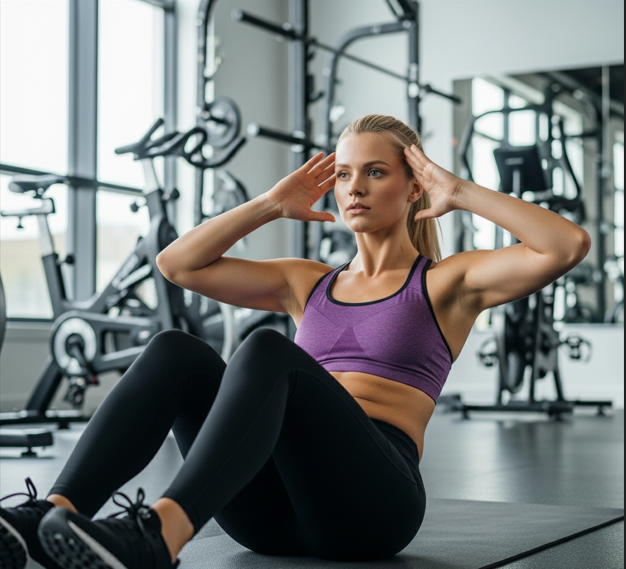
Flip traditional crunches on their head! The reverse crunch exercise targets your lower abs and deep core muscles with precision, making it a powerhouse move for building a strong, stable midsection.
If you’ve done countless traditional crunches without seeing the lower belly definition you want, you’re not alone. Standard crunches primarily target the upper abdominal muscles, leaving the lower abs underworked. That’s where reverse crunches come in.
The reverse crunch flips the movement, curling your hips toward your chest rather than your chest toward your hips. This shift in mechanics places greater emphasis on the lower rectus abdominis and the deep transverse abdominis – muscles that are crucial for core stability, posture, and a toned midsection.
Unlike traditional crunches that can strain your neck and upper back, reverse crunches are low-impact and spine-friendly. When performed correctly, they strengthen the deep core muscles that support your lower back, improving posture and reducing injury risk.
For a complete core routine, pair reverse crunches with ab workouts, core workouts, and best ab workout for lower stomach.
🔍 What Are Reverse Crunches?
The reverse crunches workout focuses on your lower abdominal muscles, transverse abdominis, and hip flexors, while promoting core stability and flexibility. Think of it as an “upside-down crunch” that engages your deepest core muscles!
✨ Key Benefits of Reverse Crunches
✅ Targets lower abs – Reduces that stubborn lower belly pooch
✅ Builds core stability – Enhances overall strength and flexibility
✅ Improves posture – Supports spinal alignment and reduces back strain
✅ Low-impact – Gentle on your neck and spine compared to traditional crunches
✅ Boosts mind-muscle connection – Teaches precise core engagement
✅ Protects the Lower Back – When performed correctly, reverse crunches strengthen the core muscles that support the lumbar spine, reducing lower back pain risk
✅ Improves Athletic Performance – A strong core translates to better power transfer in jump squats, burpees, and reverse lunges
✅ Enhances Breathing – Core engagement improves diaphragmatic function, benefiting best cardio workouts at home
✅ Reduces Risk of Injury – A stable core protects your spine during push exercises, kettlebell workouts, and deadlifts
✅ Complements Other Core Work – Pairs perfectly with planks, leg raises, and reverse crunches variations
Consistency is key. Even 5-10 minutes of targeted core work daily can transform your abdominal strength, posture, and lower back health over time.
🧠 Anatomy Deep Dive: Muscles Worked in Reverse Crunches
Reverse crunches target several important core muscles:
| Muscle Group | Location | Function | How Reverse Crunches Work It |
|---|---|---|---|
| Lower Rectus Abdominis | Front of abdomen, below navel | Flexes lumbar spine, compresses abdomen | The curling motion lifts the hips, engaging the lower fibers |
| Transverse Abdominis | Deep core, wraps around midsection | Stabilizes spine, compresses internal organs | The core engagement required to lift hips activates this deep stabilizer |
| Upper Rectus Abdominis | Front of abdomen, above navel | Flexes thoracic spine | Assists in the curling motion |
| Internal & External Obliques | Sides of abdomen | Rotates and laterally flexes spine | Stabilize the movement and prevent rotation |
| Hip Flexors (Iliopsoas) | Deep front of hip | Lifts the thigh toward the torso | Assist in the leg-lifting motion |
| Pelvic Floor | Base of pelvis | Supports pelvic organs | Engaged during core contraction |
When you perform reverse crunches with controlled form, you’re strengthening the entire core complex – not just the visible “six-pack” muscles. This comprehensive engagement improves posture, protects the lower back, and enhances athletic performance.
For complementary core work, explore ab workouts, core workouts, plank for abs, and reverse crunches.
👥 Who Should Do Reverse Crunches
This exercise is ideal for:
Anyone wanting to target lower abs – the reverse crunch is one of the best exercises for this area
People with neck pain – traditional crunches often strain the neck; reverse crunches keep your shoulders on the floor
Beginners – easy to learn and modify for different fitness levels
Athletes – core stability is essential for jump squats, burpees, and reverse lunges
Weightlifters – a strong core protects the lower back during deadlifts and squats
Runners – core stability improves running efficiency and reduces injury risk
Older adults – low-impact and can be performed on a soft mat
Anyone with lower back stiffness – strengthens supporting muscles
Postpartum individuals – helps rebuild deep core strength (consult doctor first)
Anyone wanting better posture – core strength supports spinal alignment
It works especially well when combined with ab workouts, core workouts, best ab workout for lower stomach, and reverse crunches variations for complete core development.
🏋️ How to Do Reverse Crunches Exercise: Step-by-Step
1️⃣ Starting Position
- Lie on your back with knees bent 90 degrees, thighs perpendicular to floor
- Place arms flat at your sides, palms down for stability
- Engage your core to press your lower back into the mat
2️⃣ The Movement
- Exhale and curl your hips off the floor, bringing knees toward your chest
- Squeeze your abs at the top of the movement
- Inhale and slowly lower your hips back to the starting position
- Keep the movement controlled – no momentum!
3️⃣ Repetition
- Aim for 3 sets of 12-15 reps
- Maintain slow, rhythmic breathing throughout
Modifications:
- Beginner: Keep hips on floor, focus on small lifts
- Advanced: Add ankle weights or extend legs to 45 degrees
⚠️ Safety Tips & Common Mistakes
🚫 Don’ts
✖ Use momentum to swing your legs (control is key!)
✖ Arch your lower back during the movement
✖ Hold your breath (breathe through each rep)
✅ Do’s
✔ Keep your core engaged throughout
✔ Move slowly and with precision
✔ Focus on quality over quantity
FAQ’S❓
Q: What do reverse crunches target?
A: They primarily target the lower abdominal muscles and help build core strength with less neck strain than traditional crunches.
Q: Why do I feel reverse crunches in my hips?
A: You’re likely using momentum instead of controlled abs; slow down and focus on lifting your hips with your core, not your legs.
Q: Are reverse crunches bad for your back?
A: No, when done correctly by keeping your lower back pressed to the floor, they are safe and support back health.
🌟 Pro Tip
Pair reverse crunches with planks and oblique work for a complete core routine that maximizes flexibility and strength!