Ever wondered, “Are leg extensions bad for knees?” You’re not alone. This classic Legs Workout move is often labeled as a knee-wrecker, but the truth is more about how you use it than the exercise itself. Let’s dive in and unlock the flexibility and strength this movement can offer when done correctly.
Before adding any machine exercise to your routine, it helps to understand how your entire lower body works together. The quadriceps don’t operate in isolation. They interact with your hamstrings, glutes, and even your core. For a broader foundation, review our guide on stretching exercises to see how leg extensions fit into your full leg day picture. You can also explore full body stretching routines that complement this targeted quad work.
Introduction
The leg extension machine precisely targets your quadriceps, the powerful muscles on the front of your thighs. Think of it as a spotlight exercise, isolating these muscles to build strength and improve knee flexibility and stability crucial balance that’s also supported by complementary moves like the kneeling quad stretch.
If you spend long hours sitting at a desk, your hip flexors and quads are likely shortened. Adding a chair workout or leg swings before leg extensions can help wake up these muscles. You might also benefit from a chin tuck stretch to release upper neck tension, as poor posture anywhere in the body affects how you sit on the machine.
Key Benefits of Leg Extensions ✨
- Targeted Quadriceps Development: Isolates the quads like no other exercise, helping to build balanced leg strength.
- Improved Knee Stability & Joint Health: Strengthening the muscles around the knee creates a more stable and supportive joint.
- Rehabilitation & Mind-Muscle Connection: Often used in physical therapy to safely re-activate the quads after injury, enhancing your brain’s connection to the muscle.
- Unlocks Functional Flexibility: Stronger, more engaged quads contribute to better overall leg flexibility and performance in squats, running, and jumping.
-
Enhanced Athletic Performance: Whether you’re a runner, cyclist, or weightlifter, strong quads transfer power to every lower body movement. Pair leg extensions with hips exercises to build complete lower body power.
-
Better Posture Support: Your quads attach to your pelvis. Balanced quad strength helps maintain proper pelvic alignment, reducing strain on your lower back. Add glute stretches and a standing hamstring stretch to your leg day for muscular balance.
Step-by-Step Instructions: Master the Movement 🏋️♀️
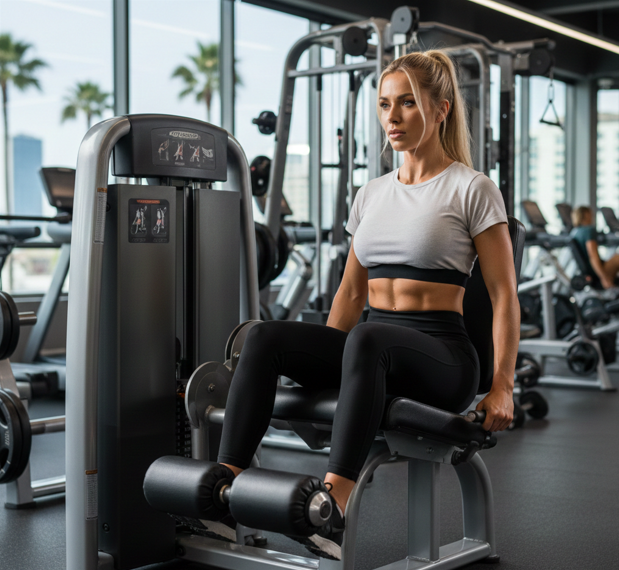
- The Setup: Sit firmly on the machine with your back flat against the pad. Adjust the backrest so your knees are perfectly in line with the machine’s pivot point.
- Secure the Pad: Place the shin pad comfortably on the lower part of your shins, just above your ankles. It should be snug but not painful.
- Find Your Grip: Hold the side handles for stability. Keep your shoulders down and core gently engaged.
- The Press: Exhale and extend your legs forward, squeezing your quads at the top. Aim for a straight line with your legs, but avoid forcefully locking your knees.
- The Return: Inhale and slowly, with control, lower the weight back to the starting position. This is where you build control and flexibility!
If you feel any pinching in your knees during leg extensions, it’s wise to check your overall leg flexibility. Tight calf stretches or a standing quadriceps stretch before your workout can make a big difference. Some lifters also benefit from warm-ups like jumping jacks for 3-5 minutes before touching the machine.
💡 Modifications:
- For Beginners/Knee Sensitivity: Use very light weight or just the machine’s lever arm. Focus on the squeezing motion and slow tempo.
- For Advanced Users: Try a “ladder leg extensions” technique: do a set of 10 reps, then immediately drop the weight and do 10 more, and repeat for 3-4 “rungs” on the ladder.
-
For Desk Workers: If you feel tightness, perform a cat cow stretch and seated spinal twist before leg extensions to free up your pelvis and lower back.
-
For Rehab: After knee injury, some physical therapists recommend starting with terminal knee extension exercises using a resistance band before progressing to the machine.
Safety Tricks: Protect Your Knees! 🛡️
- Warm-Up, Always: Never go into this exercise cold. Do 5-10 minutes of light cardio and some dynamic stretches first.
- Control the Descent: The most common cause of knee pain after leg extensions is lowering the weight too quickly. Fight gravity on the way down!
- Avoid Hyperextension: Squeeze at the top, but don’t jam your knees into a locked, hyperextended position.
- Listen to Your Body: Sharp pain is a red light. Aching or fatigue is normal; a stabbing sensation is not.
-
Strengthen Supporting Muscles: Weak glutes and hamstrings force your quads to overwork. Add a bird dog exercise and pelvic tilts to your routine.
-
Use Proper Breathing: Exhale during the press, inhale during the return. This stabilizes your core and protects your spine, similar to how you breathe during core workouts.
Common Mistakes to Avoid 🚫
- Swinging the Weight: Using momentum to lift the weight takes the work off your quads and puts stress on your joints.
- Going Too Heavy: This is the #1 reason people ask, “Why do leg extensions hurt my knees?” Ego-lifting has no place here.
- Lifting Your Hips: Your glutes and back should stay glued to the seat. If your hips come up, the weight is too heavy.
- Incorrect Pad Placement: Placing the pad on your feet or too high on your shins creates unnecessary leverage and strain on the knees.
-
Skipping the Cool-Down: After leg extensions, your quads are shortened and tight. Always follow with a standing quadriceps stretch or lying quadriceps stretch to return muscles to resting length.
-
Neglecting Opposite Muscles: Only training quads without stretching hamstrings creates imbalance. Add a seated hamstring stretch or standing hamstring stretch to every leg day.
FAQ’s❓
Q: So, are leg extensions bad for knees?
A: Not inherently. For healthy knees, with proper form and sensible weight, they are a safe and effective tool. For those with pre-existing knee conditions, they might be risky and should be cleared by a doctor or physical therapist.
Q: Why do leg extensions hurt my knees?
A: The most likely culprits are: 1) Using too much weight, 2) Lowering the weight too fast, 3) Pre-existing tendonitis or cartilage issues, or 4) Incorrect machine setup.
Q: What can I do for knee pain after leg extensions?
A: First, rest and ice the area. Then, assess your form and drastically reduce the weight. Incorporating glute stretches and strengthening exercises can also help, as weak glutes force your quads and knees to overcompensate.
Q: Should I skip them entirely?
A: Not necessarily. If you experience persistent pain, swap them for other quad-focused moves like barbell squats, lunges, or step-ups, and always include glutes stretches in your cool-down. The best exercise is the one that makes your legs stronger without causing pain.
Pro Tip: Mind the Squeeze, Not Just the Lift! 💡
Instead of just moving the weight, focus on a deliberate, one-second squeeze at the top of the movement. This maximizes quad engagement and builds stabilizing strength, teaching your muscles to protect the joint throughout their full range of motion. This mindful control is the ultimate key to building strong, resilient knees.